Abstract shapes never felt so NSFW:
Month: May 2012
Quote For The Day II
"What we thought was that Japan was a cautionary tale. It has turned into Japan as almost a role model. They never had as big a slump as we have had. They managed to have growing per capita income through most of what we call their ‘lost decade’. My running joke is that the group of us who were worried about Japan a dozen years ago ought to go to Tokyo and apologise to the emperor. We’ve done worse than they ever did. When people ask: might we become Japan? I say: I wish we could become Japan," – Paul Krugman, in conversation with Martin Wolf.
Building A Better Bookstore
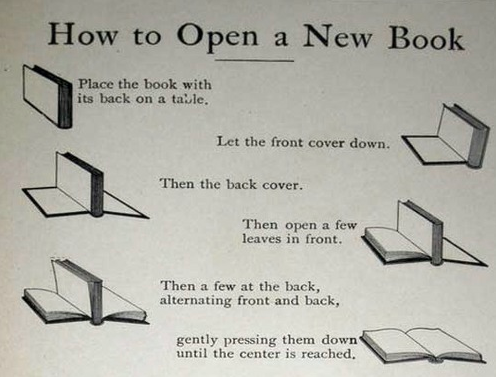
Tony Sanfilippo reimagines the bookstore as a place with bestsellers up front, a print-on-demand machine in the middle, and a scale of pricing options for how to buy or rent the books in the rest of the store, including ebooks:
"We can have the publisher drop ship a brand new copy anywhere you like, or you can purchase this used copy. You can also rent the book, but you might want to consider a membership because then the rental is free. Members don’t pay for rentals, though like non-members, if they don’t return the book eventually, the cost of the book is charged to their credit card and we order another."
"How much is membership?" you ask.
"For an individual, it’s $49.95 a year. But with that membership you can borrow any book in the store for free. In most cases you can also request that we acquire a book for you to borrow and we will, or we’ll print it for you using our Espresso Book Machine."
Scott McLemee is intrigued:
Well into the 18th century, when you bought a new volume from a bookseller, it arrived from the publisher without a binding, to be prepared on the premises according to the customer’s specifications. You could ask to have blank pages interspersed throughout it, for example, for note-taking — one casualty of progress worth regretting. Sanfilippo’s model takes us back to that arrangement, at least part of the way.
(How To Open A New Book via Sadie Stein)
Face Of The Day
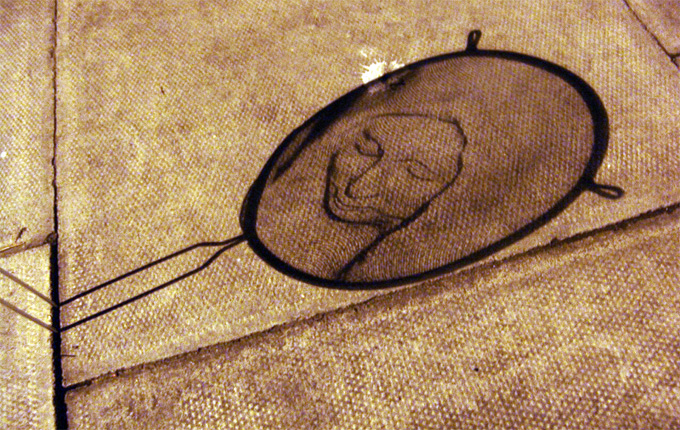
Pinar admires Isaac Cordal's recent project, Cement Bleak:
His medium of choice? A strainer. Cordal manipulates metallic colanders to look like three-dimensional faces popping out. … Using street lamps as his main source of illumination, the light seeps through the perforated structure held up by its handle, which is propped up in the cracks of the pavement, and shines down on the adjacent ground. The two-step process produces two levels of art that are each appealing in their own right. The strainers, themselves, are so finely formed that it almost seems like people simply stuck their heads into them and kneaded the metal in to conform to their faces. The structure's silhouette exhibits an equally life-like impression.
If You Want Another Debt And Spending Binge, Vote GOP, Ctd
The AP now weighs in, ultimately relying on McCain economics adviser Douglas Holtz-Eakin as a neutral arbiter. But it's another helpful run-through of the numbers. The first question, as I noted in my first post on the subject, is how to apportion the 2009 fiscal budget. The second is how to treat TARP. If you assign much of TARP and the 2009 budget to Bush, the subsequent rate of growth of spending does indeed look remarkably tight-fisted. Equally, assigning all of that to Obama, when he took office well into the fiscal year, alters things dramatically. Yes, he signed funding bills in 2009, but the cake was well-baked by then. But the AP assigns "much" of the spending in 2009, including the stabilizers, to Obama alone. They also refuse to give Obama any credit for the payback of TARP in 2010 or the decline in support for Freddie and Fannie.
The AP takes the hardest position on Obama and comes up with the following bottom line:
All told, government spending now appears to be growing at an annual rate of roughly 3 percent over the 2010-2013 period, rather than the 0.4 percent claimed by Obama and the MarketWatch analysis.
I think that's excessively tilted against the president. But even so, lets accept it for the sake of argument. A 3 percent annualized increase in federal spending would still put Obama in first place for spending restraint since LBJ – which is staggering given the scale of the economic collapse he inherited. A quick comparison? Bush's first term – with no global great recession – saw spending grow an annualized 7.3 percent. Reagan's first term? 8.7 percent.
And again, remember the Romney claim that started this all off: that "since President Obama assumed office three years ago, federal spending has accelerated at a pace without precedent in recent history."
Even when you put the maximal blame on Obama for spending in the last three years, including all the automatic spending that came with the collapse of 2008, that's still untrue. And it's odd that the GOP insists it isn't. Shouldn't they be claiming some credit for restraining spending from 2010 onwards?
To Profile Or Not To Profile?
Sam Harris debates Bruce Schneier – in a rare example of light defeating heat on this question.
The Life Of A Writer
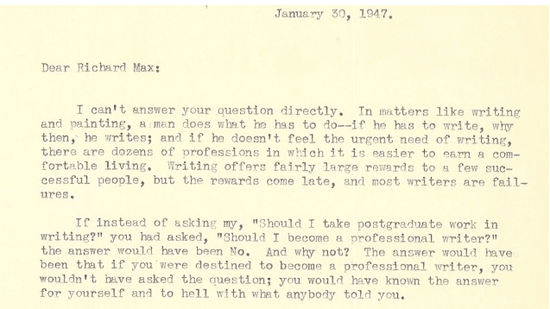
If you're asking if you should become one, you shouldn't. A classic old letter from Malcolm Cowley:
Quote For The Day
“Pot smokers, cops, I got everybody. And everybody was lovely," – John Waters, after a cross-country hitch-hiking experiment he survived intact. Lovely, lovely story.
How To Propose In 2012
New expectations are set:
Can’t Look Back
Science fiction author William Gibson confesses:
It’s harder to imagine the past that went away than it is to imagine the future. What we were prior to our latest batch of technology is, in a way, unknowable. It would be harder to accurately imagine what New York City was like the day before the advent of broadcast television than to imagine what it will be like after life-size broadcast holography comes online. But actually the New York without the television is more mysterious, because we’ve already been there and nobody paid any attention. That world is gone.
Charlie Stross illustrates how science fiction is increasingly indistinguishable from today's technology:
We used to read SF to get the heady high of a big vision, the "eyeball kick" as Rudy Rucker describes it, of seeing something brain-warpingly different and new for the first time. But today you don’t need to read SF to get a sense of wonder high: you can just browse "New Scientist". We’re living in the frickin’ 21st century. … Surgeons are carrying out face transplants. I have more computing power and data storage in my office than probably the entire world had in 1980. (Definitely than in 1970.) We’re carrying out this Mind Meld via the internet, and if that isn’t a 1980s cyberpunk vision that’s imploded into the present, warts and all, I don’t know what is.
 The Dish