The Car Lobby

One way the auto industry eventually claimed the streets of America, which were once primarily for pedestrians: 

The popular phrase "America's love affair with the automobile" eventually came along in a TV show called "Merrily We Roll Along" as part of the DuPont Series of the Week in 1961 — a time when DuPont owned a large percent of stock in General Motors. American comedian and actor "Groucho" Marx used the phrase in his narration of the show until it stuck in people's minds.

A couple months ago, Sarah Goodyear looked at how the auto industry invented jaywalking.

50 Cent’s “Little Buns”

The rapper supports marriage equality on the grounds of "to each his own". Then this:

[W]e need organizations for straight men. We do. We need organizations for straight men in the case you've been on the elevator and somebody decides they want to grab your little buns. Times are changing.

Little buns? The man is built like a brick shit house. TNC analyzes:

This is what I meant about the difference between being fine with marriage equality, and still being bigoted against gays. As sure as there were arguments against slavery that had nothing to do with an affinity for black people, there are arguments for marriage equality that still allow for bigotry against gays and lesbians. But this is what progress always looks like.

Agreed. I'll take Mr Half-Dollar's support any day of the week. But what fascinates me is that a big, muscled thug-style dude like him is terrified that another man might touch his petite bottom. The specter of terrifying, marauding gay men traumatizing straight guys is still in the psyche, I suppose. Or maybe it's true that homophobia is the fear that other men will treat you the way you treat women.

The 29-Year-Old Virgin

Lolo Jones, a hurdles sprinter going to the Olympics, revealed this week that she is saving herself for marriage. She called it "the hardest thing I've ever done in my life": 

Stacia L. Brown takes issue with public virginity:

Given the way virginity is manipulated, celebs would do well not to discuss it at all. Why would we need to know whether or not the 29-year-old athlete is sexually active? Is the public’s interest in her intrinsically tied to her sex life? It shouldn’t be. She isn’t an actress or singer who, whether right or wrong, would be expected by the public to trade in sexual identity. And even if she were a singer or actress, couldn’t it be in her best interest to demure about her sex life, publicity-wise? It would lend an air of mystery and intensify speculation. Unless celebrity virgins hope to convert or convince young (or old) fans, their decision doesn’t need to be open to public scrutiny (or ridicule).

Treating Male Celebs Like Women, Ctd

A more SFW version of Boogie Nights' final scene than you're expecting:

A reader writes:

This post really struck a chord with me. I was a ballet dancer most of my twenties and thirties and I remember how I would grind my teeth when all my years of work and dedication would be reduced to a discussion about the "dancer ass." Or seeing the ballerinas flinch when guys would leer and ponder "how flexible they must be." Women were the most egregious, sometimes grabbing a feel without asking.

It was humiliating, and the worst of it was that people figured it was the kind of attention I wanted. I mean, why else would I flaunt my stuff on stage like that?

Another has a very different take:

I don't have any problem with being objectified. I rather enjoy it.

So much that I have a few kinky videos on YouTube and Xtube. And a profile on Recon and Gearfetish. I like knowing that people get turned on when they look at me … heading towards the Pride Parade in full leather. I was living in suburban New Jersey at the time so I drove into Manhattan. Parked somewhere, I don't remember specifically any more, around 23rd and 8th because we'd be ending the day at the Eagle. Got on the subway and got more than a few looks from men and women. I went with the flow and would very discreetly lick my upper lip when I caught someone ogling me.

Recent Dish on the new movie Magic Mike, centered on a male stripper, here.

Yglesias Award Nominee

"The people I criticise here rightly contend that western governments and much of the western media ignore or excuse atrocities committed by the United States and its allies, while magnifying those committed by forces deemed hostile. But they then appear to create a mirror image of this one-sided narrative, minimising the horrors committed by forces considered hostile to the US and its allies. Perhaps this looks to you like the kind of esoteric infighting to which the left too often succumbs, but this seems to me to be important: as important as any other human rights issue. If people who claim to care about justice and humanity cannot resist what looks to me like blatant genocide denial, we find ourselves in a very dark place," – George Monbiot on some on the left refusing to see the genocides in Bosnia and Rwanda for what they were.

Romney’s Favorite Novel

Daniel Oppenheimer does a deep-read of Battlefield Earth, the book by Super Adventure Club founder L. Ron Hubbard that Mitt has claimed as his favorite:

Our hero, Jonnie Goodboy Tyler, has just finished taking down the Psychlo empire, which has ruled Earth for the past millennium and has dominated most of the known 16 universes for going on 300,000 years. Now Jonnie has to negotiate with the alien powers who are jockeying to fill the power vacuum left behind, and things aren’t looking so good for the human race. … He outwits his enemies at the conference table, finds a way to settle the 60 trillion galactic credit debt that Earth discovers it owes to the Galactic Bank and threatens the assembled dignitaries and thugs into signing a treaty forbidding war forever. Then to top it all off, he draws on his recently acquired knowledge of ancient Earth economic theory to persuade them that their interests would be best served not by reaping wealth through war, as they’ve been accustomed to doing, but by introducing free market capitalism, and commercial banking, to the universes.

Or as John Dickerson put it back in 2007, "You simply need a deep level of weird to like Battlefield Earth."

Did Gay Marriages Ruin Straight Ones?

Screen shot 2012-05-23 at 4.59.25 PM

Of course not:

Start with Massachusetts, which endorsed gay marriage in May 2004. That year, the state saw a 16 percent increase in marriage. The reason is, obviously, that gay couples who had been waiting for years to get married were finally able to tie the knot. In the years that followed, the marriage rate normalized but remained higher than it was in the years preceding the legalization. So all in all, there’s no reason to worry that gay marriage is destroying  marriage in Massachusetts.

The other four states that have legalized gay marriage—New York, Connecticut, Iowa, Vermont, and New Hampshire—have done it more recently, somewhere between 2008 and 2011. But from the little data we have, it looks as if the pattern will be more or less the same—a temporary jump in marriage followed by a return to virtually the same marriage rates as before gay marriage became legal. Washington, D.C., which started accepting same-sex marriages in March 2010, saw a huge 61.7 percent increase in marriage that year, though it’s too soon to see where it will settle. Again, no signs of the coming apocalypse.

Ask yourself: if conservatives were simply told that in Washington DC, we'd seen a miraculous increase in marriage rates, they'd be thrilled. But because it affects gay people, it doesn't count. Marriage is a vital social institution, a critical buffer zone between the government and the individual, a rampart of limited government, an incubator of social responsibility … and yet, if gays are involved, none of this counts. It is rather the end of a civilization and an attack on the family.

Or let's put it another way: what is socially conservative about bemoaning and trying to prevent a huge uptick in marital responsibility and engagement? The real social conservatives are for marriage equality; it's the fundamentalist reactionaries who cannot handle it.

Egypt Votes Reax

GT_EGYPT_120525

As we write, the votes are still being counted. David Kenner breaks down the leading candidates:

Preliminary vote counts first suggested that the country was heading to a run-off between Hosni Mubarak's former prime minister, Ahmed Shafiq, and Muslim Brotherhood candidate Mohamed Morsi. That's the ultimate "out with the new, in with the old" scenario — a reprise of the same battle that has been going on in Egyptian politics for generations, and the recipe for a serious moral dilemma among Egypt's self-styled revolutionaries. But there's a twist to this story. Nasserist candidate Hamdeen Sabbahi is vying to replace Ahmed Shafiq in second place, according to the state-owned newspaper Ahram Online's preliminary results. Sabbahi gained steam in recent days as the only candidate who could credibly claim to represent leftist, non-Islamist voters while not being connected to the former regime.

In case you're wondering why there's going to be a run-off, Brian Katulis goes into the nitty-gritty of Egyptian election law. Steve Negus predicts a Shafiq-Morsi showdown:

Sabahi's surge notwithstanding, the run-off as of mid-afternoon still looks like it will be between the Brothers' Mohammed Mursi and ex-Mubarak prime minister Ahmed Shafiq. If Hamdeen repeats his Alex performance in Cairo this may change…People lost confidence in the Brothers. But the Brothers' excellent organization means that they still managed to produce enough pluralities where it counts.

Julian Lindley-French sets the stakes:

The fact of Egyptian democracy represents a victory for the idea of democracy and should help put to bed the ridiculous notion that Arabs neither ‘get’ nor aspire to democracy. And yet the outcome might lead to an uncomfortable reality for the West – a legitimate and legitimized Islamist regime leading the largest Arab state. That government may make choices the West will find hard to swallow. The choices the new Cairo makes could well decide the fate of the Middle East and the Mediterranean basin at least as much as Iran’s nuclear ambitions or, indeed, the Euro crisis. Peace itself could be at stake in the choices Egyptians are now making.

Joseph Farag wonders what the point of the revolution was:

In many ways, the elections will result in some inevitable disappointments, as do all elections in the imperfect world of electoral democratic politics.  Not least of these potential disappointments is the fact that two of the favourites to win – Amr Moussa and Ahmad Shafik – are Mubarak regime cronies, felool as they’re known in Egypt.  Should either of these candidates succeed in their presidential race, many will be left wondering what all the bloodshed over the last fifteen months was for.  But more deeply entrenched obstacles to fulfilling the revolution’s aspirations exist, the most intransigent of which is the economic and political stranglehold that no one expects the military to relinquish following the transition to civilian rule.  Indeed, so long as the military’s budget is not subject to civilian oversight and military-owned corporations control up to 40% of the Egyptian economy, how meaningful will that transition be?

He's not wrong to worry about Shafiq. Juan Cole, nodding, pulls for a Mursi-Sabbahi contest:

Egyptian voters in a Mursi-Sabahi match-up would have a real choice between a pluralistic system and a return to virtually one-party rule. They’d have a choice between Muslim Brotherhood emphasis on private property/Turkish-style Neoliberalism and a more socialist policy (a la Hollande in France, perhaps). And in any case, both candidates would have a claim on opposition to the old Mubarak regime, and so an extreme polarization and “a further revolution”, as promised by the New Left, could be avoided.

In a rare confluence, Elliott Abrams also has some kind words for a Morsi win:

If Shafik wins, many Egyptians will believe the elections were stolen by the Army and the old regime's machine, and in any event power will be divided between the [Muslim Brotherhood] on one side and the Army and president on the other. There will be no clear lesson to learn if conditions in the country then continue to deteriorate. If Morsi wins, the MB will be in charge–and have to deliver. And when they fail, as I expect they will, it will absolutely clear whom to blame.

Paul Bonicelli is just thrilled that there's voting:

In short, with this vote, even if the Brotherhood candidate wins it all, Egypt seems to have changed from a society that was under the sway and "tutelage" of despots to one that is awakening to the rights of citizens to choose their leaders from among many options and to hold those leaders accountable for good governance. The path forward will surely be rough at times — probably often — but the path forward appears to be one of Egyptians continuing to demand that government be more their servant than their master, as it has been for 5000 years.

Michael Walid Hanna reminds us not to forget about the Army:

[T]he Egyptian military is still the most potent political force in Egypt. The struggle to bound military power and to assert civilian supremacy will take years and is by no means assured. The presidential election is an historic milestone and a necessary prerequisite in that transition, establishing an additional center of elected authority. Following the hand over, [the Supreme Council of the Armed Forces] will be forced to operate in more discreet fashion and its ambitions will be challenged by other political actors. But its approach to the presidential election should serve as an indication that SCAF will continue to exercise power selectively from behind the scenes and that limiting its political role and influence will be among the key tests for whether Egypt’s multi-year transition will be deemed a success.

Michael Totten thinks this means the stakes aren't as high as Lindley-French and others would have us believe:

Either way, it’s not terribly likely that Egypt’s foreign policy is going to change much more than it already has. The army is master of Egypt right now and will likely retain some of that power regardless.

Tarek Massoud zooms out:

We’ll know the winner of Egypt’s election in a matter of days. It will take far longer than that to know the true result of the election—that is, whether Egypt’s first popularly elected president will be able to resurrect its economy, pacify its increasingly restive population, return its Army to the barracks, and tame its feral security services. In the face of this uncertainty—about who will win and about what he’ll be able to do once in office—most of us who write about Egypt have been reduced to platitudinous celebrations of Egypt’s first free presidential contest, lamentations of the hard road that Egypt’s future president has before him, and shopworn declarations of how Egyptian politics has changed utterly. Sometimes, the best we can do is just watch.

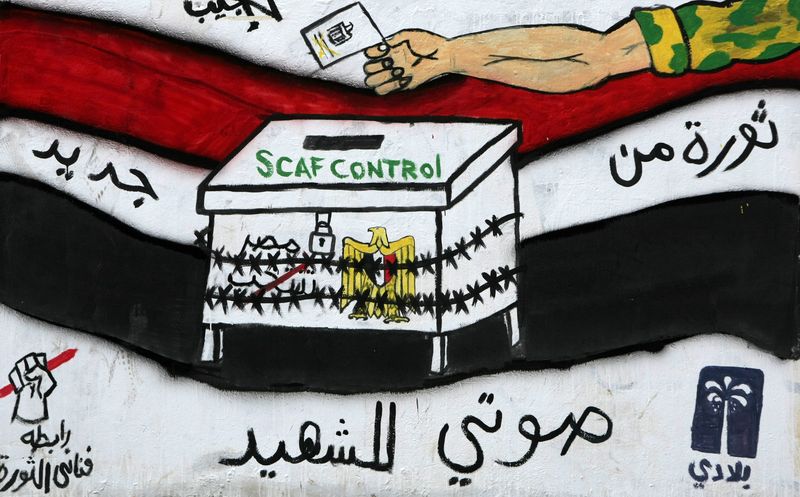
(Photo: 'Revolution once again' reads over graffiti depicting a chained ballot box being controlled by Egypt's ruling military council at Tahrir Square in Cairo on May 25, 2012. Egyptians reacted nervously to the first results of their presidential vote, some celebrating the successful election, and others horrified by the strength of Muslim Brotherhood and ex-regime candidates. By Mahmud Hams/AFP/GettyImages.)