Can The Tea Party Control Romney?

In a new ebook, Philip Klein argues that, to avoid a repeat of the GOP-sanctioned Bush nightmare, Romney-era conservatives shouldn't "shut up and get in line." Instead, they should capitalize on their nominee's "infamous calculating nature" and "play coy." Jim Antle summarizes:

When Republicans take the base for granted, government gets bigger and conservative policy objectives go unrealized. Despite his good intentions on Social Security reform, George W. Bush's presidency was an enormous missed opportunity for conservatives on entitlements. Not many more opportunities will present themselves. Romney needs to have the same political incentives to govern in a conservative fashion that Tea Party challengers have created for complacent Republican incumbents across the country.

Friedersdorf highlights a couple of Klein's blindspots, including national security and the conservative media: 

Klein persuasively argues that it's important for rank-and-file conservatives to focus on entitlement reform, health-care reform, and tax reform. I'd add deficit reduction to that list. He doesn't delve into what the rank and file currently focuses on or why they focus on those things. In addition to taxes and spending, the rank and file currently spends a lot of time obsessing over trivial nonsense: for example, an imaginary race war against white people; The New Black Panther Party; and a liberal schoolteacher abusing her position somewhere in America. Those are but three stories in conservative news right now, alongside the constant obsessions with liberal media bias, anything involving "God, guns, and gays," statements by Janeane Garofalo-style celebrities, and ginned-up kerfuffles we can't even presently imagine. Whether a Republican or Democrat is in the White House, the right-wing media thrives on those often symbolic controversies, which exacts a heavy opportunity cost. … Without confronting these forces, is there any chance the right will get through the next four years focusing on the most urgent of their governing priorities?
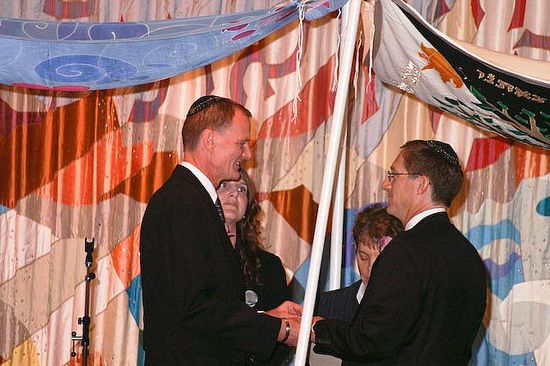
The Orthodox Case For Marriage Equality

2964585662_2837247267_z

Hillel Levin makes it, first with an important point about Jewish and secular law:

Judaism already treats Jewish and civil marriages differently, and synagogues—like all religious organizations—are free to define marriage according to their own religious principles. For example, marriages between Jews and members of other faiths are not performed or recognized in Orthodox synagogues. Other denominations perform them as they see fit. The same approach can easily be applied to same-sex marriages. Orthodox synagogues will not be forced to redefine religious marriage on account of the legalization of same sex marriage.

He connects this argument to the American tradition of religious pluralism and tolerance:

Unlike our Christian friends and neighbors, Jews grow up with our minority status deeply ingrained and without the instinctive expectation that our religious traditions and beliefs will naturally be reflected in the broader law and culture. As a minority within a minority, Orthodox Jews recognize that we reap the benefits of pluralism, tolerance, and accommodation. After all, if religious beliefs in this country were to orient secular law, we would find ourselves deeply disappointed and possibly threatened, just as we historically have in every other diaspora country. For good reason, then, American Jews and Orthodox Jews in particular are usually reticent about imposing our religious values and views on others.

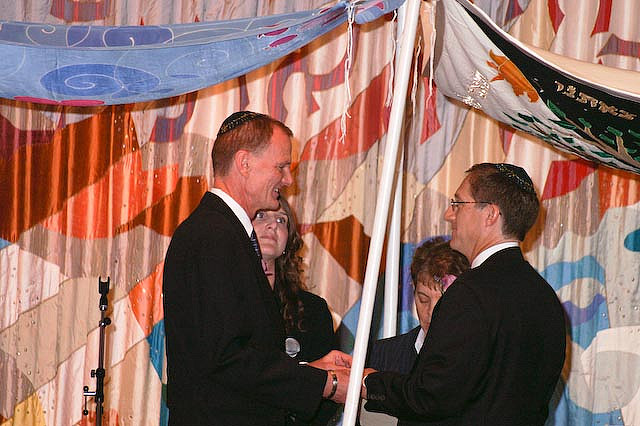
(Photo of their traditional Jewish wedding by flickr users ed and eddie)

Fear The Grexit?

Thomas Oatley and Kindred Winecoff try to calm us down:

Further economic and financial deterioration in Greece would certainly have negative impacts there and might adversely affect Greece's southern European neighbors, who are facing similar circumstances. But financial weakness in Greece is unlikely to spark a global crisis analogous to the one triggered by Lehman Brothers' collapse in September 2008 — even if economic woes eventually force Greece to exit the monetary union.

Instead, the global consequences of southern Europe's debt crisis are more likely to resemble the Latin American sovereign debt crises of the early 1980s, the East Asian crises of 1997-1998, and Argentina's crisis at the turn of the millennium. Each of these had significant local effects — widespread bank failures, sharp increases in unemployment, large exchange-rate devaluations, deep recessions — that were not transmitted globally.

Yanis Varoufakis, by contrast, pushes the panic button. If the Greeks do exit the Euro, it will likely have to happen in a 46-hour window.

Everything You Never Wanted To Know About Plywood, Ctd

A reader loves his wood:

There's even more to get engaged by when it comes to plywood. It's perhaps the most elegant of the "engineered wood products". As a tree goes through the processes of being cruised, felled, de-limbed, skidded and transported to the mill as a merchandized log, then debarked, softened in a steam vat or pond and cut into pre-determined lengths called bolts, it's a little like a clumsy strip-tease. But it's at the lathe where God's creation is fully laid bare, slowly and almost lovingly unwrapped into a long and sensuous ribbon of veneer.

I've seen rough-edged men drop their voices to a whisper watching a particularly beautiful ribbon unfold right outside the safety glass of a lathe control deck. After that ribbon is "clipped" into pre-measured lengths and dried, the sheets of veneer must be graded to determine the letter grade alluded to by Tom Sachs in the video you posted. Grading is often done photo-electrically but is really best done by human beings, especially at the levels of product quality used in the video. There's just no mechanical substitute for the judgment and keen perception of an experienced grader.

The whole process has long been likened to slaughtering livestock in that nothing gets wasted, and everything possible is captured and converted to best-and-highest use, limbs and bark included and even chips and dust from the mill processes. But unlike an animal slaughter, which starts with God's perfection and passes through unspeakable grossness until it finally reaches, at best, a visually neutral and uninteresting state once market-ready, veneer goes from stunning natural beauty to a stunning new human-altered beauty without having to pass through quite the depths that a feed-lot steer is bound for.

Although you'll probably never hear all this articulated in so many words by the folks who do it for a living, there's a sense of wonder and appreciation that never really goes away. They know a tree had to die to expose that inner beauty, and the best of them never really forget that. Some say timber folks are often the truest environmentalists, and I tend to agree.

The Decline Of Pro-Choicers? Ctd

A reader writes:

Changes in the direction of greater support for the "pro-life" position is likely due to the success of legal and safe abortions.  Abortion has been safe, legal and rare for nearly 40 years now, and so the majority of folks have no context to understand what a "pro life" world really was like.  They have the luxury to contemplate the question as some sort of hypothetical.  Should abortion become illegal and/or difficult to access, you'll see a upward spike in the "pro choice" numbers detectable within months, not years. 

To me, there is a parallel here to the anti-vaccination crowd. 

You have to be over 40 (at least) to have any understanding of what life was like before vaccines.  Maybe you didn't know anyone who died of measles, but you may have had a friend whose father was a polio victim.  Anti-vaccination advocates have the luxury of never seeing the implications of their own position and so, beyond the the debates you may see online or on day-time TV, their position gets little consideration.  Similarly, "pro lifers", for the past 40 years, have not had to witness the consequences of their position.  Additionally, younger folks (<40 years old) can't possible have a complete context for the abortion debate because they didn't live in the illegal, unsafe and rare world that preceded 1973.  Should we ever end compulsory vaccinations or make abortion illegal, you'll quickly see polls that basically say, "What the hell were we thinking?!"

A Market In Organs

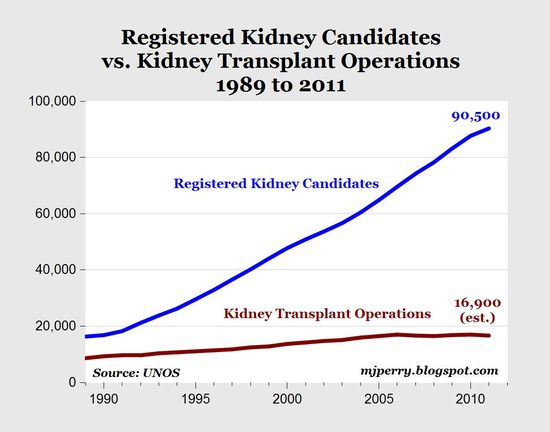
Kidney_Chart

Matt Welch wants to legalize payment for kidney donations:

[W]e know that maintaining prohibition—letting the law be guided by our moral revulsion toward placing price tags on human organs—will certainly increase the body count. We know that boosting the number of kidney donations from the living is the only real way to whittle the waiting list down. And we also know, from such procedures as egg donation, that legalizing monetary rewards is a guaranteed method for expanding the pool of living donors. Your morality may vary, but mine says that sentencing more than 6,000 people a year to an avoidable death falls well short of the Golden Rule. My inquest therefore concludes that the burden of argumentative proof on the legality of kidney sales should fall squarely on those who back the lethal status quo.

Balko is onboard:

With kidneys, and also with vital organs, you could also envision markets that, for example, would pay a smaller sum while you’re still alive if you sign to donate your organs when you die. Another plan might give larger sums to your family once you’re dead, should you die in a manner in which your vital organs remain viable. It also isn’t difficult to imagine “organ brokers” finding that there’s a market advantage to protecting their donors—for example, by including clauses in donor contracts stipulating that any  kidney donor who later encounters health problems requiring a transplant would receive a free kidney,  a paid-for transplant, and move to the top of the donor list—not because organ brokers would necessarily be kind and benevolent, but because if I were donating a kidney, I’m thinking that would be one of my primary concerns, and I’d probably chose a company or system or non-profit that could give me that peace of mind.

(Chart from Mark Perry)

Entrepreneurship Out Of Necessity

Abby Ohlheiser reports that many entrepreneurs are striking out on their own as a last resort: 

Read through advice on starting a small business, and you’ll find that the path has been lined with caution tape. Never start a small business just because you have no other options, experts counsel. This wisdom is generally offered with a nod to the number of new businesses that fail: three in 10 within two years, and the majority after five, according to the Small Business Administration. If you already have a steady job, those figures make a compelling argument for starting your business as a side project until you’re confident it will actually take off. But for those with no good options, what is there to lose?

Between 2008 and 2009, the number of Americans gaining employment from starting a small business doubled to nearly one in 10. Recognizing the trend, the Small Business Administration has set up resource pages for those trying to start small businesses while saddled with student debt or while unemployed.

Can Rifles Tear Society Apart?

Yes indeed:

The proliferation of high-powered assault rifles in societies with weak institutions can have devastating effects. … it's not just about the people who are killed by these weapons. Assault rifles in the hands of youthful thugs or gangsters often end up dissolving the fabric of society itself, condemning the survivors of violence to live with the long-term consequences of weakened institutions and Hobbesian anarchy. It's a process I've seen at work during my stints reporting on the wars in Iraq and Afghanistan.

“Repressing Unpleasantness” Ctd

Wodehousepenguin460

A reader writes:

I don't know that I will ever find anything that gives me such joy as reading Wodehouse. But how do you mention fascism and Wodehouse without bringing up Roderick Spode?

A fantastic parody of Sir Oswald Mosley, who, upon finding out that other competing fascist groups had already picked out various shirt colors as their calling cards decides that his followers will wear black shorts and tries to justify it by describing the choice as a display of pride in the knees that stood at Waterloo. Especially, when Bertie demolishes him with this:

The trouble with you, Spode, is that just because you have succeeded in inducing a handful of half-wits to disfigure the London scene by going about in black shorts, you think you're someone. You hear them shouting "Heil, Spode!" and you imagine it is the Voice of the People. That is where you make your bloomer. What the Voice of the People is saying is: "Look at that frightful ass Spode swanking about in footer bags! Did you ever in your puff see such a perfect perisher?"

BTW, I found that quote in one simple Google search and it supports my pet theory about Wodehouse. Many writers can set up a fantastic joke or story over the course of a few paragraphs. Wodehouse is funny line by line.

Isaac's piece mentions Spode. If you really want to treat yourself, settle down and read the inimitable Hitch on the irreplaceable Wodehouse. He tackles the fascism angle spectacularly.

The Daily Wrap

6a00d83451c45669e2016766b7b395970b-550wi

Today on the Dish, Andrew rebutted more attempts to pin the spending surge on Obama, credited the President with turning public opinion around on marriage equality, found another conservative thinker who's given up on the GOP, compared the US media to Australia's on Trig, and came around to single payer. We worried deficits would help the GOP, scrutinized Obama's Appalachia problem, found another problem with the Republicans-as-civil-rights-champions argument, labelled Obama the "mobile phone candidate," gaped at Obama's huge lead among Hispanics, spotlighted Romney's education plan, and continued discussion of Mormonism and racism. Frum explained Washington dysfunction, right-wing media exposed little, Giuliani worked with Serbian nationalists, and this interview icked us out. Ad War Update here.

Andrew also commemorated P.G. Wodehouse, put Britain's recession in historical context, and set expectations for Iran negotiations. We reported on the desire for change in Libya, bet the war on terror would look like the drug war, exposed the reality of the latter, and found American clothes in Haiti. Being treated like a woman broke a male celebrity, frozen eggs addressed gender inequalities, and teenage girls had caves. Men moved into traditionally "female" jobs, Facebook's IPO wasn't great but also wasn't all bad, and corporate raiders found a champion. Reader discussion exploded on the parking psychology topic, the ginger prejudice discussion also continued, science made a better ketchup bottle, and a blog changed the world. Ask Tyler Cowen Anything here, Cool Ad here, Moore Award Nominee here, Quotes for the Day here, here, and here, VFYW here, MHB here, and FOTD here.

Z.B.

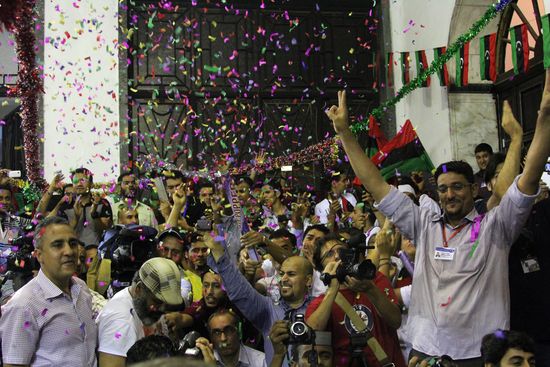
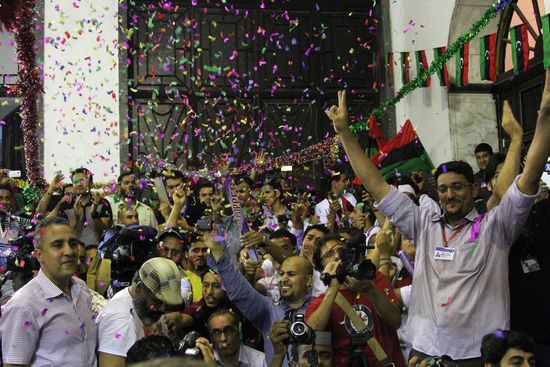
(Photo: Libyan residents of the eastern city of Benghazi celebrate after electing 41 members of the lcoal council on May 21, 2012. Some 414 candidates vied for 41 seats in the council of Benghazi after more than 200,000 citizens registered to vote on May 19. By Abdullah Doma/AFP/GettyImages.)