The Great Healthcare Rip-Off, Ctd

Brian Fung backs up my musing that "the healthcare industry keeps on raising prices because, well, it can." His bottom line:

We usually think of insurers as the major villain in American healthcare, since much of the debate in the last few years has revolved around expanding coverage and ending discrimination. But it's also the case that healthcare providers wield an inordinate amount of power. In some cases, the providers become so powerful they can push the insurance companies around…why those providers found it so easy to jack up their rates is another question. The answer appears to be that nobody's around to stop them.

This isn't capitalism. It's rentier theft, using the power that doctors and hospitals have over patients to rip them off. And when the result of that is a massive distortion of the economy and a bankrupting of the federal government, it seems to me that government should step in. I'm beginning to wonder if, in the case of healthcare, the only way to advance fiscal conservatism is through a much more socialized medical system. When I first entered this debate, single-payer seemed the worst option to me. But the more I have understood, the saner it appears. If the free market cannot work in healthcare – and it has failed spectacularly in this country to provide even a semblance of value-for-money – then it may be time to grasp the nettle.

Ask Cowen Anything: Where Should You Eat In An Unfamiliar City?

Jacob Grier transitions from Cowen’s take – ask a cabbie – to alcohol:

When I want to find good places to eat in a city I don’t know, I ask for recommendations from a bartender or barista who cares about what they do. They rarely steer me wrong.

Why that might be:

For a long time drinks received too little care in part because two of the same forces that damaged American dining – Prohibition and World War II – cast an even longer shadow on American drinking. The former threw talented barmen out of work or overseas. Both events were disastrous for quality wine, beer, and spirits. Home brewing of beer wasn’t legalized until 1978, helping open the field to new entrants. Spirits and cocktails have taken an especially long time to recover, due to complex and restrictive laws regarding distribution and service that differ in every state. The rediscovery of vintage cocktails and spirits began taking off in the late 1980s and has only recently expanded widely.

Follow Tyler Cowen‘s work at Marginal Revolution and buy his new book, An Economist Gets Lunch. Earlier videos of Cowen here, here, here, here, and here. “Ask Anything” archive here.

If You Want Another Debt And Spending Binge, Vote GOP, Ctd

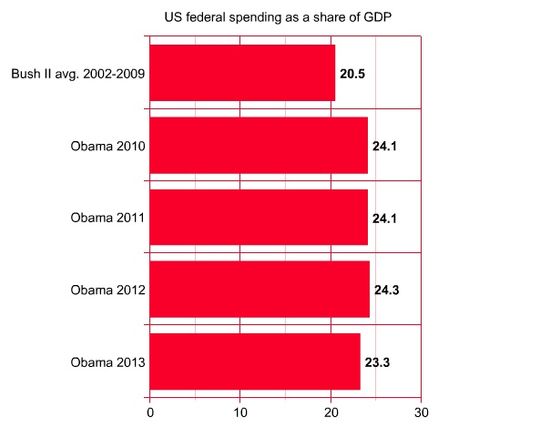
James Pethokoukis counters this graphic on Obama's spending record with one of his own:
Obama_Spending

Pethokoukis insists that Obama is responsible for his deficits:

Only by establishing 2009 as the new baseline, something Republican budget hawks like Paul Ryan feared would happen, does Obama come off looking like a tightwad. Obama has turned a one-off surge in spending due to the Great Recession into his permanent New Normal through 2016 and beyond.  It’s as if one of my teenagers crashed our family minivan, and I had to buy a new one. And then, since I liked that new car smell so much, I decided to buy a new van every year for the rest of my life. I would indeed be a reckless spender.

Suderman agrees. They're both full of it. Kilgore explains why:

I hardly think refusing to cut automatic stabilizer spending (the main areas of domestic spending increase since 2009), particularly for safety net programs where increased spending is a matter of higher enrollments by people in need rather than higher benefits, is analogous to buying a new car every year. … Pethokoukos also doesn’t mention that a recession depresses GDP, making spending (which is affected both by population growth and by higher demand for public services) a higher percentage even if nothing else happens.

That last massive lie is at the core of Romney's political strategy. By removing that context (which is like talking about the sinking of the Titanic without mentionng the iceberg), Romney is knowingly arguing that the spending and debt levels of the last three years were some kind of choice by a president who just loves to strangle the US economy by spending much more money than we have. But the only president who made that choice was George W. Bush – by crippling revenues, even as he fought wars with no budgets and new entitlements with no end (Medicare D), rendering us bankrupt even as we desperately needed a rainy day surplus to fight the depression.

Obama did not have a serious choice; he had a fate. That fate was to pick up the pieces of the most catastrophic presidency in modern times. The final bouquet – after emptying the public coffers with no serious boost to employment, profits or growth – was the financial collapse, which both shrunk the economy, decimated revenues to 50 year lows, and automatically increased spending for the unemployed and poor in desperate need of help. Once you account for that – and the Nutting graph indeed shows that this was baked in the cake by the time Obama was elected – Obama has been, like most modern Democrats, far more fiscally conservative than any modern Republican.

Now you could argue that Obama should have let the auto industry go fully bankrupt, allow the economy to head into deflation and depression without any fiscal stimulus to counter, cut the unemployed off at the knees – and we would be Greece today, underwater in a deepening and self-reinforcing depression. Can you imagine what Romney would have said about Obama's record then?

And yes, as Suderman notes, the real criticism should be focused on the absence of any long-term deal on entitlements, defense, taxes and spending – a deal that would do a huge amount for business confidence. But seriously: if one side simply refuses to put any serious revenue increases on the table at all, who's really preventing that effort?

There are legitimate issues to debate with respect to the future in this election. But the caricature of the last three years, the knowing lies that interweave with this false narrative, the attempt to describe a pragmatic, sane and successful president as somehow unqualified to tackle this mess – when the US economy has fared better in this period than much of the West – are deceptions, exploiting pain. I'm sick of them, and the cynicism they represent.

Obama’s Permanent “Appalachia And The Upland South” Problem, Ctd

Sean Trende explains its importance:

Of the 63 seats Republicans picked up in 2010, 15 were in Greater Appalachia. Without these seats, their majority would be much slimmer, and Democrats would be only 10 seats from a majority, rather than 25. Many of these seats represent districts that Bill Clinton had been competitive in during the 1996 elections, but which have slipped away from his party since as the Democrats have become increasingly liberal, urban and culturally cosmopolitan.

This is the real reason Tuesday night's results are significant.

Earlier commentary here.

Quote For The Day II

"There was a woman in Iowa who shared her story of financial struggles, and he gave her an answer right out of an economic textbook. He said, "Our productivity equals our income." And the notion was that somehow the reason people can’t pay their bills is because they’re not working hard enough. If they got more productive, suddenly their incomes would go up. Well, those of us who’ve spent time in the real world — (laughter) — know that the problem isn’t that the American people aren’t productive enough — you’ve been working harder than ever. The challenge we face right now, and the challenge we’ve faced for over a decade, is that harder work has not led to higher incomes, and bigger profits at the top haven’t led to better jobs," – president Barack Obama.

My italics.

Parking Lot Psychology, Ctd

Kottke says of the above video, "I can't tell if the app featured in this video is imaginary or not, but it's a great theoretical solution to the problem of douche parking." A reader writes:

That guy who wrote in to complain about the "parking lot vulture"? That guy is self-rationalizing dick. Parking spaces are a limited resource with a finite usefulness to each person who occupies them. If you find your psyche buckling under the pressure of someone waiting for you to vacate your spot, you likely lack the intestinal fortitude to drive a car in an area of any population density. If I see you loading your groceries or whatever into your car, I know that you are essentially done with that spot – who benefits from me continuing to drive around looking for another one? I used to wonder what possessed parking spot dawdlers, and now my darkest suspicions have been confirmed – they are irredeemable pricks. (That said, anyone who honks at a dawdler is an even bigger prick.)

Another is more forgiving of people who pull out slowly:

Could their behavior be explained by the drivers rightfully being more careful in the presence of another car? Backing out of a traffic space is a fairly risky maneuver – driving in reverse with limited visibility and lots of obstacles.  If I look around and see no one, I will exit more quickly, because there is no potential obstacle to look out for. If someone is waiting for the spot, I start to worry that the other driver might edge in when I am looking away, or if I watch the "lurker" while exiting, I may be ignoring some other car or pedestrian passing by. Such considerations seem to be more than capable of explaining the reported differences in exit times.

Another suggests:

Contrary to your reader's assertion that "The only non-violent protest a person can make with parking lot vultures is to slow-walk their departure," there is a faster, more decisive non-violent strategy: walk past your car by a few spots, until the vulture has passed your car, then turn around, walk back, and load your car like normal. The vulture, being past your car, can't back up because of the people behind him and must find another space. Sure, it won't always work, but it's better than slow-walking, which is impolite to everyone, not just the vulture.

Another stays neutral:

I've opted out of the parking lot wars by looking for the most distant spot I can find. This gets me at least a little more exercise walking, since my time for that is hard to find. So it makes it both easier and healthier for parking. What's the big deal about parking close, anyway, unless you're handicapped (in which case you have spots up close)?

Another:

I don't really have a problem with parking lot vultures. More egregious to me are people who routinely park in handicapped spaces or who take up two spaces to avoid having some nick their paint. (I know lots of people who consider such parking techniques as an open invitation simply key the car out sheer spite). Finally, there are the people who insist on driving large SUVs and pick-ups but lack the skill to park them properly. I've gotten into actual physical altercations with rednecks and frat boys sometimes because I simply could not resist telling them straight out that they might consider buying a vehicle commensurate with their limited parking skills.

And finally, straight from the vulture's mouth:

I am a parking vulture.  At the grocery store where I shop there is a certain row of spots that I covet.  They are shady in the summer and close to the storefront, so they are in high demand.  While there are dozens of other spots available, if I see someone leaving a spot, I pull over to wait, and I've been on the receiving end of behavior mentioned by your reader, where the person does not leave the spot until I stop waiting. 

Am I elderly?  No. Handicapped? No. Lazy? Definitely not. Then why do I want those spots?  The person who is getting angry with me may not notice the three small children with me.  These spots are the only ones in the lot that are next to a sidewalk.  While I am unloading and loading children and groceries, I can put my children on the sidewalk and tell them to stay there where they are safe.  I don't feel safe having my children linger in the middle of a parking lot next to my car while I am unloading the other two.  If they are not on a sidewalk, they could step behind a car backing up, dart into traffic, or wander into an unoccupied space. 

Just wanted to let your reader know that there may be other reasons for waiting for a particular spot than laziness.

An Endless Series Of Skirmishes

Caitlin Fitzgerald worries about the ease of drone warfare:

I fear that maybe we use these tactics just because we can, that because we have drones and incredibly skilled and versatile SOF teams and such, we just look for people to use them on. That scares me because it implies a casual attitude toward the many forms of potential collateral damage, scant consideration of long term effects (and therefore the absence of a robust long term guiding strategy), meaning finally, an approach to national security that is not actually optimized to keep our nation secure.

Kelsey D. Atherton compares this phenomenon to another war without end – the one on drugs:

[It] bears a striking similarity to the Global War on Terror in that it’s waged as a series of interdiction missions with no clear end state. …

But if we’re building on a War on Drugs model, the situation is unlikely to remain static. Centralized Colombian Cartels were replaced by smaller and more agile players, speedboats were routinely stopped and so drug runners built submarines, maritime routes abandoned in favor of land transport, and gangs once confined to distinct neighborhoods became transnational nonstate actors. While the US has adapted to the specific new form of the threat, the War on Drugs has remained one in which the best our current strategy can do is hope to maintain a status quo of interdiction. If the Global War on Terror follows this pattern, we might pursue the same means with better tactics, we will not be making progress towards a political end. At best, will instead be really good at treading water.