The winter of his content:
Month: May 2012
The “Mormon Mask”? Ctd
A reader fact-checks my post:
First, on the assertion that the LDS church teaches "that white people lived in America long before native-Americans," it's just not so. While the Book of Mormon is the story of a family's travels from Jerusalem to the Americas circa 600 BCE, I've never heard taught in the Church that they were the only ancestors of the Native Americans or pre-dated them in some way. Here's an an article from the Deseret News in 2006, when the Church changed the introduction of the Book of Mormon to say that the people of the Book of Mormon were "among the ancestors" of the Native Americans rather than the 1981 version that they were "the principal ancestors." Perhaps it's a generational thing (I'm 28), but whenever it's come up in discussion at church (which isn't often), the general assumption is that it all happened in a small corner of the Yucatan or the mound-building societies of the eastern U.S.
The different view of mind-body dualism – that God is a physically resurrected being and we can (through Christ) eventually become like him – the location of the Garden of Eden, that Christ will come back to Missouri as well as Jerusalem … all that is doctrine, though not really emphasized on in Sunday sermons or scripture classes. Which gets to my thought on the Mormon mask:
During my missionary service in South Carolina back in 2005, part of my duties was compiling a history of the mission, using a file of press clippings someone had started back in the early '70s. I was struck by the number of short pieces: "Mormon elders arrive in Spartanburg (or Greenville, or Charleston, etc.) to talk about families and 'Family Home Evening'" (an LDS program that combines family council, scripture study, excursions, and the like). I asked my dad, who lived in Tennessee at the time, "Was the Church really emphasizing the family this much, or was this only thing the newspapers would print about Mormons?" His answer, in short, was "Yes": that Mormons outside of Utah (and the LDS Church among other religious organizations) emphasized families and strong family life to shield themselves from anti-Mormon persecution and shunning, and as a way to purchase acceptance at the Evangelicals' "cool kids" table.
Mormon fear of bullying and the desire for acceptance from other religious institutions has led to efforts to be uber-American, to assist (and lead out on) crusades against the ERA or LGBT rights (although many members overlook the Church's real support in Salt Lake for LGBT protections in housing and employment). I think Mitt is part of this "acceptance at any cost" generation, masking his true self to the point that it's difficult to know where the mask ends and the person begins.
Although as a historian, I understand the obsession with acceptance by the larger Christian (and Republican) community, as a young-ish practicing Mormon, it makes no sense to me. We are who we are, we believe what we believe, and when we let desires for acceptance lead us away from core Christian doctrines of respecting other people and fighting for their rights, caring for the disadvantaged, and constructing a just society that emphasizes love, mercy, and peacemaking, it leads nowhere good.
Earlier Dish discussion of the "Mormon mask" here, here and here.
Reality Check

That's a big jump among independents in the last month or so. But it's still negative.
The War Candidate
Noah Millman suspects that Romney will oppose any deal with Iran. Larison wonders whether this will matter:
If Romney expressed his opposition to a deal, Obama probably wouldn’t react to that by demanding more from Iran. Iranians inside the regime already skeptical of dealing with the U.S. might seize on Romney’s opposition as proof that any commitments the U.S. makes won’t mean anything if Romney wins. Iran’s government may assume that a Romney administration would impose new demands that makes any deal they negotiate now more or less meaningless over the long term. They might or might not be right about that, but it makes sense that they would find it difficult to reach an agreement that the next administration might not honor.
I suspect the 1938 brigade to be out in force if a deal is reached. The key will be real inspections and keeping enrichment to the levels appropriate for medical use. But if those are in place, and the international community is on board, Romney is boxed in. And I think this should be a key issue in the coming election. One candidate is trying to get a peaceful deal with Iran by carefully mounting pressure and securing the kind of global support his predecessor was incapable of. The other wants another war against another Muslim country in the Middle East, as well as vast new military spending.
It's really a choice between returning to the Clinton years or the W years. But a serious and effective deal with Iran would be a cap-stone for Obama's transformation of American foreign policy after Cheney and Bolton and all the other W staffers now itching for a second ride at the wheel. This, perhaps, is where the Paulites might come in handy at the convention.
The GOP’s Idea Of Compromise
Just about right:
Obama’s Permanent “Appalachia And The Upper South” Problem, Ctd
A must-read from TNC.
Piers Morgan, Phone Hacking Instructor
The British television legend, Jeremy Paxman, spills the beans. Morgan calls him an "ungrateful little wretch". Good times.
The Decline Of Pro-Choicers?
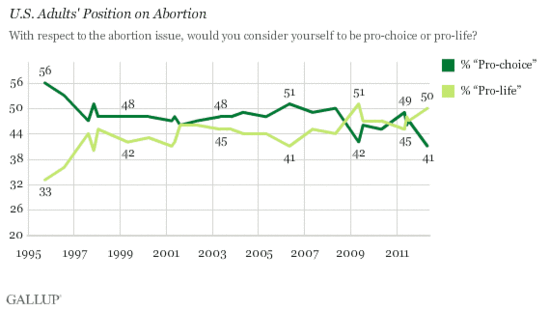
K-Lo sees "encouraging signs for life" in a new Gallup poll that indicates that 50 percent of Americans are pro-life (while 41 percent identify as pro-choice). Ed Morrissey goes further:
We may still see some hiccups and occasional spikes in the wrong direction, but the long-term prospects for abortion support look almost as grim as abortion itself.
Adam Serwer clarifies:
[A] large majority—77 percent—of Americans support abortion being legal in all or "certain circumstances," and just 20 percent of Americans are actually "pro-life" in the sense that opponents of legalized abortion understand the term. … That's good news for someone, but not for people who want to outlaw abortion.
Jon Sides likewise points out that "for the right to abortion depends strongly on the circumstances of the pregnancy." Sarah Kliff wonders why fewer abortion rights supporters identify as pro-choice:
The modern [pro-choice] movement largely came into being to defend Roe v. Wade, the 1973 Supreme Court case legalizing abortion. It might be that a label developed 40 years ago might not speak to abortion rights supporters in a way it did for previous generations.
Ed Kilgore, on the other hand, discounts the poll:
The poll is likely an outlier, as the one in 2009 clearly seemed to be, particularly given the unusual stability over time of public opinion on abortion.
I take Kilgore's point about 2009 and about measuring nebulous things like being "pro-choice". But I think it's interesting and salient that public attitudes toward abortion have shifted slightly toward a more pro-life position in the last decade or so, and that this includes the younger generation. There isn't anything like majority support for banning it altogether as the GOP wants – but Americans seem more attuned the to gravity of the moral question here. Compare that with the issue of marriage equality. The only inference is that there are a lot of pro-marriage equality folks who are also anti-abortion. I don't want to criminalize abortion in the first trimester, but if I had to describe myself, I'd probably say "pro-life."
The Bain Of This Campaign, Ctd
John Cassidy wonders how far Obama will take his critique of the private equity industry:
If the President was really serious about cracking down on this form of "vulture capitalism"—thanks again to Rick Perry for popularizing this phrase—he would surely be emphasizing specific remedies, such as eliminating the grotesque "carried-interest deduction," which allows private-equity partners to pay such a low tax rate, and limiting the tax deductibility of interest payments on the debts that firms like Bain Capital pile upon firms they acquire. At various times over the past four years, Obama has come out in favor of the first proposal, but he has never made it a top legislative priority. By the time the summer is out, he may well have done so, and he may even have embraced the second idea, too.
Wilkinson thinks Obama is playing a dangerous game:
I certainly see the appeal of characterising Mr Romney as a sadistic "vulture capitalist" who takes pleasure in the suffering of those he gladly fires. But Mr Obama may be playing with fire. He has been careful not to impugn all profit-seeking, or even all private equity, yet it's hard to see how it's possible to attack Mr Romney for the alleged depredations of Bain Capital without implicitly attacking other profit-seekers responsible for similar labour-market churn. If Mr Romney's Bain was guilty of something other private-equity firms are not, it's not clear what it is.
Another Country

Chelsea Fagan reflects on the experience of being an ex-pat:
So you look at your life, and the two countries that hold it, and realize that you are now two distinct people. As much as your countries represent and fulfill different parts of you and what you enjoy about life, as much as you have formed unbreakable bonds with people you love in both places, as much as you feel truly at home in either one, so you are divided in two. For the rest of your life, or at least it feels this way, you will spend your time in one naggingly longing for the other, and waiting until you can get back for at least a few weeks and dive back into the person you were back there. It takes so much to carve out a new life for yourself somewhere new, and it can’t die simply because you’ve moved over a few time zones. The people that took you into their country and became your new family, they aren’t going to mean any less to you when you’re far away.
My own experience is slightly odd, because the HIV immigration and travel ban both restricted my travel home for years and made me psychologically cling to my new home to excess. Like many immigrants, I romanticized America, and still do. But since I became a free man, about a year ago, my visits back home have been much less fraught, and my ability to reconnect with my previous life, my previous self, and all the friends and experiences and institutions I left behind has strengethened. It's been a bewildering process, and it continues. But I find my love for England deepening – its instinctive moderation, pragmatism, and freedom from fundamentalist fervor things I increasingly value and respect. Maybe because now I know I won't be forced back I can see it more dispassionately or less defensively. Or maybe I forget all the bad things and think only of the good.
(Photo from my vacation in Sussex, near my childhood home, last summer.)
 The Dish