Ad War Update

Crossroads GPS goes in for the kill with $10 million behind the following spot airing in ten swing states: 

How the NYT sees it:

More soft-pedal than Swift Boat, the 60-second advertisement, complete with special effects, is a deeply researched, delicately worded story of a struggling family; its relatively low-key tone is all the more striking, coming at a point in the campaign when each side is accusing the other of excessive negativity.

Jamelle Bouie is indignant

As befitting a Karl Rove outfit, the claims in the ad are either misleading, or outright falsehoods.

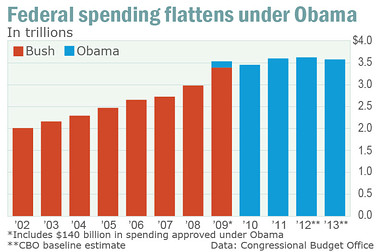
Citing a Reuters story from 2009 on conservative efforts to sink the bill, Crossroads GPS insinuates that the stimulus was a failure, despite wide consensus that the bill kept United States out of a depression, and significantly improved prospects for recovery. The ad continues in this vein, blaming high insurance premiums on the Affordable Care Act — when the cited article says otherwise — and blaming Obama for the increase in debt, despite the fact that under his administration, government spending has risen at a slower pace than any time in the last 60 years. Obama is one of the most miserly presidents in recent history, especially compared to George W. Bush, who grew spending at more than 7 percent per year; double the rate of Bill Clinton, and more than five times the rate of Obama. The simple fact is that the accumulation of debt over the last three-and-a-half years has more to do with the Great Recession than it does with any of Obama’s spending priorities.

Steve Benen adds

The Crossroads attack ad is as cynical as politics can get, working from the assumption that voters are fools. It talks about bailouts, assuming voters won't know it was Bush/Cheney that rescued Wall Street before Obama took office. It talks about debt, assuming voters don't know Mitt Romney's agenda would raise the debt far more than Obama's agenda would. It talks about student loans, assuming voters don't know that Obama expanded Pell Grants and Romney wants to scrap student loans altogether. It talks about "job-killing debt," which as a policy matter, is just idiocy. It lies about the stimulus; it lies about spending; it lies about health care.

Meanwhile, Obama's Super PAC continues to fight the Battle of the Bain

Another ad focuses on the Ampad case: 

Meanwhile, the RNC accuses the Obama campaign of "covering up" Booker's remarks. The DNC notes that private equity is not about job creation. 

Previous Ad War Updates: May 21May 18May 17May 16May 15May 14May 10May 9May 8,  May 7May 3May 2May 1Apr 30Apr 27Apr 26Apr 25Apr 24Apr 23Apr 18Apr 17Apr 16Apr 13Apr 11Apr 10Apr 9Apr 5Apr 4Apr 3Apr 2Mar 30Mar 27Mar 26Mar 23Mar 22Mar 21Mar 20Mar 19Mar 16Mar 15Mar 14Mar 13Mar 12Mar 9Mar 8Mar 7Mar 6Mar 5Mar 2Mar 1Feb 29Feb 28Feb 27Feb 23Feb 22Feb 21, Feb 17, Feb 16, Feb 15, Feb 14, Feb 13, Feb 9, Feb 8, Feb 7, Feb 6, Feb 3, Feb 2, Feb 1, Jan 30, Jan 29, Jan 27, Jan 26, Jan 25, Jan 24, Jan 22, Jan 20, Jan 19, Jan 18, Jan 17, Jan 16 and Jan 12.

Vacationing In Spain Is Still Pricey

Despite its dismal economy:

The exchange rates in some sense "should" have moved a lot, turning Spain into an American tourist’s paradise. But they haven’t, because Spain is only a small part of the eurozone. The exchange rate dynamics reflect the overall conditions throughout the currency area, most of which is doing much better than Spain or Greece. Because of Germany’s strength, the euro doesn’t fall across the rest of the continent (just as a recession in Florida doesn’t pull down the dollar in the rest of the United States).

The Daily Wrap

6a00d83451c45669e20168ebb1fdc2970c-550wi

Today on the Dish, Andrew blasted the GOP's record on spending as compared to Obama's, worried Romney would be par for the Republican course, linked Mitt's Mormonism to his Ward Cleaver public image,  and hit home the stakes in the marriage equality fight. We saw no real impact on the campaign from Obama's marriage equality announcement, evaluated Obama's line on Bain, figured no one was going to remember what we're talking about now in November anyway, explored the Derb and conservative racial panic, kept up the heat on Obama on marijuana, and laughed at the idea that Hillary would replace Biden as veep.

Andrew also judged Leo Strauss a philosophical "mediocrity" (follow-up here), expressed concerns about John Brennan's targeted killing powers, and extolled online courses. An Iran deal inched closer to reality, Egypt moved towards a historic vote, Obama blanked on an important piece of the Israeli-Palestinian puzzle, and global politics doomed the climate. The Ivies looked a lot like the 1% of universities.

Andrew also grieved over Mary Kennedy and her struggle with depression and engaged with the roots of anti-ginger prejudice. We heard a new perspective on the race/sexual orientation conversation and straight dating exposed latent prejudices about sexuality. Lobsters trailblazed on eternal youth, long days made for poor decisions, food ills worsened, and city animals hid. "Broken windows" policing broke lives, innovation didn't live up to expectations, living at home wasn't terrible, and counterfeiting took real skill. Plywood fascinated, Siri raged, and apocalyptic fiction mainstreamed. Ask Jim Manzi Anything here, Yglesias Award Nominee here, VFYW Contest Winner here, VFYW here, MHB here, and FOTD here.

Z.B.

Egypt Votes

Egyptian_Elections_GT

The Egyptian elections begin tomorrow. Marc Lynch hopes for the best:

If Egypt does witness a transfer of power from the SCAF to an elected President and Parliament with provisionally defined powers in the next few weeks, and those elected officials are able and willing to assert their authority, Egypt could have a brighter future than most believe. Perhaps, finally, its leaders can begin to confront the massive economic, social and institutional challenges which have been so badly neglected for so long (and not only during the transition).  I don't expect it to go smoothly — this is Egypt, after all.  The new President will jockey for power with the SCAF and with the Parliament, the wonderfully contentious and unruly Egyptian media will challenge and scrutinize their every move, and many activists will likely continue to take to the streets in protest.  But on the eve of the election, Egypt suddenly seems tantalizingly close to something  like a successful transition. 

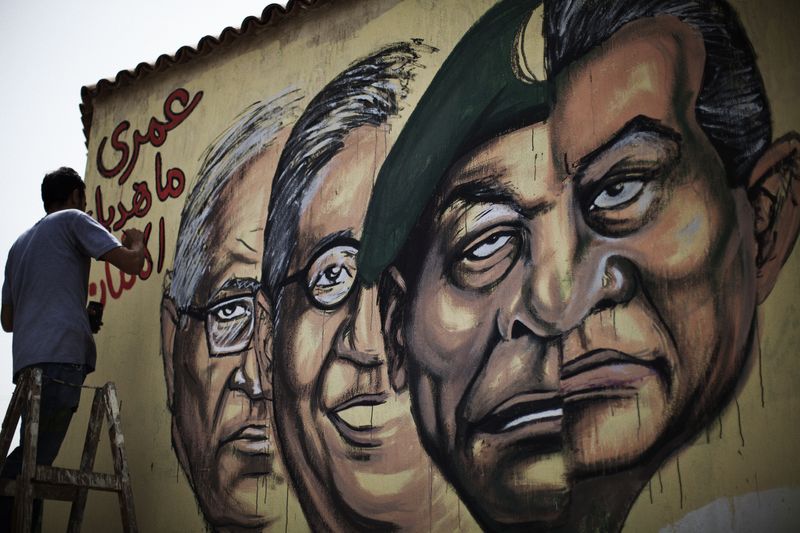
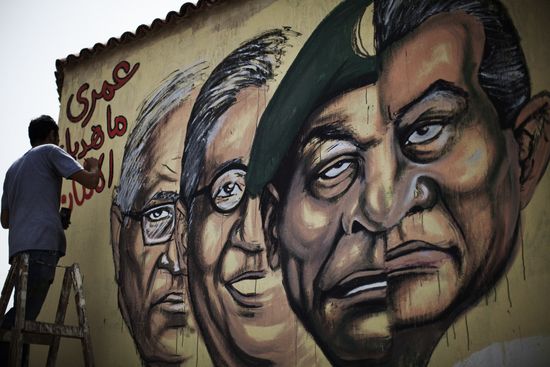
(Photo: An artist writes a slogan in Arabic that reads 'I will never give you peace' next to graffiti picturing the morphed faces of ousted president Hosni Mubarak (R) and military ruler Hussein Tantawi and presidential candidates Amr Mussa (C) and Ahmed Shafiq (L), near Cairo's central Tahrir square on May 22, 2012, one day before the country's landmark presidential elections. Buy Marco Longari/AFP/GettyImages)

The Mediocrity Of Leo Strauss, Ctd

A reader writes:

I think your experience of "Straussianism" was fundamentally different from mine in part because you went to Harvard, and thus dealt primarily with the Harv, and not Strauss-largewith some of the less-polemical and less-politically convinced Straussians. I've found that many Straussians are indeed much like what Gottfried describes, but these are the ones who studied with Mansfield and/or Jaffa-inspired teachers. Allan Bloom, too, cast a long shadow, and was evidently interested in dipping his fingers in what Nietzsche called die grosse politikthat drama is delightfully recounted with nuance and affection in Saul Bellow's Ravelstein. In my experience, those Straussians who are really interested in reading Plato tend to be really pretty skeptical about politics in just the way you are. My own Straussian teachers spanned the political spectrum, and shared in common a concern for "fundamental questions" rather than dogmatic truths.


For what it's worth, I suspect the latter perspective is truer to Strauss.

The best work on Strauss' thought, done by two of his former students, Catherine and Michael Zuckert, suggests quite contrary to what you wrote that Strauss believed that content of the transhistorical truths that existed was closer to a series of perennial, yet basically intractable, questions. So the problem with historicism is not that it obscures capital-T Truth, but that it implicitly denies the possibility of a sincerely open-ended, skeptical, and zetetic philosophical quest in pursuit of certain perennial human questions (a quest which has been transmitted to us primarily by the great philosophers). My own experience of the "Straussian" education did not lead me to become more certain about things, but to become profoundly skeptical about conventional political dogma in general, and to want to spend my time reading and thinking about these big issues, and (now) sharing my own wonder with my students. Although it's at a considerable generational remove by now, I have Leo Strauss to thank for that more than any one else.

I can't help but think that Strauss himself would be profoundly amused by the wide variety of interpretations of his life and work (as well as the cultish nature of some, though certainly not all, of his followers). The interpretations vary so wildly–Strauss is secretly a Nazi (Altman), Strauss' belief in esoteric writing indicates psychosis (Walsh), Strauss is the leader of an anti-democratic cult (Zeno, Drury), Strauss was concerned primarily with the Athens/Jerusalem question (Pangle); Strauss was a Nietzschean philosopher of the future (Rosen); Strauss was a friendly critic, but ultimately a profound defender of, liberal democracy (Smith)–that one finds almost finds evidence for Strauss' esotericism thesis arising from his own writings–how else could so many intelligent people reading the same body of work arrive at such divergent views?

To paraphrase a classic review of Strauss, we can never know whether this Sphinx had a secret or not, but that we care is certainly provocative in itself, and the task is made more difficult by Strauss' allusive literary style, and the, in my view, intractable question of whether he himself wrote esoterically.

The Munchies Map

11pm

Mark Wilson interacts with an infographic showing 24 hours of eating habits around the world:

Not only do eating trends get worse over time, they get worse in a direct, predictable path. Food decisions at 10 a.m. are worse than at 7 a.m.; at 4 p.m., they’re worse than at 12 p.m., and at 11 p.m. they’re even worse than 10 p.m. In the interactive version, all you have to do is scroll right to see that, when the lights go out across the globe, every developed region begins to munch on the deplorable. Our species is remarkably predictable, and I can’t help but wonder, what other societal trends would look exactly the same–vandalism, infidelity, shamefully self-reflective Facebook posts–honestly, how many good decisions are any of us making after midnight? 

Apocalypse Is The New Realism

Ben Marcus summarizes the trend towards end times in American fiction:

Do Americans read [Cormac McCarthy’s The Road] differently – say, as a great realist novel – because our nation’s ridiculous lucky streak (a luck sustained through tremendous violence to others) was broken ten years ago and we got to sample, however briefly, feelings of deep vulnerability? Nothing of the 9/11 attacks even remotely suggested an apocalypse but they certainly helped expose the troubling fiction of our immortality. Which might mean that fictions of our end times are now, through bad luck or comeuppance, however you wish to view it, among the truest and most realistic stories that we can tell.

More on the psychology of armageddon here.

Face Of The Day

GT_LEBANON-KID_120522

Lebanese citizens waving Lebanese flags and a picture of Lebanese Armed Forces Commander General Jean Kahwaji rally in support of the army in Beirut's northern suburb of Dora on May 22, 2012 as tension rose in the country over the killing of a Sunni Muslim cleric by army troops on a checkpoint in the north two days ago, leading to street battles between pro- and anti-Syrian groups in the capital which left two people dead, sparking fears the conflict in Syria is spilling across the border into Lebanon. By Joseph Eid/AFP/GettyImage.

Mary Remembered

Kerry Kennedy eulogizes her best friend:

Like millions of Americans, Mary suffered from depression. She had it for as long as I knew her, and as it reared up in high school, college and beyond, 120517012227_1079135she fought it back, for a day, a week, a month. These last 6 years or more, she fought it as hard as she knew how.

But that disease was not Mary herself. She was deeply Catholic, and she was an angel. And like the archangel Michael, who battled Satan when he tried to take over Heaven, Mary fought back the demons who were trying to invade the Paradise of her very being. She fought with everything she had. And I think God said to her "Mary, you have been my warrior on the front lines for too long, you have fought valiantly, and now I am bringing you home."

I've lived with depression in my family all my life. It is hard to describe what it robs people of – more, perhaps, than any "physical" ailment or disease. It robs you of life. And if left unchecked, death seems no different. My heart goes out to Mary and her family and friends – and to all those, right now, reading these words, battling the darkness.

Hillary Won’t Be Veep

Tomasky thinks Obama should switch Biden's and Clinton's roles. Harry Enten smacks down the idea:

[H]istorical precedent is against such a move: even the desperate Herbert Hoover didn't change horses in 1932, despite knowing he faced certain defeat. Others have changed vice-presidents in the last 100 years, but never for desirable reasons: it happened in 1944 because Henry Wallace, as vice-presidential candidate, succeeded in alienating everyone; and in 1976, because Nelson Rockefeller actually refused to run. The real reason veep switches don't happen often is because vice-presidents don't make much of a difference. 

Massie is on the same page:

It projects weakness which, generally speaking, is the kind of thing a candidate seeks to avoid doing. It's the kind of thing that changes the lens through which the media filters its reporting.