More engaging than you'd expect:
Month: May 2012
The Mediocrity Of Leo Strauss
Here's a new tack: instead of whispering about secret cabals, insider code, and conspiracy theories about Straussians, Kenneth McIntyre simply reviews the man's work (by way of a new treatment by Paul Gottfried), and comes away underwhelmed:
Strauss was at best a mediocre scholar whose thought expressed a confused bipolarity between a very German and ahistorical Grecophilia on the one hand and a scattered, dogmatic, and unsophisticated apology for an American version of liberal universalism on the other. Amongst prominent European philosophers, Strauss was taken seriously only by Hans-Georg Gadamer, until Gadamer concluded that Strauss was a crank, and by Alexandre Kojève, whose work reads today as if it were a parody of trendy French Marxism. In Britain, neither Strauss nor the Straussians have ever been taken seriously.
Gottfried is a real scholar and this book is not, by all accounts, a hatchet job. I might add that it was strange arriving at Harvard to discover that the only non-left-liberals in the faculty were Straussians. The concept of a conservatism that was not dogmatic, that did not rest on eternal truths to be found in Plato and Aristotle but on the prudential management of contingent liberal societies … well, I realized I had left it all behind in Britain. I just had my Oakeshott in the Widener library for succor.
 Nonetheless, I'd argue that Strauss's often idiosyncratic takes on the great philosophers are often stimulating, and full of insight. Straussians were much more fun to study with because they believed they were dealing with live issues, not the dry residue of dead historicism. Yes, there's also a lot of nonsense (numerology and the like).
But the real trouble, I'd argue, is with Strauss's 1930s-driven lack of faith in modernity, his insistence that unimpeachable truths (not insights, eternal truths) about human nature could be gleaned by close reading of ancient texts by a few in the elite, and his followers' need to disguise their disdain for democracy and religion (making them insufferable cynics). It was hard to find a Straussian scholar who wasn't obsessed with domestic politics and who wasn't a neoconservative, itching for a new war for freedom somewhere.
America, alas, didn't have a Burke or an Oakeshott to craft its conservative philosophy. It ended up with the work of a German Jewish exile, whose political didacticism was as pronounced as his philosophical inscrutability. The failure of American conservatism to come up with more than fundamentalist religion and gloriously noble foreign interventionism as its core policies (along with making government insolvent by pretending that lowering taxes increases revenue) might be seen as a consequence of this strange admixture. Or as McIntyre tersely puts it:
[T]he primary effect that both neoconservatives and Straussians have had on the American conservative movement is to suck all the air out of it and ensure that there is no one to the right of them, while their primary effect on American politics generally has been to reinforce the ideologically charged notion that America is some sort of propositional nation constituted like a vast pseudo-religion by a set of tenets needing constant promulgation. It is a story of America as armed doctrine, and Gottfried is assuredly right in arguing that there is nothing conservative about it.
So why did the "cult of Straussianism" succeed?
"It took hold here for the same reasons that cults generally succeed in the U.S.: ignorance, inexperience, and a desire to have a simple answer to complex problems."
On Dissing Gingers
A reader writes in reaction to our latest MHB:
I’m an American who’s lived in the UK for over 10 years. In fact, I’m such an Anglophile I became a British citizen. So I like to think I have a pretty good grasp of what makes the English tick. I get the UK/France rivalry. I understand that I’m supposed to hate the Germans (but never mention The War). I can queue with the best of them, and I’ve got talking about the weather down to an art form. However, one thing I will never understand, and something that has never been explained to me satisfactorily, is why the British give redheads (gingers) such a hard time. Perhaps you can enlighten us?
No clue. Maybe a residue of anti-Celtic prejudice? Maybe in a once-all white island, someone had to be the despised minority (after Jews and Catholics). The good news is that Pixar looks set to release a major Ginger-empowerment movie:
But prejudice is, alas, eternal. And Rebekah Brooks doesn’t help.
Racial Panic And The Firing Of Derb
Frum weighs in on what it means for what's left of conservatism.
Marriage Equality Support As Non-Event?
Obama's announcement hasn't moved the polls much:
[F]or all the hubbub, and all the column inches devoted to gaming out the political fallout, Obama's announcement led to little evident movement in the polls, and what movement there has been has been in his favor. That doesn't mean gay marriage can't matter later in the campaign — if it increases turnout among Ohio evangelicals, or leads to much-improved superPAC fundraising for Obama, it could have an impact on the election without having a major effect in national polling — but for now, it doesn't appear to be changing many votes.
Marijuana Is Not A Joke
Penn Jillette rages against Obama's drug policies:
From the transcript:
Do we believe, even for a second, that if Obama had been busted for marijuana — under the laws that he condones — would his life have been better? If Obama had been caught with the marijuana that he says he uses, and 'maybe a little blow'… if he had been busted under his laws, he would have done hard fucking time. And if he had done time in prison, time in federal prison, time for his 'weed' and 'a little blow,' he would not be President of the United States of America. He would not have gone to his fancy-ass college, he would not have sold books that sold millions and millions of copies and made millions and millions of dollars, he would not have a beautiful, smart wife, he would not have a great job. He would have been in fucking prison, and it's not a goddamn joke. People who smoke marijuana must be set free. It is insane to lock people up.
A-fucking-men.
Would Romney’s Economics Be More Clinton Or W?

We'd better hope – against all current evidence – that it's more like Clinton than that other guy no Republican ever mentions:
Today’s conservatives oppose tax increases so strenuously that many were willing to default on the nation’s debt last summer rather than raise taxes by a single penny. They overwhelmingly believe in a nonsensical theory called “starve the beast,” which asserts that tax cuts automatically reduce spending and tax increases never reduce the deficit because they invariably lead to spending increases.
The Clinton and Bush 43 administrations are almost perfect tests of starve-the-beast theory; the former raised taxes in 1993, while the latter signed into law seven different major tax cuts, according to a Treasury study. If there were any truth whatsoever to starving the beast, we should have seen a rise in spending during the Clinton years and a fall in spending during the Bush years. In fact, we had exactly the opposite results.
Bruce Bartlett has the numbers that prove it. What we really have right now is a choice between two conservatisms: one believes in a balanced approach to long-term debt (with increased taxes on the wealthy, investments in infrastructure, reform of entitlements); the other believes in slashing taxes and revenues still further, increasing defense spending, slashing core discretionary spending and entitlements. I don't think it's a debate any longer which approach would increase the debt more. There isn't a debate about Clinton's and Bush's records. The former was a conservative; the latter a big government spender and borrower who so crippled this country's finances it could barely survive the financial crash that was the exclamation point to the wreckage of the last Republican era.
The View From Your Window Contest: Winner #103

A reader writes:
Looks like Maine, but really could be almost anywhere along the New England coast. So I'll take a stab in the dark and say Kennebunkport – Bush was in the news this week, right?
Another writes:
Well, from the architecture and the construction of the bridge, it appears to be Northern California, one of my favorite places on the planet. I'm entirely devoid of Google-Earthly skills, so this is a complete guess, but it sure looks like Bodega Bay, where Hitchcock shot the gas station fire in The Birds, looking north from the ocean side.
Another:
Oh, if I didn't have to crank out a bunch of work this week to make up for Memorial Day coming up, I could spend more than two minutes looking at the photo. That being said, I lived in Seattle for about 10 years and it looks a lot like the Puget Sound/the San Juan Islands. Maybe Friday Harbor? Wherever it is, it's making me homesick.
Another:
It actually could be any location along the Oregon or northern California coasts – that bridge just reeks of Highway 101, as well as the blue building in the background. But I don't have all day to obsess over Google Maps, so I'll just throw my dart at Coos Bay, Oregon as a placeholder, mainly because it doesn't look like Florence or Yachats. Maybe Lincoln City. Probably not Astoria.
Another:
For the first time, I knew instantly where the view was: looking north toward the Highway 1 bridge over the Noyo River toward Fort Bragg, California. Just north of the town of Mendocino, this former logging town is home to the Skunk Train, MacKerricher State Park, and lots of pick-up trucks.
Another gets cute:
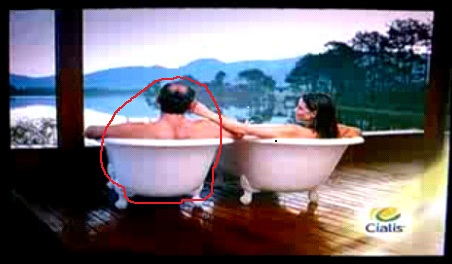
Cialis, a quaint seaside village:
For once, a VFYW that wasn't hard. I'm sometimes stimulated to search the net for an entry, but this time it just came. I hope you're able to open the photo showing that special spot from which the photo is taken. If not, let me know – I could always copy it from my hard drive onto a floppy disc.
Aaand another:
The geography and architecture are both 100% Oregon Coast, and the closest bridge resemblence I can find is the Yaquina Bay Bridge. I am going to guess Newport, OR, somewhere along SW 26th street.
Close. Another nails it:
This one was easy for an Oregonian! I guess I'm aiming for the fastest response prize, since I won the book two weeks ago. This is a view north from the deck of the Admiral's Suite, top floor at the Channel House B&B in Depoe Bay, Oregon. The bridge is a distinctive icon for people who know the Oregon Coast. The photo on their website shows the bathtub that is also seen in the VFYW image.
Another gets to that link through a different path:
Looking for "semicircular bridge" got me the phrase "arch span bridge". Googling "arch span bridge" got me to the Depoe Bay Bridge. Google-imaging the bay got me to Ellingsworth Street. Which I thought was pretty good, but my boyfriend pointed out that, with a little more sleuthing, we could probably zero in on exactly where the photo was taken. And ten minutes of clicking around later, we found this, which appears to be the room from which that photo was taken.
Another gets more detailed:
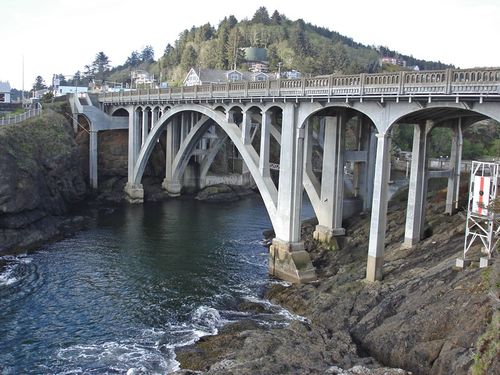
The bridge is a dead giveaway for anyone who has been to Oregon, as it bears the clean lines and arches that are the signature of engineer Conde McCullough, who designed a score of bridges for US Route 101, along the coast. A bit of image searching for his bridges, looking for one with the arch purely underneath the roadway, and running through a town, reveals this to be in Depoe Bay. Some Street View and hotel searching reveals the View to be from the Channel House Inn, 35 Ellingson Street, Depoe Bay, Oregon, 97341. Looking at the photos from the Inn's website, we find two suites that each have a hot tub on the balcony with a spout in the same configuration as in the View. These are the #1, the Admiral's Suite, on the top floor:
and #3, the Whale Watch suite, on the second floor.
Given the height of the View, looking across the roadway to the building on the other side, I would opt for the higher suite (#1, the Admiral's Suite). Photos by someone who stayed in this suite match up nicely to the View, even to the detail of the widths of the shingles. Here is a nice photo from outside, the red rectangle showing the openings that can be seen in the View of the balcony of the Admiral's Suite at the Channel House Inn:



Another:
This week's photo was obviously taken somewhere in the Pacific Northwest. At first I figured it would be located further south, maybe near Coos Bay, but after starting my map search at the south end of the state and working my way north, examining each coastal settlement with a smallish inlet and bridge close to the sea (Curry County, Coos County, Douglas County, Lane County…) I hit paydirt with the open-spandrel arch bridge at Depoe Bay. And though I was happy to not have been forced to run the same exercise going south (California is a lot longer N-S than Oregon!), I also kicked myself a little given my having driven over this span numerous times in the 20 years I've lived in Oregon. Here's another view of the same bridge taken from a similar (if somewhat lower) vantage point:
Another:
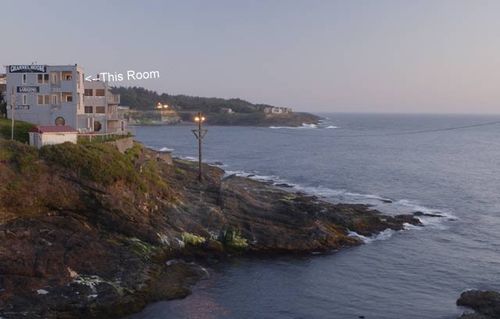
After spending more time that I'd like to admit scouring pictures and maps of the California coast, looking for that distinctive bridge that would seem right at home in Big Sur, we found the Channel House Inn in Depoe Bay, OR. An assist should go to Alaska's long days and interminable twilight, as we didn't realize just how late we were staying up, fixating on a photo.
The Channel House is at 35 Ellingson St, just off the channel to what the Depoe Bay Chamber of Commerce says is the "world's smallest navigable harbor." After perusing Tripadvisor reviews and some photos on the hotel website, we have come to the conclusion that the view is from the Admiral's Suite, located on the top corner of the north wing. (see photo). Or it could be the Whalewatch suite, beneath the Admiral's. But we're going to go with the Admiral's, and hope that the VFYW submitter was "CyberTrucker" or "BikerbabeofBend" who stayed in the Admiral's suite and also submitted some Tripadvisor photos. Here's our chosen window, looking back across the channel:
This may have been the easiest contest yet, consisting of more than 250 entries, the vast majority of them correctly answering Depoe Bay. But only a handful of readers have correctly guessed previous windows without winning, and their entries are seen above. Among them, the reader who has entered more contests than any other – about two dozen – is the winner this week: his initials are T.F.
Another reader:
Filmgoers should also recognize the spot. Depoe Bay is the site of the fishing expedition in One Flew Over the Cuckoo’s Nest.
More fun facts:
If local trivia counts for extra points, the Spouting Horn is just to the north, a geologic oddity on the rocky shoreline that, because of it's funnel-like shape, can shoot huge spumes of water up in the air during the storms that come rolling in every winter. Further local trivia: Depoe Bay used to be the (probably tertiary or beyond) summer home of Angelina Jolie!
Another local:
Just behind the pillar is a whale watching center where, if you are lucky, you can spot the spray from passing pods of Gray Whales.
Another:
My wife grew up south of there, and it is equidistant between where I hunt ducks to the south and pursue the rare chum salmon on the Kilchis River that flows into Tillamook Bay (home off the famous cheese) about 45 miles to the north. On the east side of the road lay about 20 tourist shops and Gracie's Sea Hag restaurant, which isn't the worst place for fish and chips and a pint after a rainy Oregon morning standing in a river.
Bonus footage of the bay we found while unsuccessfully searching for that scene from Cuckoo's Nest:
(Archive)
Why Marriage Matters
In one brutal story of a love interrupted and then erased from existence:
The video hit a nerve for Michael Fleck:
[Tom Bridegroom] [yes, that's his actual name!] had been with his partner, Shane Bitney Crone, for six years. They traveled together, lived together and started a business together. They lived in California, yet had never been married.
Unfortunately, Tom’s parents were not accepting of their child’s homosexuality or his relationship with Shane. When he died, all of Tom’s assets passed to his parents, even though to any outsider looking in, Shane was clearly his closest survivor. However, neither one of them had end-of-life documents. Shane had no legal right to any of Tom’s possessions, not even the ones with little monetary value, but exceptional sentimental weight. Nor was he able to hear firsthand from the doctor the circumstances of his partner’s death.
You can feel secure but without civil marriage, you aren't. So many of us learned this in the plague years – watching de facto spouses denied entrance to hospital rooms, thrown out of shared apartments by the spouse's family, denied access to the funeral, brutalized by those who never cared for someone until he died. I swore to myself then that this would be my life's work: to prevent such horror from happening again. We've made a start. But as this video shows, we are not close to the end yet. And that churches – churches – should be in the vanguard of brutalizing these people in this way – and justifying it - fills me with oceans of sadness. And grief again.
The Romney “Laugh”
Garry Wills is puzzled by it:
Everyone has noticed by now the non-laugh laugh of Mitt Romney, a kind of half-stifled barking. But what does it mean? It is blurted out as abruptly as it is broken off. Is it a kind of punctuation, part comma, part full stop, part interrogatory mark? What, if anything, is it trying to convey? Why does it seem more like coughing or burping than laughter?
Waldman decodes it:
[Romney’s] laughs in public almost always come when he’s been asked a probing question or finds himself saying something to which he thinks his audience will react negatively. That’s why the laughs are always so jarring, not so much because of their particular form (we all do a fake laugh for other people’s benefit now and again), but because they come at utterly inappropriate moments. They come when he ought to be grimacing, not laughing. That’s why when Mitt Romney laughs, nobody laughs with him.
Am I wrong to think there is also a Mormon angle here? Parker-Stone capture it here:
One gets the sense that Mormons, perhaps because they remain deeply insecure about their religion, make an extra effort to seem utterly great, happy, nice, genial human beings. Hence what’s been called “The Mormon Mask.” (More discussion of the concept here.)
Romney laughs that way; he also talks as if he’s learned the English language from some tribe of extremely cheerful, mainstream, extremely white Americans from around 1958. The reason the Parker-Stone treatment of Mormons is so hilarious (while also affectionate) is because it’s true. We don’t really know Romney and we can’t get a grip on his personality because he won’t tell us much about the most important thing in his life: his total dedication to the doctrines and practice of a Church that teaches that white people lived in America long before native-Americans and that Jesus visited them; that God the Father has “a body of flesh and bones as tangible as man’s; that humans can eventually become gods; and that the Garden of Eden and location of Christ’s second coming were and will be in the state of Missouri.
How to overcome the huge gap between what one believes and how the general culture would react if the details of his faith were fully explained? One option: The construction of a personality designed to mimic the least offensive, nicest, all-American persona. So Romney sounds and looks like a focus-group tested model president from 1965. But the focus group doesn’t exist – except in his own mind and manner every year of his life.
Perhaps that’s why we cannot seem to get through to the real Mitt Romney. He may have lost the ability to get through to it himself.
 The Dish