Is The Era Of Big Innovation Over?

Hierarchy of innovation-thumb

Justin Fox worries:

We have no colonies on Mars, we still can’t get by without prehistoric fuel, the dishwasher still doesn’t get all the dishes clean, and very few of us have personal jetpacks. You call this progress?

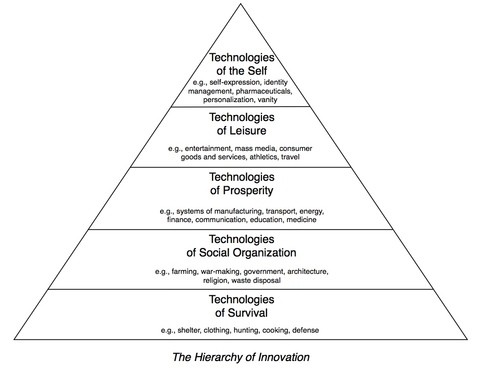
Nicholas Carr redraws Maslow's hierarchy of needs (seen above) and tempers Fox's concerns:

[A]s we move to the top level of the innovation hierarchy, the inventions have less visible, less transformative effects. We're no longer changing the shape of the physical world or even of society, as it manifests itself in the physical world. We're altering internal states, transforming the invisible self. Not surprisingly, when you step back and take a broad view, it looks like stagnation – it looks like nothing is changing very much. 

Is Food Poisoning Getting Worse?

More and more foodborne illnesses are resistant to antibiotics. A reason why:

An animal that routinely ingests antibiotics on a farm becomes a "factory" for drug-resistant bacteria, as described by a 2011 article in Clinical Microbiology Reviews. Huge farms known as CAFOs, for concentrated animal-feeding operations, may house as many as 160,000 broiler chickens and 800,000 hogs, a 2008 survey by the Government Accountability Office found.

These farms may pack animals like boxes in a warehouse: Hogs are kept in crates too small to turn around or lie down in, and laying hens are confined in cages the size of a sheet of paper. In badly run CAFOs, this overcrowding leads to filthy conditions that increase disease. When FDA inspectors examined Wright County Egg, an Iowa egg-production facility that likely contributed to almost 2,000 cases of salmonella in 2010, they found mice, flies, maggots and piles of manure up to 8 feet high.

The Perfect Counterfeit

Requires enormous skill:

The hardest features to forge with any level of sophistication are on the front of the note: the US Treasury seal, the large “100″ denomination in the bottom-right corner, and the united states of america at the top. Real US currency is printed on massive intaglio presses (intaglio is Italian for engrave). The force with which the presses strike the paper lying over the engraved steel plates creates indentations that fill with ink, giving the bills a delicate 3-D relief and a textured feel. Its absence is a telltale sign of a counterfeit. For [German artist and printmaker Hans-Jürgen Kuhl] this was the most critical puzzle piece: how to create that texture convincingly without the benefit of actual engraving.

The Daily Wrap

Today on the Dish, Andrew Eclipselegislators' English skills. We clarified the debate surrounding Romney's Bain days, worried about President Romney's cabinet, figured the GOP wouldn't cut spending, told Republicans to start paying more attention to Spanish-language media if they wanted to win, decoded polling on whether evangelical anti-Mormonism would hurt Mitt, declared Romneycare a success, watched a hyperbolic climate change denial organization implode, found an absolutely appalling anti-gay outburst, and didn't expect a truly gay president for decades. Ad War Update here.

Andrew also defended non-scientific means of knowing about the world, accepted the Dharun Ravi verdict, confessed his obsession with pageviews, told us about his fascination with a real reality show and Crystal Bowersox, and debunked Jose Rodriguez's narrative of the torture program (follow-up here). We checked in on Egypt's election, were afraid the liberals might have failed, noted an instance of settler violence, spotlighted a sad Palestinian story, tracked some absurd resupply lines in Afghanistan, and theorized that the rise of the BRICs might not be so bad for the US.

Inequality caused teen pregnancy, childbirth produced poverty, the rich had prettier cities, and labelling more people alcoholics wasn't necessarily a bad thing. Work sparked a civil war in your brain, parking spot tussles created a territorial response, creative thinking required forgetting purpose, sex/gender norms shifted our perception of straight relationships, and worms grew in brains. Lawns destroyed and Romans walked. Readers sent in beautiful eclipse pictures and a remixed Cold War film blew our minds. The Avengers appealed to our post-Great Recession psyches and readymade food grossed us out. Ask Tyler Cowen Anything here, Quote for the Day here, Yglesias Nominees here and here, Moore Award Nominee here, VFYW here, MHB here, and FOTD here.

Z.B.

A Life Observed

Philip Kitcher sounds off on the constraints of scientism:

Organisms are aggregates of cells, cells are dynamic molecular systems, the molecules are composed of atoms, which in their turn decompose into fermions and bosons (or maybe into quarks or even strings). From these facts it is tempting to infer that all phenomena—including human actions and interaction—can "in principle" be understood ultimately in the language of physics, although for the moment we might settle for biology or neuroscience. This is a great temptation. We should resist it. Even if a process is constituted by the movements of a large number of constituent parts, this does not mean that it can be adequately explained by tracing those motions.

Robert Krulwich explains the above video:

Science is our way of describing — as best we can — how the world works. The world, it is presumed, works perfectly well without us. Our thinking about it makes no important difference. It is out there, being the world. … The world knows. Our minds guess. In any contest between the two, The World Out There wins. 

Jerry Coyne pushes back against Kitcher's claim:

[Art and literature] function not to find out new things about our world, but to convey to others in an expressive ways truths that are derived from observation.  Of course the arts have other functions as well: they can enable us to see in new ways, for example.  Who can look at a lily pond the same way if you’ve seen Monet’s renditions?  And many of us are moved by Bach or Coltrane. But those aren’t ways of knowing—they’re ways of feeling.

It is indeed "scientism" to dismiss the real progress that has been made in history, archaeology, and other social sciences (though I’d be a bit hard pressed to identify real advances in economics). But few of us would deny that progress, so Kitcher’s form of "scientism" is in many ways a straw man.

I still maintain that real understanding of our universe can come only from using crude versions of methods that have been so exquisitely refined by science: reason combined with doubt, observation, and replication.  As one of my commenters said last week, "there are not different ways of knowing.  There is only knowing and not knowing."  I would add that there is also feeling, which is the purview of art.  But none of this gives the slightest credibility to religion as a way of finding truth.

Being moved by Monet cannot be about discovering something "true" about our lives? Religion ceases to have "the slightest credibility" with respect to the truth of the human condition because it has no scientific basis? History – a discipline with its own methods and questions – is not a pursuit of the truth of how things happened the way they did? To relegate of all these human modes of understanding to the supremacy of science is, well, to junk the whole of knowledge for a slice of it that can only measure empirical patterns. Science is a critical part of our understanding. It simply isn't and cannot be the whole. If that is all human knowledge is, it is pretty sad, and limited to the last few centuries out of 20,000. It consigns the human experience for the vast majority of our existence to condescending oblivion.

What we have to understand first and foremost is not what is out there, but who we are, with all the immense complexity that demands.

Will Anti-Mormonism Ever End?

Laurie F. Maffly-Kipp wonders:

Whereas in 1919 evangelicals could still use the recent legacy of polygamy to distinguish their behavior from those of the Mormons, by the 1970s Mormons seemed quite, well, conservatively Christian in their behavior. They touted wholesome family values, they supported traditional roles for women, and they practiced an admirable fastidiousness toward the use of coffee, alcohol, and cigarettes. … [Mormons] have practiced for a century, tinkering with the formula when necessary, and yet their efforts still don’t seem to be good enough for other Americans, who keep moving the bar in response.

A recent study argues that evangelicals may not care much about Romney's religion. Larison pushes back against it:

[T]he information in the “brief explanation” [of Mormonism] was as neutral in its language as possible. If one wants to assess the effect of Mormonism on how voters will respond to Romney, one needs to present respondents with the sort of information about Mormonism’s theological differences that they are likely to encounter in the coming months. For example, does it matter to these respondents that Mormons have a very different doctrine of God from that of orthodox Trinitarians? We have no idea, because they are never presented with that information, and according to the study’s report the vast majority of respondents was poorly-informed about Mormonism. Maybe it won’t matter, or maybe this is something that is already known and taken into account, but it can’t be measured unless someone asks the right questions. 

Ad War Update: Battle Of The Bain

Romney capitalizes on Booker's bipartisan disdain for negative campaigning: 

Undeterred, Obama is doubling down on the Bain attack. Mark Memmott tries to follow the melodrama: 

[A]n opening is an opening. So team Romney and his supporters focus on the "stop attacking private equity" part of Booker's comments and start firing back at the Obama campaign. Which prompts Booker to put out a video of his own, to say he thinks "President Barack Obama has done such a strong job as a leader of our nation that he more than deserves re-election." … That doesn't stop the Romney campaign from putting out a new video of its own, though. Called Big Bain Backfire, it uses Booker as one example of an Obama supporter who has "had enough" of the Obama campaigns tactics. And that brings us back to the Obama campaign, which as the Los Angeles Times says is doubling down on its Bain Capital-related story line with another, nearly six-minute long, video. Will the cycle ever stop? Probably only when one side decides it's time to focus on a new issue.

Here's the Obama campaign's latest: 

Maggie Haberman has more on the Ampad case: 

The story of the workers laid off by Ampad — who had to reapply for their jobs with smaller wages and benefits, only to see their Indiana plant close within a year — has been told to great effect in the past, particularly in Mitt Romney's 1994 U.S. Senate race against the late Ted Kennedy.  The company kept adding other firms to its rolls, amassing debt while several hundred workers were laid off between 1995 and 1999. The company went into bankruptcy in 2000, holding a debt load of more than $400 million. Bain's return on its $5 million investment was $100 million. 

But a final bankruptcy filing on the firm in last December also shows what happened to Ampad creditors. Out of a debt load of $170 million owed to unsecured creditors, Ampad ended up paying out less than $330,000, the filings show. That amounts to two-tenths of a cent for every dollar owed in that case. 

Alex Burns notes the trickiness of economic populism, which as First Read explains, plays "very well" in the Industrial Midwest: 

The challenge for the Obama camp is figuring out how to drive the Bain message without provoking a full-blown revolt among elites who matter when it comes to fundraising and the national-level media narrative. Because as First Read also points out, Republicans will now make a mantra out of the phrase: "Even Democratic Newark Mayor Cory Booker has called these types of attack unfair…"

Elsewhere, the RNC goes after Biden on coal. 

Previous Ad War Updates: May 18May 17May 16May 15May 14May 10May 9May 8,  May 7May 3May 2May 1Apr 30Apr 27Apr 26Apr 25Apr 24Apr 23Apr 18Apr 17Apr 16Apr 13Apr 11Apr 10Apr 9Apr 5Apr 4Apr 3Apr 2Mar 30Mar 27Mar 26Mar 23Mar 22Mar 21Mar 20Mar 19Mar 16Mar 15Mar 14Mar 13Mar 12Mar 9Mar 8Mar 7Mar 6Mar 5Mar 2Mar 1Feb 29Feb 28Feb 27Feb 23Feb 22Feb 21, Feb 17, Feb 16, Feb 15, Feb 14, Feb 13, Feb 9, Feb 8, Feb 7, Feb 6, Feb 3, Feb 2, Feb 1, Jan 30, Jan 29, Jan 27, Jan 26, Jan 25, Jan 24, Jan 22, Jan 20, Jan 19, Jan 18, Jan 17, Jan 16 and Jan 12.

Who Would Fill Romney’s Cabinet?

Dan Drezner is relatively unworried about Romney's insane foreign policy rhetoric because "statements on foreign policy are broken pretty easily, and campaign rhetoric melts quickly in the face of foreign policy realities." Drezner's main concern: 

The one way in which this might be interesting is whether someone like John Bolton winds up as Secretary of State.  Based on his United Nations ambassador days, and based on the near-delusional level of megalomaniacal egotism displayed in Bolton's memoirs, I'd argue that his appointment would make a difference in foreign policy outcomes.

The loudest signal emerging from the noise of Romney's foreign policy team is that Bolton's influence might be larger than I would have suspected.  The fact that Grenell was Bolton's spokesman at the UN, and that his Russia views sound like Bolton, are distressing signals.  The fact that one of Romney's concrete budgetary criticisms of the Obama administration this week was that, "[i]n 2010, 17 federal government agencies gave $7.7 billion to more than 25 United Nations programs, billions of it voluntarily," sounds… Boltonish.