Real Reality TV

Michael Apted's inspired Up Series of documentaries began with a group of seven-year-old British children more than half a century ago. The film crew checked in with the same individuals every seven years as they grew up. The latest installment, with participants now 56 years-old, aired in the UK last week. I've seen every one, and recommend them highly. A documentary series designed to chart the injustices of Britain's class system ended up being sidetracked by the sheer fascination of real people's lives. This is, in fact, the actual reality television – over a lifetime.

Jonathan Bell considers the series' place in our sharing culture today:

The subjects are guinea pigs for an experiment we’re all now conducting on ourselves, whereby our past selves remain constantly at our fingertips, informing our every move and shaping the way that we live our lives. They were the Neil Armstrongs of the self-regarding society, trusted with insight and self-knowledge unprecedented in the history of everyday life. … The internet is awash with long-term projects, a photo a day, a painting a day, now and then, then and now, rose-tinted nostalgia, wayback machines. The web is voracious in its desire to chronicle the world disappearing behind us. Perhaps the films mark the start of our collective quest to elevate the quotidian, to bring meaning to where there was once nothing. 

From Caroline Frost's review, the lessons reality teaches:

that, in the final tally, love is more important than money, that building foundations for your children is one of the most important purposes anyone can find for themselves, as Paul puts it, "teaching other people to care", and that anyone who, by the age of 56, has health and a tiny bit of wealth is basically doing all right.

More on the project here. Ebert talks with Apted about the project here. David Zweig explains why 56 Up, "insanely, anachronistically," is being aired only in the UK. Yep: insane.

Its humanity transcends culture, nation and class.
40 Percent Alcoholics? Ctd

The new mental health diagnostic guide may broaden the definition of alcohol abuse. Deni Carise calms fears:

[T]he new DSM will not cause more people to be diagnosed with addiction. Instead, more people who may not yet be addicted (but whose drug use is nonetheless problematic and unhealthy) will be able to access very inexpensive but proven effective treatment earlier and easier. Treating these folks is no different from treating those in the early stages of diabetes — it requires minimal professional help, some education, and simple lifestyle changes. We wouldn’t wait until a pre-diabetic started experiencing the symptoms of full-blown diabetes before we offered him or her help. Instead, we would intervene early in hopes of preventing such a difficult future. The same should apply for those with early substance misuse.

Keith Humphreys, meanwhile, argues that labeling risky behavior risky isn't a moral judgement.

When Will The Real First Gay President Arrive?

Jonathan Bernstein speculates:

Overall, I think that there are only light barriers right now in the Democratic Party, and anyone who wins a nomination is automatically a viable general election candidate.

On the other hand, we're not talking about a very large population to begin with. If issues of particular interest to their community recede in the future, it's hard to know whether gays and lesbians will be disproportionately drawn to politics or not. And even light barriers, if they work throughout the system, could make it significantly less likely that a viable candidate will emerge. So it wouldn't shock me, either, if it doesn't happen for decades.

The Great Healthcare Rip-Off

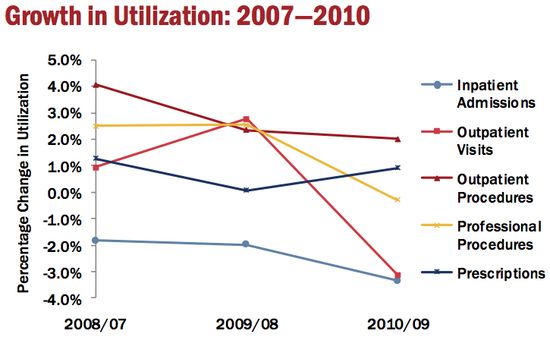
Growth-in-Utilization

We're not using more healthcare, as the numbers above show. But the price keeps going relentlessly up, as the healthcare industry in America increasingly marks itself as a private sector fantastically less efficient than the public sector. There's not even been an increase in the intensity of the care given:

The intensity of inpatient admissions increased only 0.7% from 2009 to 2010, whereas the intensity-adjusted price increased 4.6 percent.

I'm beginning to think the healthcare industry keeps on raising prices because, well, it can.

The Tyranny Of Pageviews

Ackerman confesses how much the numbers can mess with your head:

I know, I know: poor me. I only get to do what I love for a living, during an epochal collapse of the journalism industry and a Hobbesian economy, and here I go complaining Screen shot 2012-05-21 at 12.40.13 PMabout, essentially, the world ignoring my brilliance. Maybe the piece sucked. Maybe the story just wasn’t as good as I thought it was; or maybe it is as good as I thought it was and I did a bad job of telling it. Maybe I promoted the piece badly. Maybe everyone else had better things to do for the last 48 hours than read it.

But when you start seeing the actual, quantifiable statistics that are, in non-trivial ways, the results of your work, it’s a mindfuck.

You're telling me. A lot of us in this line of work were nerds in high school and college and were obsessed with grades. Most adults can leave such markers of success behind most of the time – but when you add traffic stats, low nerd self-esteem and the blogosphere together, it's a different story. Writers always want validation. Now they can have it in a crude and satisfying, if ultimately soul-destroying way. I find myself checking stats while waiting in line at Chipotle or in a doctor's waiting room – simply because I can. Even after 12 years and one of the most loyal readerships any blogger could ask for, I'm still insecure if we're down for the week, or month.

But Spencer is right, of course. That way lies madness. And certainly not quality. But what are you gonna do?

(Illustration: my daily crack, or a month's worth of daily visits and pageviews to the Dish via Sitemeter.)

When Settlers Attack

They have the police and Israeli military behind them, as this unsettling footage shows:

Some background:

The Palestinian Authority demanded an impartial investigation into the incident and action from the international community over settler attacks and provocation. "The gravity of the footage lies not only in the settlers' provocations and shooting live ammunition towards unarmed residents, but also in the irresponsibility of the Israeli soldiers who stood watching the events," said a statement from the prime minister's office.

The settlement's spokesman, Avraham Binyamin, was quoted in the Israeli media as saying its security squad came under a hail of stones while trying to extinguish fires lit by Palestinians. "It is clear that use of arms by IDF forces or the security squad was done in a tangible life-endangering situation," he said.

Villagers in Asira say attacks and intimidation by settlers from Yitzhar are routine. Yitzhar has a reputation for being one of the most hardline settlements in the West Bank. Israel's education ministry closed down a state-funded yeshiva (religious school) on the settlement last November after the security agency Shin Bet said it had accumulated evidence that students were engaged in acts of violence against Palestinian villagers.

Aren’t We All Culture Warriors?

David Sessions asks:

Often in both the media and among hip, moderate-to-liberal evangelicals, only the right fights the culture war. Conservatives are culture warriors, but gay marriage activists are not. Thus when the topic turns to “getting beyond the culture wars,” what is really meant is conservatives giving up or at least shutting up. We will get beyond the culture wars when the conservatives at least admit they’ve lost and decide to stop talking about this stuff so much. 

His larger point:

Deep down, I think describing serious political conflict as a “culture war” is part of the liberal allergy to vigorous debate; it tries to shove deep disagreements into a corner with some kind of label indicating that this is not welcome in “reasonable” discourse. “Culture warrior” is an epithet, used by the “sides” against each other and by bipartisan elites against all that shrill partisanship. But the reality is that certain issues like abortion, gay marriage, etc, are deeply divisive, and they symbolize and encapsulate dearly-held views about what is good and right in our country and the identities of people who hold those views. Despite what Washington pundits might tell you, people should have strong feelings about these issues, and they should fight about them. It’s called politics. 

It is, but the point is not that these issues should not be debated. It is that they should not define the entire political debate and the two parties.  Once that happens, politics becomes close to impossible because the deepest religious and experiential convictions – on both sides – are the hardest to mediate. Other Anglo-Saxon democracies have a slightly different way of dealing with this. In Britain, controversial social issues are invariably given a free vote in parliament so that individual deputies, on moral questions, can vote their consciences and not their party line. That both honors the importance of the debate, but also its intractability and its ability – unlike, say, how to finance health insurance – to make politics close to impossible. That's what makes the American conversation on this a "war", rather than a "debate".

The best American way on this is surely federalism, which is why Roe was such a premature disaster. I think playing these debates out in the states allows for greater diversity in a very diverse country, a means to understand better the experiment we are conducting, and a safety valve for all the passions these debates bring. Turning a war into an argument is the goal. And winning an argument is much more intellectually satisfying than winning a war.