
I should never say never. A reader writes:
Here's a pic of the eclipse seen on a garage door in the Bay Area. The leaves on a tree formed hundreds of pinhole cameras!
I should never say never. A reader writes:
Here's a pic of the eclipse seen on a garage door in the Bay Area. The leaves on a tree formed hundreds of pinhole cameras!
A reader writes:
Neither side gets the Bain story correct. Two concepts are missing from the conversation. The first missing concept is "Cash Cow." Bain did not target "troubled companies." Cash Cows, instead, are profitable, with good cash flows, but relatively-slow growth, and paying standard tax rates with few write-offs. The second missing concept is "Tax Arbitrage," which is, very simply, this:
You take the Cash Cow, paying, say, 30% in taxes, and use various strategies to drive the tax rate to near-zero without killing the cash flow. Then you pocket the 30%, and the investors pay lower capital gains and "carried interest" tax rates on those extracted "tax savings."
For roughly half of the companies receiving this "operation" will die because of the high debt and other obligations brought on by the Tax Arbitrage strategy. But you, the equity capital firm, get your investment out early. Half of the companies will prosper under this treatment (though not for existing employees who are outsourced or downsized), and you flip those to new owners for huge profits, taxed at capital gains rates.
This is NOT "Capitalism." This is manipulation of the tax code for profit for some, at the expense of others. Millions of Americans work for years for Cash Cow companies. Slow growth is not a sin; it is a reality in many businesses, and a good Cash Cow can provide employment and community stability to generations of workers and their families.
Glenn Carle – a former CIA interrogator, familiar with the Bush-Cheney torture techniques – exposes them one more time on Australian television. Start the tape 28 minutes in.
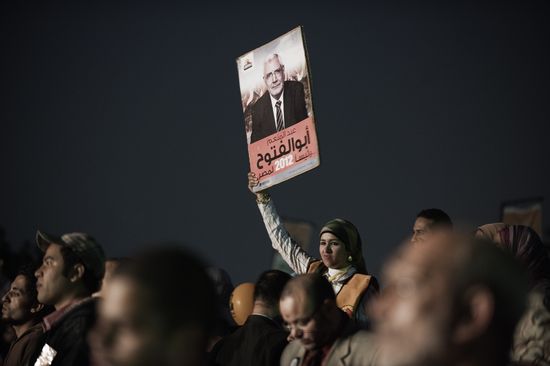
Shadi Hamid profiles Abdel Moneim Aboul Fotouh, the contradiction-filled Egyptian candidate propelled towards the presidency by a bizarre coalition of liberals and ultra-conservative Salafis:
[T]he same attacks that follow Aboul Fotouh's counterparts in Turkey and Tunisia will be used against him: that he is a proponent of "stealth Islamization" and that he remains faithful to the project of applying sharia. The critics might be right. If Aboul Fotouh becomes president, there will be a battle — between his liberal, revolutionary supporters and his Islamist backers — over the direction his presidency takes. Now that the major Salafi organizations have endorsed him, they are likely to have significant influence in an Aboul Fotouh administration, pushing his presidency to the right on social and moral issues. But though Salafists are a critical bloc of support for the Aboul Fotouh campaign, they have little presence in the candidate's inner circle and campaign organization.
Marc Tracy worries about the implications of an Aboul Fotouh administration for the Egyptian-Israeli peace treaty:
Aboul Fotouh has had some pretty dispiriting things to say about Israel and the Israeli-Egyptian peace. He has used Israel as a symbol of Moussa’s devotion to the old ways, challenging the former Arab League secretary to agree that Israel is the "enemy" (he wouldn’t) and even spread the false rumor that Moussa has an Israeli half-brother. Israel is a "racist state," he has said, the Camp David accords a "national security threat." There’s also the matter of Aboul Fotouh receiving the hardcore Salafists’ backing despite being further toward the middle on matters of mosque and state (more Brotherhood fatigue). Will President Aboul Fotouh keep the peace in Sinai? More likely, the military rulers will not give him the power not to.
Those not given to watching these events entirely through the prism of what's good for Israel might be cheered by the story in today's NYT. The Egyptians, it appears, have taken to democratic life with what can only be called verve:
Even at a cellphone shop, the store clerk was asking each customer to name their candidate of choice, said Shadi Hamid, the Egyptian-American research director of the Brookings Doha Center. "People are just obsessed," Mr. Hamid said. "Apparently, as we are finding out, Egyptians like to vote." Compared with Egypt right now, he said, the level of voter interest in the American election "is not even close."
(Photo: A female supporter holds up a placard of Egyptian former Muslim Brotherhood member and now presidential candidate Abdelmoneim Abul Fotouh, as she attends an elections campaign rally on April 2, 2012 at the Azhar park in Cairo. By Gianluigi Guercia/AFP/Getty Images.)

Pristina, Kosovo, 10.20 am
"So where has the idea that Shakespeare is "universal" come from? Why do people the world over study and perform Shakespeare? Colonialism. That's where, and that's why. Shakespeare was a powerful tool of empire, transported to foreign climes along with the doctrine of European cultural superiority. Taught in schools and performed under the proscenium arches built where the British conquered, universal Shakespeare was both a beacon of the greatness of European civilisation and a gateway into that greatness – to know the bard was to be civilised. True story," – Emer O'Toole, The Guardian.
Ezra Klein argues that a "world in which global growth slows so much that countries with three or four times our population never surpass the United States’s economic output is a world in which much is going wrong." Walter Russell Mead nods:
American power is committed to the concept that international relations is not a zero-sum game; it is about hunting for global win-win solutions. Many observers try to assess American power as if we were playing a zero-sum game in which every ounce of Indian, Chinese or Brazilian wealth or power somehow detracts from the United States.The failure to recognize this basic truth about American power is why so many analysts—basically going back to the 1940s—have so persistently prophesied American decline, even as the U.S.-backed international system has gone from strength to strength.
Jerry Weinberger distills one of Cowen’s key points:
Small mom-and-pop ethnic enterprises tend to enjoy what he calls a “cross subsidy”—that is, family members, masters of their cuisine, cook and serve for free. Such establishments are more likely to be found in outer suburbs or on the grungy side of town. That’s because rent, a fixed cost, is cheap in those areas, and that makes the food cheap. Again, that’s been known for a long time. But I’ve never seen it observed that from this principle, one can deduce that, all other things being equal, you’ll dine better in New York on an east-west street than on a north-south avenue.
Cowen promotes pockets of ethnic food in suburban strip malls. His experience shopping at Great Wall, a Chinese grocery store in Fairfax, Virginia:
The most striking difference, other than having lots of Chinese food, is how much of the store is devoted to greens. Once you push your cart through the door, those are the first things you see, and lots of them. They’re fresh and cheap, and there’s a more attractive selection than in any other area supermarket. … Once I started shopping at Great Wall, I began to eat more greens, and to enjoy them more. I never had to tell myself they would ward off cancer, make the earth a better place, help me lose weight, or ease animal cruelty. I wanted to eat them, and the purchases felt virtually free of charge, given the low prices. I could try any new and unknown green without investing much money.
But he offers two surprising foods on the rise in the DC area – hamburgers and pizza:
Right now, in this area, we’re at a very high plateau with ethnic food, which is great. I don’t see a single cuisine really on the march, the way Ethiopian food was in the 80s. Or Bolivian was about 10 years ago. But in terms of some transformative development, I’m seeing hamburgers, pizza and good fast food. The Chipotle revolution is turning out to be real.
Follow Tyler Cowen‘s work at Marginal Revolution and buy his new book, An Economist Gets Lunch. Earlier videos of Cowen here, here, here, and here. Video archive here.
"Despite repeated calls from other senators and myself, the Congress—both Democrat and Republican—could not bring itself to have a formal debate on whether the use of military force was appropriate in Libya. Meanwhile, the administration conducted month after month of combat operations in Libya, with no American interests directly threatened and no clear treaty provisions in play. The administration—which spent well over $1 billion of taxpayer funds, dropped thousands of bombs on the country, and operated our military offshore for months—claimed that “combat” was not occurring, and rejected the notion that the War Powers Act applied to the situation," – Sen. Jim Webb (D-VA).
The CIA chief who destroyed the evidence of his own torture sessions is still peddling untruths in defense of the indefensible. From a New Yorker interview with Ali Soufan:
There are now thousands of pages of declassified memos and reports that thoroughly rebut what Mr. Rodriguez and others are now claiming. For example, one of the successes of the E.I.T.s claimed in the now declassified memos is that after the
program began in August, 2002, Abu Zubaydah provided intelligence that prevented José Padilla from detonating a dirty bomb on U.S. soil, and identified Khalid Sheikh Mohammed as the mastermind of the September 11, 2001, attacks. Mr. Rodriguez has been repeating this claims.
The reality is that both of those pieces of intelligence were gained by my partner and me, with C.I.A. colleagues, in early April, 2002—months before the August, 2002, start of the E.I.T. program. But in the memos they were able to promote false facts, even altering dates, to make their claims work. In the so-called C.I.A. Effectiveness Memo, for example, it states that Mr. Padilla was arrested in May, 2003. In reality, he was arrested in May, 2002. But saying 2003 fits with the waterboarding narrative. When the Department of Justice asked Steven Bradbury, acting head of the Justice Department’s Office of Legal Counsel and the author of the 2005 O.L.C. memo to reinstate E.I.T.s, why he didn’t check the facts, he replied, “It’s not my role, really, to do a factual investigation of that.”
The claim about waterboarding leading to unmasking of K.S.M. as the mastermind of the September 11, 2001, attacks is similarly false. We got that information in April, 2002, before the contractors hired by the C.I.A. Counterterrorism Center even arrived at the site. One by one, the successes claimed by E.I.T. proponents have been shown to be false.
Once you have committed crimes of this gravity, there is a massive psychological need to justify them, and to buttress your legal defense against war crimes. If you have to lie to justify being a war criminal, you have to lie thoroughly. And you have to destroy or amend any evidence to the contrary. That's what Rodriguez has been doing, by destroying the tapes and changing the factual record. It's called obstruction of justice. It's also a crime.
But we live in a republic where the CIA is not considered governed by the rule of law – an alarming situation which has been legitimized by president Obama. In that sense, the CIA is a state unto itself. It is another country.
(Photo: Anti-Iraq war protesters act out water boarding torture on March 19, 2008 in front of the White House in Washington, DC, during a demonstration. By Nicholas Kamm/AFP/Getty Images.)
 The Dish