Three studies showed that drivers leaving a public parking space are territorial even when such behavior is contrary to their goal of leaving. In Study 1 (observations of 200 departing cars), intruded-upon drivers took longer to leave than nonintruded-upon drivers. In Study 2, an experiment involving 240 drivers in which level of intrusion and status of intruder were manipulated, drivers took longer to leave when another car was present and when the intruder honked.
Month: May 2012
A Side-Effect Of Poverty
Teen pregnancy:
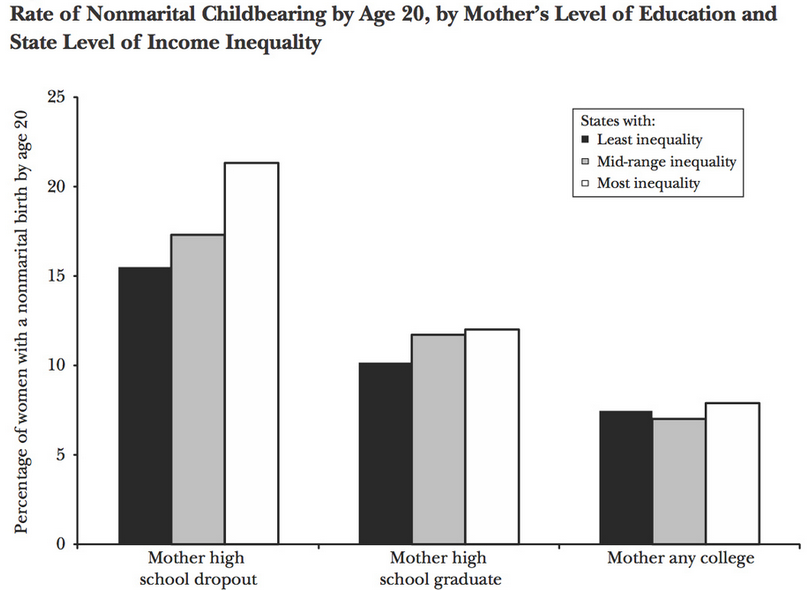
A new study by economists Phillip Levine and Melissa Kearney suggests that income inequality is a major cause of teenage pregnancy. Yglesias summarizes:
Where poor people can see that hard work and “playing by the rules” will reward them, they’re pretty likely to do just that. Where the system looks stacked against them, they’re more likely to abandon mainstream norms. Those who do so by becoming single teen moms end up fairing poorly in life, but those bad outcomes seem to be a result of bleak underlying circumstances rather than poor choices.
Anna North calls for a real solution:
Really, they say, teen pregnancy is more of a social problem than a sexual one. And the best way to solve it isn't to target pregnancy directly, as sex education programs try to do, but rather to improve girls' lives as a whole. … This might seem like a bipartisan solution, since it requires neither preaching abstinence nor handing out condoms. But, says Levine, there's a problem: "Buying condoms is a cheap solution. Abstinence-only is really cheap. Improving life chances is not."
Millman wants more research on how we can reduce poverty:
I’m already sold on the idea that economic aspiration is the key to keeping poor girls from getting pregnant. But how the government can successfully promote that kind of aspiration is not something we agree on the answer to. We need more data – from more experiments.
Will Wilkinson draws a different lesson:
Perhaps we'll be less eager to combat teen motherhood now that we understand that it doesn't much harm the economic prospects of the young women most likely to go in for it. My own reaction to this news is to wonder whether it isn't cruel to try to discourage relatively poor teen girls from seeking the comforts of motherhood, if motherhood won't hurt their prospects. If we set aside as ill-founded our paternalistic economic motivations to reduce rates of teen motherhood, only the impulse to discourage the proliferation of those people and/or that culture seems to remain. I'm not comfortable with that.
Your Brain On Work
Jonah Lehrer summarizes the findings of a new study on willpower:
[This study helps] us map out the individual differences that make it slightly easier for some people to engage in hard labor. These diligent souls seem to get a bit more pleasure from the possibility of reward, but they also seem less sensitive to their inner complainer, that disruptive voice reminding them that minesweeper is more fun than editing, or that the ballgame on television is much more entertaining than their homework. At any given moment, there is a tug of war unfolding in our head, determining whether or not we’re willing to put in the effort. This sentence only exists because, for a few minutes at least, I was able to win the war.
Entry Denied
Randa Jarrar, an American of Palestinian descent, discovers she can't visit her sister in Ramallah:
I had deleted anything on my website critical of Israel, which amounted to about 160 posts. I had deleted the section in my Wikipedia entry that said that I was a Palestinian writer. It had been unsettling, deleting my Palestinianness in order to go back to Palestine. I had been told that the Israeli officers might confiscate my phone and read my Facebook posts and Twitter feed, so I temporarily deactivated my Facebook account and locked my tweets. The entire endeavor left me feeling erased.
But all that didn't allow her entry, since there is still a Palestinian ID attached to her name.
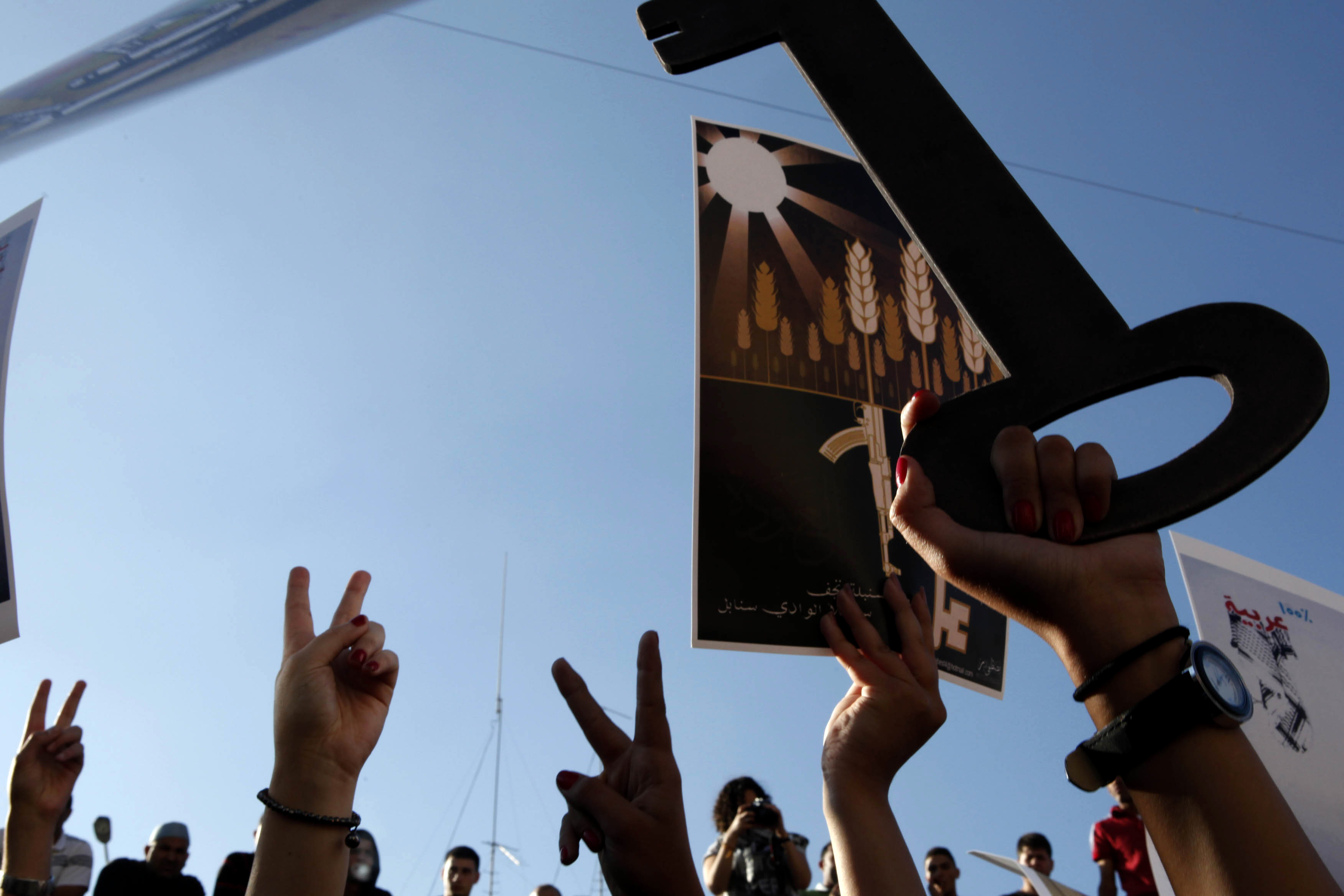
(Photo: Palestinians flash the victory sign and hold symbolic keys of homes that were snatched when the state of Israel was created in 1948, during a protest outside Damascus gate in Jerusalem's Old City on May 15, 2012 marking Nakba day, which commemorates the exodus of hundreds of thousands of Palestinians after the establishment of Israel. By Gali Tibbon/AFP/GettyImages.)
Yglesias Award Nominee
"This kind of stuff is nauseating to me on both sides. It's nauseating to the American public. Enough is enough. Stop attacking private equity," – Newark mayor Cory Booker (D), criticizing the anti-Bain ads launched by the Obama campaign against Romney. Booker kept up the pressure on Twitter.
Our Tower Of Babel, Ctd
A reader writes:
You quote Robert Bellah:
"The more complex, the more fragile. Complexity goes against the second law of thermodynamics, that all complex entities tend to fall apart, and it takes more and more energy for complex systems to function."
Utterly untrue. Bellah is making the fundamental mistake of confusing the fate of the individual entity with the fate of the larger dynamic system of which it's part. A quick glance at the overall arc of the 4.5 billion year evolution of life on earth shows the inevitable march of complexity. Complexity does not "go against" the second law, any more than does the metabolism of your individual body—it uses it, through a related, albeit higher-order mechanism, to advance higher and higher stages of self-organization.
More complex systems are in fact far more efficient in their use of energy than less complex ones, which—from the thermodynamic perspective—is precisely what drives evolution (biological, social, technological and mental). Dawkins might not like it, but from the system's science perspective, evolution is not directionless: Increasing complexity is built into the fabric of the universe.
Bellah not only has it deeply wrong on the science, he has it deeply wrong on the implications for philosophy; at least to judge by this short snippet you quote: more complex is not more fragile, it is more robust.
His outlook reads as dour and pessimistic. That's not the world as it is—that's Bellah's projection onto it, based on a deep misreading of the interplay of thermodynamics and biology. The truth may be something almost 180 degrees different—something much more akin to Malick's vision in "The Tree of Life:" not only is the evolution of biological complexity inevitable, given sufficiently propitious initial conditions, so is the evolution of mental, emotional and spiritual complexity—including consciousness, empathy, compassion, and grace. To cite Einstein, "The most important decision we make is whether we believe we live in a friendly or hostile universe."
Bellah's science—again, to judge by a very small snippet—is inherently hostile, at least from our human perspective. Were his science right, we would all perforce become mid-50's French existentialists. But it's not. The applicable science is in fact friendly—I would say, grandly, magnificently friendly, even if, from the individual human perspective, humbling, awe-inspiring, or, like Krishna in his cosmic form, or Yahweh in the whirlwind, sometimes terrible to behold.
Who Is Christwire For?
Rob Trump wonders:
There are two opposing things going on at Christwire, and both are fascinating. On the surface of Christwire are the extreme, exaggerated viewpoints that signal a satire of conservative Christianity. This might lead you to believe that [creators Bryan Butvidas and Kirwin Watson] are left-leaning and nonreligious. But they’re not, as the Times originally reported; both identify to some extent as Christian. Which might, if you had missed it before, help flesh out the other level on which Christwire operates: as a satire of those whose opinions of Christians are so negative that they’re completely blind to exaggeration and humor, and willing to accept anything about the side they hate. On Christwire, pretty much nobody comes out looking good.
One of the site's longest-running writers offered his take:
I'd like to think that our ideal reader is the type of liberal who is prone to knee-jerk self-righteousness, quick to be offended by anything that goes against what his college professors and Facebook friends are parroting on a daily basis. He's the type who reads a headline and maybe a sentence or two before posting his outrage to Tumblr and Twitter. He's the sort who only believes in Freedom of Speech when it applies to the things he already believes in. I think this is a real intellectual problem for young people today. They just can't understand the idea that freedom means living around ideas you despise.
Getting Merkel To Fourth Base
Niall Ferguson guesses Europe's greatest power will soon acquiesce to the inevitable [pay-walled at the Sunday Times]:
It is still possible that the game of chicken between Athens and Berlin ends with the two cars colliding. But my sense is that both will swerve at the last minute — the Greeks because they see the costs of exit would be catastrophic for them, and the Germans because — if they don’t realise it already, they pretty soon will — the banking crisis that this would unleash as deposits fled the periphery would be highly destabilising for the whole eurozone, Germany included. The Greeks say, ‘We’re not going to comply with our commitments’. The Germans say, ‘Then you’re out’. They’re both bluffing. … I think that’s one of the reasons Germans will swerve in this game of chicken, because anything that threatens monetary union is pretty threatening to German business . . . Germans are going to have to make some kind of concession to the periphery. It’s not enough just to say ‘austerity, austerity’.
In some ways, you can see the current crisis as a critical error in the construction of a united Europe. On the other hand, you can see it as a necessary step, implicit in the very beginning of this stealthy attempt by European elites to corral their populations into a new super-state. How to talk the German electorate into the final product:
Here’s the choice, Mein Herr. You accept the logic of the Mitterrand/Kohl era, which always was ‘we’re having monetary union in order to get to a federal Europe’ . . . The logic of the 1990s was that ‘monetary union will force us to evercloser fiscal union, which is hard to sell politically, but we’ll make it happen — we’ll back into it through a monetary union’. That always was the model — which was one reason for being against it as a British Eurosceptic. Now we’re at the moment of truth when you can no longer maintain the fiction that a monetary union can exist independently of a fiscal union … On the other hand — and this is the message to Angela Merkel — to use George Bush’s phrase: this sucker’s going down. We’ve reached that point.
I agree with Niall. In the end, Germany has to surrender, or face catastrophe. And when it surrenders, it will de facto be the unwilling but indispensable power-center for a newly integrated United States of Europe. And what will Britain do then?
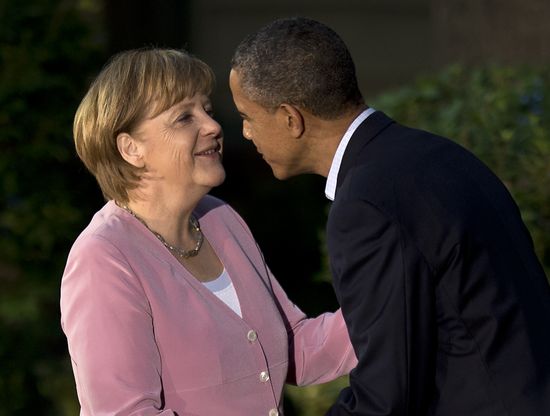
(Photo: US President Barack Obama greets German Chancellor Angela Merkel upon her arrival at the Camp David presidential retreat in Maryland on May 18, 2012 for the G8 summit. By Brendan Smialowski/AFP/GettyImages.)
What Drives Anti-Gay Crusaders?
Some thoughts from yours truly.
 The Dish