Auden’s Documentary On America

From the annals of little known Auden facts: did you know there was a distinguished set of documentaries he helped write and produce, including one about America? Can you imagine anything like this happening today:

'U S' concentrates on the dark past of the modern Republic – the appropriation of Native American lands, the forced migration of slaves from west Africa and the condition of their descendants as a contemporary underclass. It is a serious, thought-provoking and confrontational piece, entirely free from shallow feel-good rhetoric. This willingness to examine social failings, reminiscent of the GPO's 1930s documentaries exposing housing problems and malnutrition, comes from a time when America was confident enough to be self-critical.

Here is part of Auden's verse commentary for the sequence entitled 'Devastation of our natural resources':

The marvellous machines we have made obey us,
And couldn't care less for the consequences:
Nothing good or evil can happen to them.
If we want it that way, they will lay waste the earth.
Loot the land and leave behind them
An irredeemable desolation.
Yes, we are free in our greed to let poisons
Befoul the streams till the fish die,
Discommodate cities, turn smiling fields
Into junk graveyards and garbage dumps,
Let noxious effluvia fill the air, polluting our lungs.

Lady Bird Johnson, wife of the president, saw the film during her visit to the HemisFair on 6 April 1968, two days after the assassination of Martin Luther King. Her husband remained at the White House during the ensuing period of widespread protests and rioting. She was predictably appalled and delivered her verdict through clenched teeth: 'very artistic, very stirring, but it lack[s] the element that is going on today to provide balance – the element of hope.' Auden had anticipated the inevitable reaction with relish: 'Now we've made a subversive film for the US government', he told the director.
The Line Between Science And Magic

Eric Scott watches The Avengers for religious overtones:

The worldview of these films is grounded in the materialist philosophy embodied in the first one in the series, Iron Man, a world where everything is ultimately attributable to super-science. Even Thor, overtly based in myth, attempts to hand-wave the magic away by invoking Clarke’s Law (namely, that any sufficiently advanced technology will seem like magic to an outsider’s eyes). Finding a way to meld that science-fiction mindset with the fantastic world of myth has caused enough friction for the series; reconciling it with real-life religion may simply have been too much to ask.

Adam Frank appreciates the film's adherence to Clarke's Law:

[T]he mysterious "Tesseract" driving The Avengers plot is either a divine artifact of great power or a cube containing that most scientific of entities — Dark Energy. Likewise the portals between distant parts of this fictional universe are either the "Rainbow Bridges" of ancient myth or wormholes of modern general relativity. While excellent science advising is one reason these story elements are so engaging, it's the willingness of the series creators to stay within the lines they've drawn for themselves that is just as important. The reason why these lines matter is simple. We already live in a universe with rules.

More on The Avengers here, here and here.

Quote For The Day

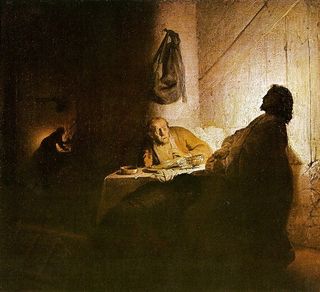
"Memory is the sense of loss, and loss pulls us after it. God Himself was pulled after us into the vortex we made when we fell, or so the story goes. And while He was on earth He mended families. He gave Lazarus back to his mother, and to the centurion he gave his daughter again. He even restored the Rembrandt_emmaus-opensevered ear of the soldier who came to arrest him — a fact that allows us to hope the resurrection will reflect a considerable attention to detail.

Yet this was no more than tinkering. Being man He felt the pull of death, and being God He must have wondered more than we do what it would be like. He is known to have walked upon water, but He was not born to drown. And when He did die it was sad — such a young man, so full of promise, and His mother wept and His friends could not believe the loss, and the story spread everywhere and the mourning would not be comforted, until He was so sharply lacked and so powerfully remembered that his friends felt Him beside them as they walked along the road, and saw someone cooking fish on the shore and knew it to be Him, and sat down to supper with Him, all wounded as He was.

There is so little to remember of anyone — an anecdote, a conversation at table. But every memory is turned over and over again, every word, however chance, written in the heart in the hope that memory will fulfill itself, and become flesh, and that the wanderers will find a way home, and the perished, whose lack we always feel, will step through the door finally and stroke our hair with dreaming, habitual fondness, not having meant to keep us waiting long," – Marilynne Robinson, Housekeeping.

(Painting: the revelation at Emmaus, by Rembrandt.)

Our Tower Of Babel

As the global economy groans under its own political contradictions, and as the planet endures unprecedented abuse by humans, this passage from Robert Bellah's Religion In Human Evolution sticks in the mind:

Simplicity has its charms. Some relatively simple organisms have survived in more or less the same form for hundreds of millions of years. The more complex the species, the briefer its life. In some cases this is because species have changed into even more complex forms, yet extinctions have been massive. There have been several species of the genus Homo; now there is one. The one remaining species may be partly responsible for the extinction of its last remaining relative, the Neanderthals. The more complex, the more fragile. Complexity goes against the second law of thermodynamics, that all complex entities tend to fall apart, and it takes more and more energy for complex systems to function.

Better Cinematic Sex

Elaine Blair argues it's happening on Lena Dunham's "Girls", referencing a scene where the male character climaxes on Dunham while fantasizing she's a heroin-addicted 11-year-old girl :

Hollywood sex scenes are not typically interested in even hinting at the ways that people actually reach orgasm, and this is disheartening above all for female viewers, who develop a certain melancholy by the time that they have seen their one thousandth sex scene in which it is taken for granted that by sex we mean mutually rapturous face-to-face vaginal intercourse. Even though the only person having fun in Dunham’s scene is the guy, there is nonetheless a certain joy in seeing someone get off in some other way.

In a New York Times interview Dunham has spoken, apropos of this scene, about her male peers’ saturation in pornography, and about her own suspicions, in some intimate situations, that her partners were mimicking gestures that they had seen online. But if Adam is meant to be obviously under the influence of porn, and his moves echo a staple porn sequence, what Dunham has done with the scene suggests that pornographic convention can actually be an antidote to a certain kind of prudish Hollywood bias.

The explicit sexual nature of the show might explain why 60% of its audience is male. More analysis of "Girls" here and here.

(Video: A scene from Lena Dunham's film Tiny Furniture)

“Why That Cute Girl At the Bar Isn’t Smiling At You”

A recent study suggests that we always think smiling faces are meant for us but angry faces aren't. One explanation why:

From an evolutionary standpoint, it makes sense that we would think happy faces are directed toward us. Having such a bias would increase interactions with potential mates and lead to a higher chance of procreation. What makes less sense is the tendency to think angry faces are directed away from us. Protecting yourself from danger is nearly as crucial as mating, and therefore it would seem adaptive to overestimate the number of angry faces looking in your direction. If that big Neanderthal from the other tribe seems to be scowling at you, you should probably just assume he is and get the hell out of there. My guess would be that the tendency to think angry faces aren’t directed toward us is a result of more recently evolved emotional management skills. In the long run you’ll probably be happier if you assume all the fearful and angry faces you see have nothing to do with you.

A Poem For Saturday

Screen shot 2012-05-16 at 10.11.15 AM

Twitter user @Pentametron is gathering iambic pentameter tweets:

Meet Pentametron. He’s a robotic Twitter account, but he’s not part of the spam variety – he turns tweets into Shakespeare-like poetry, using an algorithm to seek out and retweet the most poetic of our 140-character musings.

Creator Ranjit Bhatnagar explains how the algorithm works:

If it knows all the words, it checks the [Carnegie Mellon University dictionary] dictionary for the stress patterns of the words, which add up to the rhythm of the tweet. If the rhythm seems to match the pattern of iambic pentameter, the tweet goes into a bin of potential lines of poetry. On average, about one in every 50,000 tweets qualifies.

Bhatnagar takes inspiration from the the surrealists, but with a modern spin:

It's fascinating to me that on the internet of free phone and video calls, one of the most popular sites just moves words around. Lots and lots of words. One of the goals of Pentametron is to show how weird and interesting this giant flood of language is.

The Sounds Of Aronofsky

The famous director's films are recut into a symphony of sounds:

Forrest Wickman analyzes:

These extreme close-ups and equally magnified sound effects are most well-known from Requiem for a Dream, in which they’re used to parallel various kinds of addiction (not just hard drugs but others like television and coffee), and this cut is particularly heavy on inserts from that film. It’s lighter on shots from Black Swan and The Wrestler, for which Aronofsky largely reinvented his style. But the video makes clear that Aronofsky didn’t do away with these techniques completely. Regardless of the differences, I agree with what the last shot seems to suggest about these effects: They’re all pretty transporting.

Madame Mike

Michael Merriam recounts what it's like to man the desk at a DC brothel:

The closest we ever came to getting busted was when a dominatrix named Erin sat smoking on the porch, in full regalia, and ashed onto the neighbor’s lawn. He saw her do it and asked her not to. "Fuck you," she said (she’s a dominatrix), and the authorities became involved. But they didn’t have much interest in getting too involved. The cops don’t want to bust prostitution, really.

A vice cop once gave me a seminar, of sorts, on how not to get arrested for vice. If, say, your client is giving you some kind of problem, and you fear for your safety, and you really need the police, this is what you say: You met this guy, you liked him, you went home with him, he started the problem. The cop will know you’re lying, but he has more interest in arresting your assailant than in arresting you. Thus the vice squad is refigured as a sort of immune system, as the very force of differentiation between actual vice and, you know, the gold-hearted hooker and the charming scamp.