Is OWS Over?

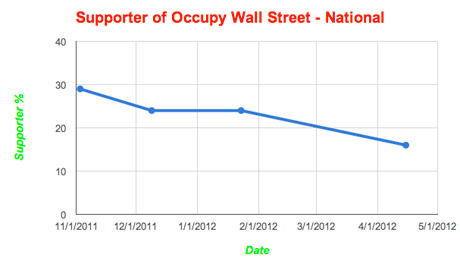
Occupy Wall Street is hemorrhaging support:

OWS_Support

Walter Russell Mead pens an obit:

Despite generally favorable coverage from the MSM (something the Tea Party has never had), OWS has essentially fallen apart. It is not a significant presence on the streets; it is not a significant presence in Democratic Party politics; it is not a significant presence in the national conversation. Its vaunted strategy of shunning conventional politics in favor of self organizing groups making decisions from day to day more or less evanesced into space while the Tea Party, equally anarchic, did in fact spawn the kinds of movements and political changes that the OWS crowd did not.

Eyeing The “Grexit” Ctd

Carsten Nickel calms fears that Greece's departure from the Euro is imminent:

If and when it becomes inevitable, the Germans will offer concessions to keep Greece in the club. As a measure of Merkel's flexibility, consider how many agenda items now under discussion appeared to have been ruled out months ago: Talk of a European growth agenda will launch at the Brussels summit in late May, and the Bundesbank has now hinted that it could accept a German inflation rate slightly higher than the eurozone average as part of a macroeconomic adjustment process. Once Greek elections are behind us, Germany might well offer concessions on the timing of the Greek bail-out program.

Berlin calculates that a combination of eleventh-hour German flexibility and rising Greek fear of the potentially catastrophic consequences of Euro exit will persuade Greek voters to back a government that will accept the central German demand: That European financial help will continue to depend on Greece's willingness to push forward with structural (and painful) reforms.

Connecting The Dots

144566528

I was struck by the juxtaposition of two stories on the NYT front page today. The lead story is the shift in America's racial make-up toward a minority-majority country:

Whites Account for Under Half of Births in U.S.

The second is a Republican Super-PAC aiming to target "Barack Hussein Obama" as a radical, anti-American racist:

G.O.P. ‘Super PAC’ Weighs Hard-Line Attack on Obama

This is the great unspoken drama of American politics right now – and has been for a while. In a world of economic distress, where a globalized economy gradually eclipses any single country's ability to control its own economic destiny, and when multiracial immigration tears at the cultural identity of nation states, it is utterly predictable that more atavistic strains of nationalism will emerge. Across Europe, the hard and far right is gaining, as the center buckles. In America, the fervor behind shutting down Mexican immigration is occurring just as that immigration has slowed to a trickle or begun to reverse itself.

And the Tea Party, utterly indifferent to massive spending in good times by a Republican, had a conniption at a black Democrat's modest measures to limit the worst downturn since the 1930s. Conniption isn't really he right word: this was a cultural and political panic in the face of a president who was advocating what were only recently Republican policies: tax cuts, Romneycare on a national level, cap-and-trade, a W-style immigration reform, and a relentless war on Jihadism. They reached back to a time, when there were only three kinds of Americans – native, white and slaves. They even wore powdered wigs.

To ignore this cultural turmoil is to miss the forest for the trees in this election. No one represents the new and future America more clearly than Obama: a mixed-race, pro-immigrant, pro-gay pragmatist. And Romney's great strength in this election is that he looks and speaks and acts like a generic American president from the 1950s.

His Mormon faith adds heft to his American brand (Mormonism is more purely American than any other branch of Christianity and until recently, was rooted in white, racial superiority.) His style is comforting, even as his policies (so far as we can glean them at all) are more radical than any Republican in decades. (He is, for example, far to Reagan's right on entitlements, taxes and spending, as well as on immigration.) His slogan is: "Believe in America." Not too subtle, is it?

Expect the subtext to become text in this election. Look at the currents that push more powerfully than the surface's waves and ripples. Are we afraid of this future? Or eager for it? I'd say it's about 50-50 right now, but the passion this time lies with the resistance and the fear. Which is why I have come to think that, unless the future America turns out this year in the vast numbers they represented in 2008, Romney is the favorite to win this election.

(Photo: U.S. President Barack Obama signs his receipt for David Mazza and Casey Patten, Co-Owners of Taylor Gourmet, while visiting Taylor Gourmet, a sandwich restaurant May 16, 2012 in Washington, DC. By Win McNamee/Getty Images)
“How I Learned My Husband Was Gay”

A reader writes:

Andrew, I've been reading your blog for about three years and feel like you're someone who can understand how I'm feeling right now. My ex-husband and father of my two oldest sons passed away of kidney cancer last November. We had been divorced since 1984 and hadn't spoken for the last ten years. He was my first love – I was 17 and he was 24. We married six months later. The first year was the happiest. I gave birth to our first son two years later and another two years after that. By the tenth year it was over.

The first hint I got was from my Mom; she called to tell me she read his obituary in the paper and wanted to know why the memorial service was being held in a "gay church".

I laughed and told her that "churches can't be gay". She just said that that was what she had heard. I didn't think anything else about it until my oldest son came home for the service and during dinner I jokingly repeated what my mom had said expecting my son to laugh along. He didn't laugh. He looked down and said "Mom, there's something I have to tell you: Dad was married to a man for the last five years of his life."

At first it wouldn't sink in. I couldn't even process it much less believe it. I protested that there was no way he could have been gay; we were young and in love and he had a wife before me and one after me!

It took a few days, but then the memories started flooding back – the times he would disappear and I wouldn't know were he was. The coldness when I questioned him about where he had been. How he could be such a good husband and father most of the time and then a complete stranger at other times.

When I finally left after ten years, I didn't even know why – I just knew something was missing in our relationship. I still had feelings for him and wanted it to work but when I tried to explain to him how I felt he could only reply "Well, I kept a roof over your head and you never missed a meal". I wanted us to stay friends, but he was so angry with me it was impossible. For years I felt guilty, responsible for breaking up our family. When he married his third wife I was relieved and happy for him. After 15 years he left her and had a girlfriend that my sons described as a "skank". They were relieved when he broke up with her and moved in with a "room mate".

The gay marriage debate lately has had me thinking about him again and feeling so sad. How he tried so hard to fit into the mold society demanded and how much emotional pain and turmoil caused to all our families when he couldn't.

I always thought gays should be allowed to marry but didn't think it affected me personally. Now I know better. This is why we, as a society, must love and accept everybody the way they are and not the way we demand they be. I can't regret loving him because of the wonderful sons we have. I only regret not being the one he could trust with the truth of his life.

I'm crying now writing this. It's been 38 years since we married, 28 since we divorced and six months since he died, and I am still trying to finally have some closure.

This is the flipside of the social conservative debate. One of the great threats to successful marriage in this country is the way in which fundamentalism and homophobia coax gay people into straight relationships which are, at root, based on a lie. The human pain and wreckage this causes – to both gays and straights, and especially children – is immense. Yet so many on the right seem not to care or even notice. They just want us to disappear. It was so much easier when we didn't so obviously, you know, exist.

The Confidence Of Obama Fans

It baffles me, but most Americans, and the overwhelming majority of Democrats, believe that Obama will be reelected. Charles Blow sees this as good news:

It highlights the ever-present Republican anxiety and unease with the candidate they have. How skewed is this difference in confidence? The poll found that Republicans are twice as likely to believe that Obama will win than Democrats are likely to believe that Romney will win.

Quote For The Day I

"Written by Andrew Sullivan, an advocate of homosexual behavior, ["The First Gay President"] is somewhat misleading in the way it frames the public’s view on marriage in this nation," – Alan Sears, NRO.

I fairly and accurately reported on poll findings, replicated by several different polls, showing a big shift in public opinion over the last three years. But what, one wonders, is "homosexual behavior"? Interior design? Flag football? Saving The New Republic? Losing a limb as an active duty soldier? Taking care of a spouse when he's sick?

The Paranoid Right’s Obama

This is going to be one ugly campaign, as every billionaire with a grudge against the president unleashes truck loads of propaganda to defeat him. Paul Waldman highlights two anti-Obama films, including Dinesh D'Souza's (trailer above):

If Obama wins, he'll go through his second term, doing things that these nutballs will certainly disagree with. But the hammer and sickle will not be raised over the White House, private enterprise will not be outlawed, and we won't all be herded onto collective farms. And then what will they say? They certainly won't say, "Well, maybe we overstated things a little."

For a satisfying brutal takedown of the book upon which D'Souza's film is based, see Andrew Ferguson at The Weekly Standard. But note the scene at 1.08, where a black family is fighting over a Monopoly game, followed by white people holding candles. This is about rescuing white America from a black president. That's all it is. And it's as vile as it is potent.