There may be more to the somewhat different responses to last week's big marriage news by Glenn Greenwald and yours truly. Here's an insightful little post that helped me understand it.
Month: May 2012
The Franco-German Relationship – In 40 Seconds
An awkward dance:
That little German nudge, just short of a shove, is priceless.
Mary
It's been a long, long time. But I knew Mary Richardson in Boston in the 1980s. She was one of sweetest, most compassionate people I met in those years, standing out in the Kennedy entourage for her vast swoosh of long black hair and bubbly charm – as well as what was clear then as it is now: a vulnerability. I am not surprised she became, by all accounts, a superlative mother. May she finally rest in peace, and may her children find a way to survive the darkness into which they have now been plunged. Depression is a terrible thing. As is addiction.
The Execution Of An Innocent Man?
A new and comprehensive report on a very troubling case in Texas.
The Photography Of Newsweek
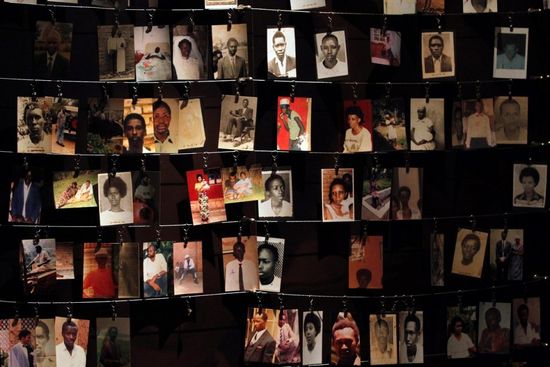
A new tumblr. The magazine's picture department is letting its resources spill out onto the web. It's an intoxicating melange of imagery and history. (And no, no one asked me to say that. I just think it's cool.)
(Photo: Photographs of people murdered during the 1994 genocide are displayed at the Kigali Memorial Center. By Dai Kurokawa/EPA/Landov)
A War That Would Spawn More War
A new RAND report comes out strongly against striking Iran. One snippet:
[A] post-attack Middle East may result in the worst of both worlds: a nuclear-armed Iran more determined than ever to challenge the Jewish state, and with far fewer regional and international impediments to doing so. Thus, what the region’s future may hold is not an Iran that has or has not acquired nuclear weapons, but rather a nuclear-armed Iran that has or has not been attacked by Israel. And while a nuclear-armed Iran that has not been attacked is dangerous, one that has been attacked may be much more likely to brandish its capabilities, to make sure that it is not attacked again.
Fallows nods. Meanwhile, Goldblog flags some evidence compiled by Anthony Cordesman that Iran is racing towards nukes. And Mehdi Khalaji worries about the prospects for negotiation:
Regardless of their outcome, the new negotiations have put Khamenei in a perilous position. As the person in charge of Iran's nuclear policy, compromising is as dangerous for the supreme leader as digging in his heels. This might be the last chance for the Iranian leadership to change its nuclear policy, prevent a military confrontation, and save the country's economy. But for Khamenei, nuclear concessions might also undermine his monopoly over domestic politics. Khamenei is not a suicidal jihadist. In 23 years of leadership, he has avoided engaging in risky domestic and foreign policies. But he is not immune to miscalculation.
Go-Go-Gone
RIP Chuck Brown, a Washington musical legend. A tweet that says it all:

Netanyahu’s Legacy
In a global survey, poll respondents now ranked Israel "third among nations perceived as having a negative influence on the world." Israel was beaten by only Iran and North Korea. But in America, support for Israel is actually growing, presumably because of the religious bonds between the settler movement, Greater Israel, and the Christianist right. Israel has lost European support in startling ways:
Negative attitudes were also recorded in France (65%), Germany (69%), Britain (68%), Australia (65%) and Canada (59%). Support for Israel also declined in China, India and Russia.
The natural inference would be a rise in anti-Semitism (especially in Europe). And no doubt that plays a part. But is anti-Semitism really the reason for Israel's being designated an increasingly bad influence in the world among, say, the Chinese or Indians or Australians? Surely the ethnocracy on the Israeli-controlled West Bank, and the threats of initiating global war have taken a toll as well. And note that all these "anti-Semites" still think Iran is a greater force for harm. As, of course, it is.
The Rise Of The Islamist Capitalist, Ctd
A reader writes:
In light of your post on whether Islamists are turning toward the bottom line, you should check out the 60 Minutes segment on Fethullah Gülen, whose movement is in many ways the ultimate expression of what an Islamist capitalist movement might look like. Gülen is certainly not an Islamist in the traditional sense as the word is used when referencing Arab Islamist movements, but the Gülenists are tightly bound up with the AKP in Turkey, and they prioritize education and making money over all else. Much like the AKP leadership, Gülen and his followers are personally pious but their public activities are not oriented toward religious ends. I don't know that this would translate well to Arab Islamist movements given their differences in outlook and orientation, but it presents an interesting model nonetheless.
A supplementary video for the full 60 Minutes segment is embedded above.
Can Psychology Explain Politics?
The Dish has been spotlighting two writers, Jonathan Haidt and Chris Mooney, who attempt to use psychological studies to explain political debates. Andrew Ferguson thinks they're both full of it:
The studies rely on the principle that has informed the social sciences for more than a generation: If a researcher with a Ph.D. can corral enough undergraduates into a campus classroom and, by giving them a little bit of money or a class credit, get them to do something—fill out a questionnaire, let’s say, or pretend they’re in a specific real-world situation that the researcher has thought up—the young scholars will (unconsciously!) yield general truths about the human animal; scientific truths.
His point:
We all of us, on the right and left and in the middle, outsource our understanding of large swaths of the world to authorities we deem trustworthy, from oncologists to plumbers to priests. Mooney shuts off his skepticism when he is confronted with what other people tell him is Science.
 The Dish