Future Gay Republicans

GT_KARGER_120516

Marc Tracy imagines them. He points out that "27 percent of gays voted for Sen. John McCain" in 2008:

Maybe that number will go down this year given Obama’s announcement, but in terms of a longer trend, it implies that eventually the gay vote—at least the gay male vote—will be very much up-for-grabs. And why shouldn’t it be? 50, 30, or even 20 years from now, both parties will support gay rights, at least on its face, and the issue will be largely uncontroversial. … At that point, roughly half of the gay population will be men who are disproportionately wealthy; disproportionately childless; and likely less concerned with social issues, their primary one having been resolved. And what do we call wealthy American men who care about economic policies with a limited personal commitment to public education? Usually, we call them Republicans. (I’d expect lesbians to remain a strongly Democratic group, in part because they’re women.) 

I've long thought that gay men are a natural fit for a non-bigoted GOP. We await one. And the wait seems to be getting longer.

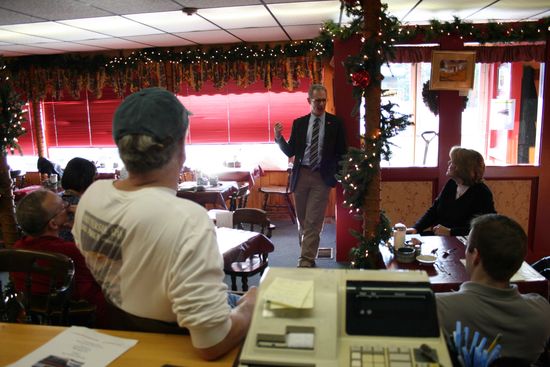
(Photo: Potential Republican presidential candidate Fred Karger talks to citizens on January 31, 2011, at the Golden Egg, a diner in Portsmouth, New Hampshire, about his potential presidential candidacy and the planned closure of the nearby Sagamore Bridge, a vital conduit for commerce. By Dan Zak/The Washington Post via Getty Images)

My “Gift” To Romney

Jennifer Rubin claims that my Newsweek cover-story will help Romney. She pens an imaginary Thank You note from Romney to Newsweek:

[R]eally, to characterize the president as the first "gay president" was an unexpected joy for Ann, the boys and me. I’m not about to go stoking the flames of anti-gay fervor in my base. That’s not my style, and as I always say to Ann, a moment not talking about Obama’s economic bellyflop is a moment wasted. But you’ve done it for me! Why, I don’t suppose there is a social conservative activist in the country who wouldn’t toss his cookies (excuse my language) over that label. They tell me they are fired up and ready to go! It’s very important in business and government to delegate, so I am relieved that you and your other journalist friends have taken care of this for me.

I wonder how Rubin would respond to a similar analogy about, say, "the first Jewish president", as Peter Beinart has described Obama? If that had been a Newsweek cover, would she have written a post on how great it is that her candidate – running against a Jew – could now exploit anti-Semitism for his political advantage? I mean: there is no policy dispute here. She is simply delighted that her candidate can get an advantage through homophobia. PM Carpenter throws up his hands:

[F]or Rubin to mobocratically ridicule President Obama's attention (as well as Sullivan's and Brown's) to a piercing social issue that has caused immense and indescribable personal pain to millions of victimized Americans is, well, I guess one can say it is nothing but the unfurling of Rubin's truest colors.

Or to put it more bluntly: If I had said the same thing, in a Jewish context, I'd be a bigot. What does that make Rubin?

Quote For The Day II

"When evangelicals turn their anti-gay sentiments into a political campaign, all it does is confirm to my gay friends that they will never be welcome in the church. It makes them bitter, and it makes me mad too. This is why I never refer to myself as an evangelical. Ugh. I’m embarrassed to be part of that group,” – an evangelical college senior, in a blog post by Rachel Held Evans.

Money quote from the post written the day after Amendment One passed in North Carolina:

As I watched my Facebook and Twitter feeds last night, the reaction among my friends fell into an imperfect but highly predictable pattern. Christians over 40 were celebrating. Christians under 40 were mourning. Reading through the comments, the same thought kept returning to my mind as occurred to me when I first saw that Billy Graham ad: You’re losing us.

I’ve said it a million times, and I’ll say it again…(though I’m starting to think that no one is listening): My generation is tired of the culture wars.

We are tired of fighting, tired of vain efforts to advance the Kingdom through politics and power, tired of drawing lines in the sand, tired of being known for what we are against, not what we are for.

And when it comes to homosexuality, we no longer think in the black-and-white categories of the generations before ours. We know too many wonderful people from the LGBT community to consider homosexuality a mere "issue." These are people, and they are our friends. When they tell us that something hurts them, we listen.

Pressuring The President

Conor Friedersdorf claims that I'm not doing it very much:

In the aftermath of a huge step like embracing gay equality, gushing is understandable. But the prior months of comments about how lucky we are to have him, the invocations of "12 dimensional chess," constantly comparing him to the Road Runner, the celebrations of his strategic acumen as if it's as laudable as doing what's right, and enthusing about how cool he is?

It's increasingly hard to take at the end of a first term littered with broken promises. And it obscures the fact that Obama ought to be pressured much more on myriad issues. If under the status quo, Sullivan constantly emphasizes to readers how lucky the country is to have Obama, how virtuous a person he is, and how much he deserves reelection, rather than holding him accountable — which ought to be the priority — there's no reason for Obama to fully investigate his predecessors for torture; to hold his Department of Justice accountable for Fast and Furious; to get Congressional approval before going to war; to repeal the Patriot Act rather than renewing it sans reform; to stop spying on Americans without warrants; to abandon his list of American citizens to extra-judicially kill; to reclassify marijuana under the controlled substances act; to end his war on whistleblowers; to stop invoking the state secrets privilege; and the list goes on.

Obama on his failure to investigate torture? Only a month ago I called him "craven". A few weeks earlier I wrote, "Not all countries are as cowardly, morally compromised and as authoritarian as the US when it comes to investigating claims of torture." And such criticism stretches back to the beginning of Obama's term. From April 2009:

And so Obama's refusal to investigate war crimes is itself against the law. And so torture's cancerous route through the legal and constitutional system continues, contaminating the future as well as the past, rendering the US incapable of upholding Geneva against other nations, because it has violated Geneva itself, and giving to every tyrant on the planet a justification for the torture of prisoners.

In February 2010, I called the administration's continued failure to investigate a "betrayal … a travesty, a disgrace, an abomination, another example of how the government treats its own members in ways it would never ever treat anyone else":

We have known for a while that president Obama and attorney-general Eric Holder have decided to remain in breach of the Geneva Conventions and be complicit themselves in covering up the war crimes of their predecessors – which means, of course, that those of us who fought for Obama's election precisely because we wanted a return to the rule of law were conned.

Also that month:

The perverse truth is that, in some ways, the Obama administration is in greater violation of Geneva than even the Bush-Cheney administration.

September 2010:

With great courage and clarity, the Obamaites could have cut this Gordian knot; instead they tightened it. And torturers across the world – far, far worse than Bush or Cheney – are now smiling.

Earlier that month:

Yes war requires some secrecy. But Obama has gone much further than this now. The cloak of secrecy he is invoking is not protecting national security but protecting war crimes. And this is now inescapably his cloak. He is therefore a clear and knowing accessory to war crimes, and should at some point face prosecution as well, if the Geneva Conventions mean anything any more.

More Dish pressure on the administration over torture here, here, here, here, here, here, here, here, here, here, here, here, here, here, here, here, and here. And that took about 10 minutes on Google. How about other issues mentioned by Conor, such as congressional approval on wars such as Libya?

Going to war with only 25 percent public support, with no Congressional buy-in, and opposition from the defense secretary is, to my mind, a form of madness. … And as public doubts and fears multiply, the president will be in [Brazil talking about jobs] thousands of miles away. This is recklessness on a Bush-Cheney level.

In a related post titled "King Barack I":

Many of us supported this president because he promised to bring back the constitutional balance after the theories of Yoo, Delahunty, et al put the president on a par with emperors and kings in  wartime. And yet in this Libya move, what difference is there between Bush and Obama? In some ways, Bush was more respectful of the Congress, waiting for a vote of support before launching us like an angry bird into the desert.

Regarding Obama's war on medical marijuana? I wrote as recently as February:

What Obama is doing is causing sickness and death. It seems to me that the Obama generation who helped elect this president need to go to war against this betrayal. Every time you are sent a fundraising email or in any way contacted by the Obama election campaign, tell them to call you back when they call this war off. Hit them where it hurts. Heckle him and his surrogates whenever you can. Holder and Obama have betrayed us on this. Make sure they hear from you.

On indefinite detention? As recently as December:

[Obama's] abandonment of the promised veto of the military bill that threatened to unleash the military in the homeland to capture, and detain indefinitely without charges, anyone suspected of being a member of al Qaeda or of "substantially supporting" them is another sign that his campaign pledge to be vigilant about civil liberties in the war on terror was a lie. … And something else much more damaging will be done: Obama will sign a bill that enshrines in law the previously merely alleged executive power of indefinite detention without trial of terror suspects.

On even small and obscure issues such as Fast and Furious? Critical posts here, here and here. The list goes on. At the same time, I try to see the whole picture – and explain why I think this president has achieved far more than his critics on the right and left believe. Politics is not just about purism, or demonstrating one's own independence; it's about prudential judgment. I made my case here.

I would simply ask: which other blog or commentator has the same balance of harsh criticism on specifics and serious praise for the long-term achievements of this president?

The End Of A Third-Party Pipe Dream

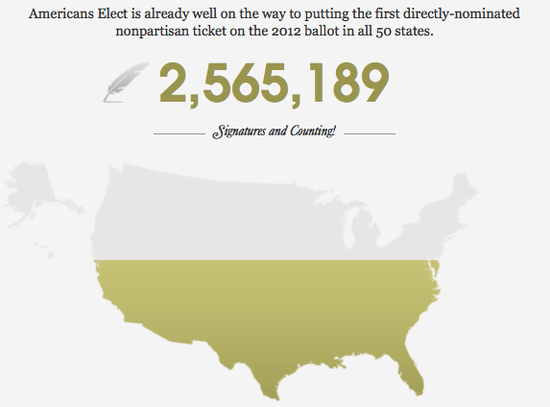
Americans_Elect_Signatures

Avlon is sad that Americans Elect has failed to find a candidate. Chait is unsurprised:

I do think there is a general desire out there for a third-party candidate. It’s just that the desire isn’t ideological. Lots of Americans think the parties both stink and have little understanding of what the parties actually believe. The idea that there’s a third-party movement rooted in any set of policy goals is silly, and the notion that the there’s a third-party movement rooted in Tom Friedman’s particular policy goals is completely insane.

Larison nods:

Americans Elect failed because it stood for almost nothing, and what it did stand for (bipartisanship, mindless “centrism”) are things that the people who vote for third party candidates dislike or don’t value as something desirable in itself.

Douthat adds:

Why … would Americans fed up with the two party system entrust their loyalties to a nascent movement that promises that this time, this time, a high-minded, bipartisan elite will get things right? Especially since the most successful third party surges, from the William Jennings Bryan-era Populists down to Ross Perot’s 19 percent, usually arise from precisely the opposite impulse – a “plague on both your houses” populism that highlights issues and anxieties that the leaders of the two major parties have decided to ignore.

Pareene sympathizes;

I actually feel kind of bad for those Americans Elect goobers. It’s not their fault that Americans don’t actually want an independent moderate unity presidential ticket. (It is their fault that they spent $10 zillion pushing the idea.) But there is really no excuse for the bizarre belief that anyone wants Joe Lieberman to be president.

What Is Romney Worth?

A comprehensive analysis

Supplemented by a dozen interviews – from local real estate experts to private equity partners – we get a detailed look at the current state of Mitt’s money, pinpointing his net worth at $230 million, split between 9 different asset classes. Highlights include the sale of nearly all of his individual equities – he sold 71 stocks since his last disclosure – and a big move into cash. He now holds $16 million, up from $1 million in August. 

Still, he's no George Washington.

“Simply Orthogonal To Facts”

In some ways, Romney is the reductio ad absurdum of what has been wrong with conservatism in America (but not Britain) this past decade:

In Romney’s telling, the terms debt and spending are essentially interchangeable. When presented with Obama’s position — that the solution to the debt ought to include both higher taxes and lower spending — he rejects it out of hand.

The AP notes that Chait's analysis is reality-based, and Romney's narrative is essentially a lie. But it's the "out of hand" dismissal of increasing revenues that is so telling. How many households take no account of their income when deciding what to spend? How feasible is it politically – as Jim Manzi notes here – that we will seriously lower the debt entirely on one party's terms, rather than by some bipartisan deal? Romney's position is, it seems to me a declaration that partisanship trumps debt-cutting in his mind. Given his own rhetoric about the danger of the debt, that's quite something. And it sure isn't conservative. It's radical to be playing ideological brinksmanship at this point.

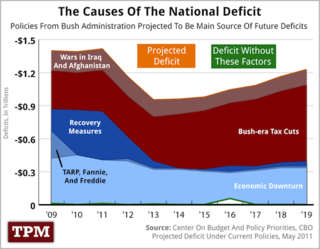
And I think this is actually Romney's biggest liability in this race. On the key question of how to lower the long-term debt, Romney takes the view that only 6a00d83451c45669e20163058f224f970d-800wispending on entitlements matters. Everything else can and should actually add to the debt. More Pentagon spending and more tax cuts for everyone, including the 1 percent (even below the Bush era rates), are fine. That kind of debt is somehow not debt for Romney because he assumes that if you slash taxes, revenues will increase. This was an interesting theory in 1981. It is a failed experiment today. (Why we need to drastically increase defense spending in a period of necessary austerity is beyond me.)

More to the point, I just cannot see how that argument wins against the logic that this sacrifice needs to be shared, that we all need to do our part, that, at this stage in the debt-binge begun in earnest under Reagan, we should double down on supply side economics in the face of massive evidence that it doesn't fucking work. You need some kind of intravenous injection of Jude Wanniski to get this argument off the ground and in the air.

Let me be clear: I have long favored serious retrenchment of entitlement spending. It is the most important thing we can do to curtail future debt. But I do not only oppose the perverse unfairness of balancing the budget entirely on the backs of the needy; I don't think Romney's positions will help reduce the debt. Call me crazy, but I think a permanent and sustained reduction in revenues will increase the debt. Call me crazier, but I tend to think a balance between spending cuts and revenue increases is obviously a fairer, more effective, and more feasible path forward.

I'd be fine with 3-1 on the spending cuts-revenue increase question. I'd prefer the revenue increases were achieved through tax reform, rather than increasing tax rates. But Romney is stuck with the position that he would even turn down a 10-1 ratio, and that the cuts should be entirely on the backs of the poor, while increasing defense spending, and lowering still further the taxes paid by his own class.

How on earth do you win a general election when you are so far out on the fringe?