Ask Cowen Anything: The Healthiest Cuisine In The World?

Tyler Cowen’s tips for ordering for freshness bear repeating – from Will Dean’s review of Cowen’s new book:

If you’re in a rich Western city, choose a dish with sauce. Your raw materials might not be that fresh (they’ve been in a fridge for a few days), so the quality of the food will depend on the creativity going into its composition. America is good for this because it attracts lots of creative immigrants. Conversely, if you’re in a poor country with not much history of refrigeration then it’s likely the culture will be for food to be eaten as fresh as is possible, so that it doesn’t go off. Which means, Cowen says, that you should choose “ingredients-intensive” dishes – such as a barely adorned fish, or a plate of cheese and vegetables.

Marianna Tsatsou examines the original Mediterranean diet:

Homer wrote that the main substances of the meals were bread, meat and wine. … As for olive oil, which was already known in Homer’s Greece, they used it only as part of ancient Greek rituals – for example, in the Olympic Games athletes anointed oil to their body before entering the arena. Oil was not included in the “Mediterranean trio” until the classical times.

Dr. Artemis Simopoulos believes the diet followed in Greece before 1960 was best:

At one time, Greeks got omega-3s in every meal, Simopoulos says — in such foods as figs, walnuts, wild plants and snails. (Snails are considered good eating in France too, but Greek snails reportedly boast more omega-3s than their French cousins.) The consensus among nutrition experts is that Americans don’t eat enough omega-3s. And no one expects an influx of wild plants and gastropods into the American diet any time soon. But there are other good sources of omega-3s, including flax seed oil, cod liver oil and canola oil; soybeans and tofu; and fatty fish, such as mackerel, sardines and salmon.

Marc Gunther points to another culprit in unhealthy American cuisine:

Because “Americans spoil and cater to their children,” he argues, we grow up eating food that is “blander, simpler and sweeter” than food elsewhere:

A lot of American food is, quite simply, food for children in a literal sense. it’s just that we all happen to eat it.

Interesting, no?

Follow Tyler Cowen‘s work at Marginal Revolution and buy his new book, An Economist Gets Lunch. Earlier videos of Cowen here and here. Video archive here.
Yglesias Award Nominee

"I'm going to go hard left on you here, I'm going ACLU … A drone is a high-tech version of an old army and a musket. It ought to be used in Somalia to hunt bad guys but not in America. I don't want to see it hovering over anybody's home. Yes, you can say we have satellites, we've got Google Street View and London has a camera on every street corner but that's not an excuse to cave in on everything else and accept a society where you're always under — being watched by the government. This is not what we want," – Charles Krauthammer, on the use of drones for domestic police surveillance.

The Greenwald Pounce

I will leave it to you, dear readers, to decide if what I said above was "creepy", as Glenn Greenwald has it. It seems to me I was completely candid about the emotions that flooded my frontal cortex in the wake of Obama's ABC News interview. I did not say they undermined my core point that technically the president doesn't matter on this matter. It is possible both to assess the limited practical impact of an interview and express emotion at the same time.

Still, Glenn and I have different temperaments. He's perfectly entitled to label me a pathetic, sappy human being for being moved by the great cause of my life finally finding a home in the Oval Office. But it's deeply unfair to accuse me, especially on the issue of gay rights, of being a sycophant to this president. On this very blog, I often lacerated Obama and the administration when I thought they were dragging their feet – on the HIV ban, on the DOJ's original defense of DOMA, and especially on gays in the military, when I went on CNN to accuse the president of "betrayal". I wasn't a terribly reliable hagiographer then, was I? And you can read my cover-essay and see if it is pure hagiography, as opposed to a genuine judgment of a political and moral evolution.

As to my reference to Obama as a father figure on the Chris Matthews Show, after constantly saying that we shouldn't be looking for a father figure, well: consider me busted.

The power of a president's words did surprise me. The president is the head of state. When he speaks, history is being made. When a president uses that authority to express solidarity with gay citizens and their families, and to assert his belief in their core equality, for the first time ever, I'm not going to apologize for being moved, just as I was moved by the sight of an African-American being sworn into the presidency in the first place. And forgive me, but if someone had told me two decades ago that by 2012, a black president would be endorsing gay marriage, I would have asked where he got that stuff he was smoking.

Glenn is a fantastic blogger and a friend. I'm sure my occasional sentiment irritates him as much as his detached purism sometimes baffles me. But I am not a toady to power; in this village, I am more of a feral creature. I have excoriated presidents and hailed them at times. I just believe this president matters; and, for me, he now matters more. If that is a position a blogger should not take for fear of being seen as a suck-up, so be it. It's from my heart.

Update: Glenn emails to say that his point was that I should apologize to those who insisted that it would matter a lot if the president said the words. I don't recall a specific individual I criticized on those grounds, but, yes, those who believed his words mattered were right and I was wrong.

The Bain Card, Ctd

Steel_production

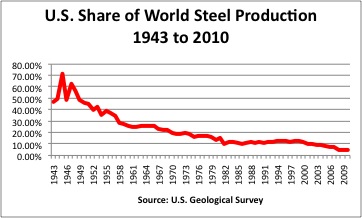
In response to Obama's attack, Philip Klein charts the decline of steel:

For decades before Bain ever got anywhere near GST, the American steel industry was already declining for a number of reasons, a big one being global competition.

Alex Koppelman counters:

Patrick Brennan points out that dozens of other steel companies went bankrupt around the time that GST did. (Additionally, it’s worth noting that Romney had left Bain two years before GST filed for Chapter 11.) That’s true, but it won’t save Romney from his own error. If anything, it might ultimately make it worse: saying Romney’s company was just part of the trend that killed the American steel industry helps him how, exactly?

Allahpundit is impressed by Romney's counter-attack:

If they actually anticipated the GST Steel attack spot and put this together in advance as a direct answer, that’s some mighty fine strategizin’. Maybe they have an entire vault full of unreleased response ads for every conceivable Obama attack, like some sort of campaign version of Prince.

Waldman drinks neither campaign's Kool-Aid:

The truth is that both the creation of jobs and the destruction of jobs happened at various times. That's because Romney and Bain were in business for one purpose: making money. Sometimes they did so in ways that destroyed jobs, and sometimes they did so in ways that created jobs. We may never figure out whether the total jobs ledger was positive or negative, since you can always argue that particular losses would have happened anyway without Bain, or that particular gains would also have happened anyway. So we should embrace a little nuance here. Romney's Bain career was neither completely evil nor completely saintly.

Bainbridge once again defends private equity's record on jobs:

Job losses caused by private equity acquisitions are concentrated in takeovers of public corporations that are visible to the media and therefore to the public. The public doesn't see the vastly larger number of acquisitions of privately held companies, which exhibit large employment gains.

Scherer anticipates Romney's overall strategy:

If Obama uses unemployed people who lost their jobs after Bain Capital investments, Romney will use unemployed people who lost their jobs during the recession that has largely defined Obama’s time in office. … It’s a strategy that depends heavily on circumstance. If the economy is growing and confidence is rising, Romney will be whistling in the wind. But if the economy is struggling, then Romney’s message is designed to ride the wave.

Byron York expects Romney to hammer Obama over the auto bailout. Chait doubts this will work:

The comparison is fairly silly, because the key point is that Romney’s career produced huge gains for owners of capital, and the auto bailout forced them to swallow huge losses. But it shows Romney’s recognition of what the voters want.

And Tomasky expects the campaigns to fight to a draw:

I suspected the Bain story is going to devolve into one of those he said-he said things, and most undecided voters will shrug and assume that the truth is somewhere in the middle.

The Tea Party’s Mission

Tea_Party_Hat

How Kornacki understands it:

Tea Party Republicanism: It isn’t really about ideology; it’s about governing tactics. … It’s not really about moving the GOP to the right; the party is already there, and has been for a while. It’s about reflexively opposing the other party on every issue, resisting compromise at all costs, and exploiting every available legislative tool to stymie the other side. This mind-set is already pervasive in the House, and as the Times story shows, it’s now making its way into the Senate.

I see it as a cultural protest, a kind of nullification of modernity.

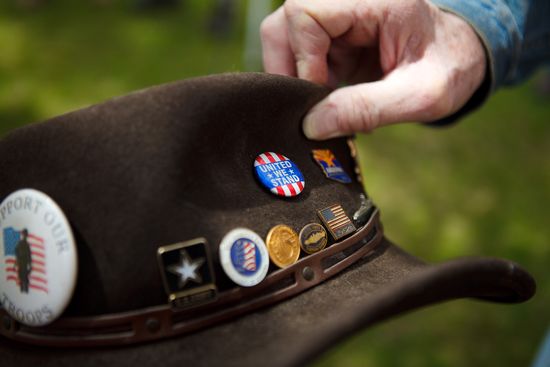
(Photo: Tea Party member Mike Keating displays the pins that decorate his hat, while waiting for the start of a rally supporting Arizona's Immigration Law SB 1070 at the Arizona state Capitol April 25, 2012 in Phoenix, Arizona. By Jonathan Gibby/Getty Images)

Evan, Without Whom …

Evan

The indispensable man in bringing marriage equality to America is Evan Wolfson. He has dedicated his entire life to the cause, and his giant intellect as well. And so it was more than fitting that he was honored yesterday with the Barnard Medal of Distinction less than a week after the president endorsed marriage equality, and got to hear the president chart an arc of widening American opportunity and inclusion from "Seneca Falls to Selma to Stonewall." History will one day see him as the critical legal critic, community organizer, and strategic activist behind this movement. Money quote from him:

It was just incredibly moving, to stand on the stage in front of these amazing young women graduates, with President Obama, receiving an award from Judge Kaye, in the week that the president embraced the freedom to marry. Really, it doesn’t get much better than that. And it was especially moving for me because I had my family there — [including] my husband.

It just really felt like we were seeing our cause embraced in the heart of the country, as well as in the wave of the next generation. Lots more to do, lots more to do. But, truly, a wonderful milestone moment.

No doubt Glenn Greenwald will roll his eyes. But Evan did the work, not Glenn. And he will continue to do the work. And he deserves his moment of joy and emotion. He doesn't allow himself many.

China’s Gamed Economy

Minxin Pei casts a skeptical eye on Chinese growth numbers:

Inflating local growth numbers is so endemic that reported provincial GDP growth data, when added up, are always higher than the national growth data, a mathematical impossibility. And, even when they do not doctor the numbers, local officials can game the system…[by using] financial leverage, typically by selling land or using land as collateral to borrow large sums of money from often-obliging state-owned banks, to finance massive infrastructure projects, as Bo did in Chongqing. The result is promotion for such officials, because they have delivered quick GDP growth. But the economic and social costs are very high. Local governments are saddled with a mountain of debt and wasted investments, banks accumulate risky loans, and farmers lose their land.

April was a bad month for China.

The Problem With Veggie Burgers

They aren't much better than meat for the environment:

[A] girl can only eat so much roasted kale before she starts craving protein: tofu, veggie burgers, and the (okay, creepy) occasional piece of fakin' bacon. But coaxing soy into a red-and-white rectangular strip takes work—which is why Eshel believes most veggie burgers are the caloric equivalent of "shooting yourself in the foot." A 2009 study by the Swedish Institute for Food and Biotechnology found that while producing a plate of peas requires a fraction of the energy needed to produce the same number of calories of pork, the energy costs of a pea-burger and a pork chop are about equal.

Using Cell Phones As Phones

So passé:

In 2009, the United States crossed a digital Rubicon: For the first time, the amount of data sent with mobile devices exceeded the sum of transmitted voice data. … Even as the number of wireless connections increased from 286 million in 2009 to 303 million in 2010, voice usage on those phones decreased. And our calls are getting shorter. While in 2003 the average local mobile phone call lasted a leisurely three minutes, by 2010 it had been trimmed to a terse one minute and 47 seconds.