Why Is Healthcare Price Transparency So Hard?

Avik Roy mourns the death of an Arizona healthcare bill, which would have required healthcare providers to announce prices:

“Do we want free market health care?” [Arizona state senator Nancy Barto (R.)] asked in a recent blog post. “Then why have common sense reforms that will produce one been opposed, defeated and/or vetoed at the legislature for the last 2 years—even though we have a Republican Governor and Republican supermajority?”

It’s a good question. “The short answer,” she writes, “is swarms of lobbyists. The longer answer is legislators succumbing to lobbyists on issues that should be rather plain.”

Price transparency seems like the kind of thing that everyone should be able to rally around. But you’d be wrong. Pretty much everyone in the health-care world—other than the patient—has an interest in keeping prices opaque.

The Female Pay Ceiling

Economix-24payscalegap-blog480

Catherine Rampell narrates:

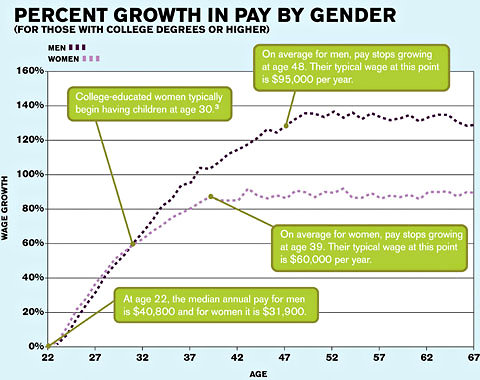
At age 30, both college-educated men and college-educated women have experienced wage growth of almost exactly 60 percent, compared to what they earned at age 22. The typical 30-year-old male college grad working full-time receives $65,300 annually, and his female counterpart receives $51,000. Then, at age 30, college-educated women are likely to start having children. Not coincidentally, that’s also when women’s earnings growth starts to slow. Meanwhile, men’s earnings growth remains about steady. By the time women reach age 39, their wage growth pretty much stops altogether. The typical female, college-educated, full-time worker at age 39 earns about $60,000 — the same amount received by female, college-educated, full-time workers at age 50, 60 and beyond. College-educated men, meanwhile, continue getting raises until about age 48, when their pay plateaus at about $95,000. 

(Chart from PayScale)

Did Jesus Foresee The US Constitution? Ctd

I wondered how Romney’s faith shapes his foreign policy worldview. Larison points out that there “are many observant Mormons in America and around the world that don’t subscribe to the American nationalist triumphalism that Romney embraces, and there are quite a few non-Mormons that approve of this triumphalism and describe it in virtually identical terms”:

Believing a nation to be favored by God doesn’t necessarily imply that the nation is free to do whatever it wants. If the belief is a genuine one, it implies that the nation has duties to God and cannot act contrary to God’s will. Indeed, being favored by God theoretically imposes a higher standard of conduct on the nation in question. Replacing or conflating God’s will with whatever is expedient or useful for the nation would appear to a genuine believer to be the worst kind of blasphemy and impiety. Of course, the belief could just as easily be turned into a license for aggression if that is what one wants to do with it. In other words, it is more likely that Romney is an aggressive American nationalist and hegemonist and then interprets (or ignores) teachings of his religion in a manner most consistent with that view.

Why Are American Idol Winners Usually Southerners? Ctd

Screen shot 2012-05-29 at 8.19.29 PM

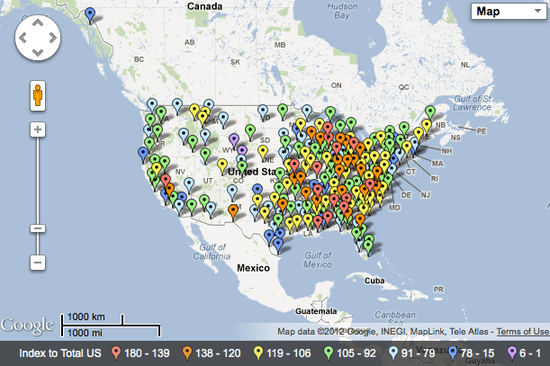
A reader sends the above map taken from this article showing the ratings of American Idol across 200 US cities. A reader writes:

This one is easy and it's been discussed before, including, I believe by the producers of American Idol themselves.  The Southern states by far vote at a much higher rate than the Northern states do.  The Northeast has the lowest percentage of Idol voters, the West comes next, with the South in first.  When Chris Allen won over Adam Lambert a couple of years ago, Arkansas (his home state) voted more times than the population of the entire state, and I believe it was 2-3 times the population of that state.

Another writes:

Here's my take on why there are more Southerners win on Idol: more Southerners go to church.

Hence more Southerners sing in church, which means more Southern kids get validation for their talent from adults who aren't related to them than kids who perform solely in school choirs. That boost – confidence at performing in front of church crowds that respond well to their performances – I believe gives amateur Southern singers an edge. It's not that they have a lack of opportunities to record; it's that they have an abundance of opportunities to perform. They come better polished.

Another:

I have never watched a single episode of Idol and cannot comment on it per se, but the thread reminds me of watching the Miss America pageant during my girlhood in the '60s through the early '90s. It always seemed to me that Southerners dominated that contest, too.  A quick check (per Wikipedia, anyway) shows that from 1951 to 2012, Southern girls won nearly 35% of the contests, instead of the 22% statistically expected.  Can’t get at the data easily, but I think the if the top ten were studied for the same period it might go as high as  60-75%.  And no, I’m not arguing that Southern girls were more physically attractive; I postulate it’s the high value Southern culture places on charm – being pleasing, gracious and entertaining to others.

Should The President Decide Who Lives And Who Dies?

Daniel Klaidman provides disturbing details on Obama's targeted al Qaeda assassination program. Amy Davidson is unsettled:

Brennan and other officials interviewed by the Times and Newsweek said that Obama had enormous faith in himself. It would be more responsible, though, if he had less—if he thought that he was no better than any other President we’ve had or ever will. The point isn’t just the task, or burden, he takes on, but the machine he has built for his successors to use. Perhaps, just to suggest a range, he could picture each of the Republican contenders from this past season being walked through the process, told how it works, shown some of those video clips with tiny people and big explosions, and taking it for a test drive. Never mind whether Obama, in particular, sighs or loses sleeps or tosses a coin when he chooses a target: What would it mean for a bad, or craven, or simply carelessly accommodating President to do so? In the end we are not really being asked to trust Obama, or his niceness, but the office of the Presidency. Do we?

Why Not Dump Trump?

800px-Orange_and_cross_section

Douthat sees no downside:

[P]recisely because Trump’s highest goal is so transparently the perpetuation of his own celebrity, his latest attention-seeking stunt offers Romney an almost cost-free chance to repudiate a figure who’s notionally to his "right" (though in reality lacks any ideological commitment whatsoever) without risking any kind of sustained conservative revolt. Trump isn’t Rush Limbaugh or Sarah Palin: His conservatism is feigned, his right-wing fans are temporary admirers with no deep commitment to his brand or cause, and hardly anyone in the conservative media is likely to rise to his defense.

Byron York provides a window into the Romney campaign's thinking:

Romney aides believe that cooperating with Democrats and media figures who are demanding a Trump disavowal would most certainly lead to more calls for more disavowals of other figures in the future — leaving Romney spending as much time apologizing for his supporters as campaigning for president.  Team Romney views it as a silly and one-sided game designed to distract voters from the central issue of the race, which they remain convinced will be President Obama's handling of the economy.

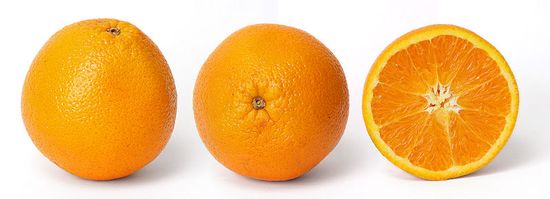
(Photo: "Fir0002/Flagstaffotos" under license, from Wiki.)

Marriage, Marijuana And Millennials

A Dish threadgasm! Even Dreher sees overlap:

I’m wondering if the erosion of the strict taboo against drug use, at least in one’s youth, has to do with the fact that so many of us have known, or at least been around, marijuana users for a long time. We know that most people can use the stuff without ruining their lives, or disqualifying themselves from public service. If so, then it tracks with the erosion of the taboo against homosexuality among younger Americans, who have had more direct experience of being around gay people.

I think the fact that the drug clearly has helped people deal with otherwise crippling illnesses has played a part too. Here's one of Rod's readers reacting:

I have multiple sclerosis.  It's not every day that I smoke, but on tough days a few hits from a bowl does more to relieve my symptoms than any liver damaging pill prescribed by my doctors.  If people condemn us for doing what works… well, that says more about their character than it does ours.

Ann Romney also has MS.  I would love to hear her opinion on medical cannabis.

Recall that the federal government insists that there is no medical use for this drug whatsoever, and that it is as dangerous as heroin. I think most people, as Rod notes, know this to be untrue. They see more damage from alcohol than from cannabis. And so real popular support for prohibiting cannabis isn't there. The passion is on the anti-Prohibition side, and the arguments are there as well. In that sense, this is just like the marriage equality movement. Hence these two graphs, which are effectively identical. Here's the trend on pot:

Screen shot 2012-05-29 at 7.29.51 PM

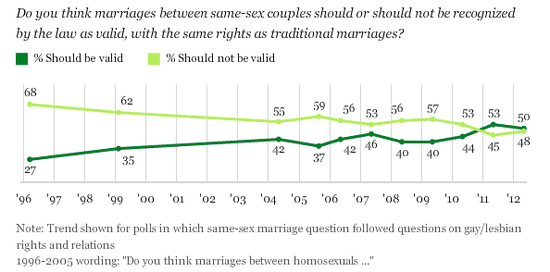
Here's the trend on marriage equality:
Screen shot 2012-05-29 at 7.31.36 PM

In both cases, the trend is reinforced by generational change:

Support for legalizing marijuana is directly and inversely proportional to age, ranging from 62% approval among those 18 to 29 down to 31% among those 65 and older. Liberals are twice as likely as conservatives to favor legalizing marijuana. And Democrats and independents are more likely to be in favor than are Republicans.

Which is exactly the dynamic with marriage equality. Which is why Obama's DEA acting like Bush's against dispensaries and pot farms is so perplexing. Doesn't Obama understand that this issue is his new coalition's issue.

At some point in his second term, if he gets one, Obama might do for cannabis use what he just did for marriage equality: mainstream it. Well, I can hope, can't I?
The Power Of A President’s Words, Ctd

Frum flinches:

The U.S. has had such a comparatively happy history that it's hard to think of a domestic analogy that would capture what Poles feel when the worst crimes of their worst oppressors are attributed—not to the authors—but to them. "The Hawaiian sneak attack on the U.S. naval base at Pearl Harbor" is a pathetically inadequate approximation, but at least it gets the grammar of the insult.

Tomasky nods, labelling it "the first time [Obama]'s ever embarrassed me as president." Ari Kohen pushes back:

Approximately 3 million Polish Jews — roughly 90% of the country’s Jewish population — were murdered by the Nazis. The Nazi killing machine was the most effective in Poland of all the occupied countries and it’s pretty clear that the anti-Semitism behind the mass extermination of Jews wasn’t limited to the occupying forces. Here’s just one quick example, from an article published in 2008

Gross suggests that being a direct witness to Nazi atrocities — Jews from all over Europe were herded to concentration camps in Poland — unleashed a brutal anti-semitism in the country that had for almost nine centuries been home to one of Europe’s largest Jewish communities. Gross provides extensive evidence of how many Poles chased away or killed Jewish Holocaust survivors, often out of fear that returning Jews would reclaim their property that had, during the occupation, been taken over by other Poles.

I’m sure that the Polish people have thought at great length about these matters in the years since the article was written and I’m sure they’ve confronted the legacy of anti-Semitism in their country. If not, it would be really irresponsible for the Prime Minister and Foreign Minister to suggest, as they seem to be doing here, that the killing of Jews in Poland had nothing whatsoever to do with Poles.