The Mainstream Shifts

Nw_052112_domcvr

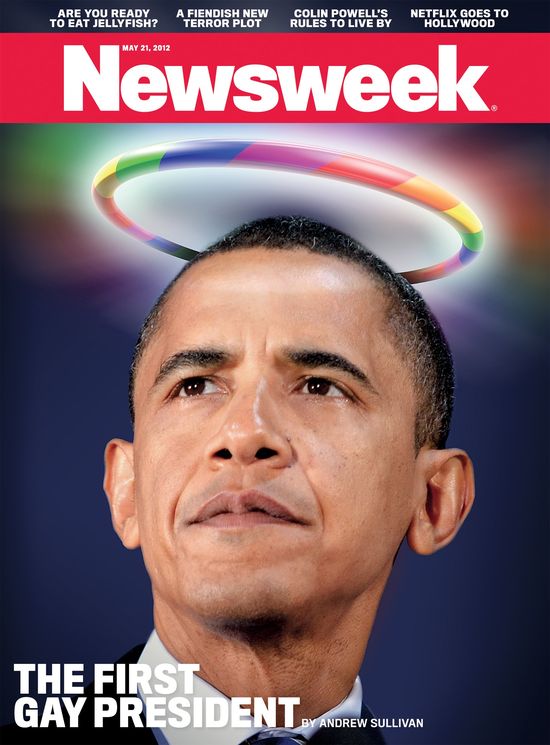
My cover-essay on Obama's historic embrace of full gay equality is now online. It isn't just about one interview:

[It's easy to] be skeptical of Obama’s motives, of how long it took, of whether this is pure and late opportunism. But when you step back a little and assess the record of Obama on gay rights, you see, in fact, that this was not an aberration. It was an inevitable culmination of three years of work. He did this the way he always does: leading from behind and playing the long game.

And Obama's own life-story resonates with the same conflicts of identity that many gay people grow up with:

Barack Obama had to come out of a different closet. He had to discover his black identity and then reconcile it with his white family, just as gays discover their homosexual identity and then have to reconcile it with their heterosexual family. The America he grew up in had no space for a boy like him: black yet enveloped by loving whiteness, estranged from a father he longed for (another common gay experience), hurtling between being a Barry and a Barack, needing an American racial identity as he grew older but chafing also against it and over-embracing it at times.

This is the gay experience: the discovery in adulthood of a community not like your own home and the struggle to belong in both places, without displacement, without alienation.

Has The Welfare State Made Us Complacent?

Charles Murray wonders:

In a world when death can come at any time, there is also a clear and present motivation to think about spiritual matters even when you are young. Who knows when you’re going to meet your Maker? It could easily be tomorrow. If you’re going to live to be at least eighty, it’s a lot easier not to think about the prospect of non-existence. The world before the welfare state didn’t give you the option of just passing the time pleasantly. Your main resources for living a comfortable life—or even for surviving at all—were hard work and family (especially, having children to support you in your old age). In the advanced welfare state, neither of those is necessary. The state will make sure you have a job, and one that doesn’t require you to work too hard, and will support you in your old age.

Why Religion Resists Evolution

Dan McAdams offers a new theory – that evolution isn't a very good story:

Every great story you can think of—from Homer’s Iliad to your favorite television show—involves characters who pursue goals over time, characters who want something and set out to achieve it. In this sense, the classic biblical creation stories are very good stories. You have a main character—God, the creator—who sets out to achieve something over time. There is purpose and design to what God, the main character, does. God is an agent—a self-conscious, motivated actor. All stories have agents.

Evolutionary theory, however, is not a story in that there is no prime agent, no self-conscious and motivated main character who strives to achieve something over time. For this reason, there is no overall narrative arc or design, no purpose that is being achieved by a purposeful agent. Instead, you have random, mechanical forces—variation, selection, and heredity. Bad story! But, at the same time, extraordinarily brilliant and elegant theory, for it provides a compelling and scientifically testable explanation for life on earth.

Jonathan Gottschall thinks he has a point:

Stories are about a character finding a solution to a problem. Evolution has problems and solutions but no character. As a result, according to Gottschall, "it doesn’t connect as well—especially at the emotional level."

The Creation Of A Human Conscience

It began with meat, according to evolutionary anthropologist Christopher Boehm:

[M]y theory is that you cannot have alpha males if you are going to have a hunting team  that shares the meat fairly evenhandedly, so that the entire team stays nourished. In order to get meat Meatdivided within a band of people who are by nature pretty hierarchical, you have to basically stomp on hierarchy and get it out of the way. … My hypothesis is that when they started large game hunting, they had to start really punishing alpha males and holding them down. That set up a selection pressure in the sense that, if you couldn’t control your alpha tendencies, you were going to get killed or run out of the group, which was about the same as getting killed. Therefore, self-control became an important feature for individuals who were reproductively successful. And self-control translates into conscience.

(Photo: Zhang Huan, Homeland, 2001. Hat tip: Brain Pickings)

The Global Contraceptives War

Melinda Gates is waging it, in accordance with her Catholic faith:

Gates believes that by focusing on the lives of women and children, and by making it clear that the agenda is neither coercive population control nor abortion, the controversy over international family-planning programs can be defused. Right now, she points out, 100,000 women annually die in childbirth after unintended pregnancies. Six hundred thousand babies born to women who didn’t want to be pregnant die in the first month of life.

How times have changed:

In the middle of the 20th century, global family planning was seen as an issue of national security, not feminism. In the aftermath of World War II, high birth rates and falling death rates in poor countries led to an international panic about overpopulation, which many believed would cause widespread instability, leaving countries vulnerable to communist revolution. By the early 1960s, Dwight Eisenhower was calling for foreign aid for birth control in The Saturday Evening Post, and he and Harry Truman became honorary chairmen of Planned Parenthood. In 1965 President Lyndon Johnson implored the United Nations to “face forthrightly the multiplying problems of our multiplying populations … Let us act on the fact that less than $5 invested in population control is worth $100 invested in economic growth.”

Over the next 15 years, the U.S. led the world in a massive effort to bring family planning to every corner of the globe. Powerful Americans lobbied the United Nations to create the United Nations Fund for Population Activities, or UNFPA, and then to expand its work. “Success in the population field, under United Nations leadership, may … determine whether we can resolve successfully the other great questions of peace, prosperity, and individual rights that face the world,” wrote George H.W. Bush in 1973.

Gates' full TED talk on contraception and why it shouldn't be controversial is here.

Missing Mom

Timothy Egan mourns the mother he recently lost:

When the last of your parents dies, as Christopher Buckley wrote in his memoir, "Losing Mum and Pup," you are an orphan. But you also lose the true keeper of your memories, your triumphs, your losses. Your mother is a scrapbook for all your enthusiasms. She is the one who validates and the one who shames, and when she’s gone, you are alone in a terrible way.