Feeling Your Troubles Float Away

Springs

Restricted environmental stimulation technique (REST), also known as "floating", is a treatment for various physical, mental and emotional disorders. Matt Stangel tries out a tank of "thrice-filtered water, which is 40 percent Epsom salt and kept at a temperature of 93.5 degrees":

After my third session, beer—a once-favorite beverage—becomes entirely unappealing, along with alcohol in general, a side effect that lasts for weeks after my ninth session. I also notice a marked increase in my overall sense of well-being, while my persistent anxiety disappears completely. Additionally, I begin to write creatively with an uninhibited ease that I haven’t experienced in years. I am astounded by the changes.

(Photo: "Weeki Wachee spring, Florida, 1947," by Toni Frissell, in the public domain via Flickr and the Library of Congress)

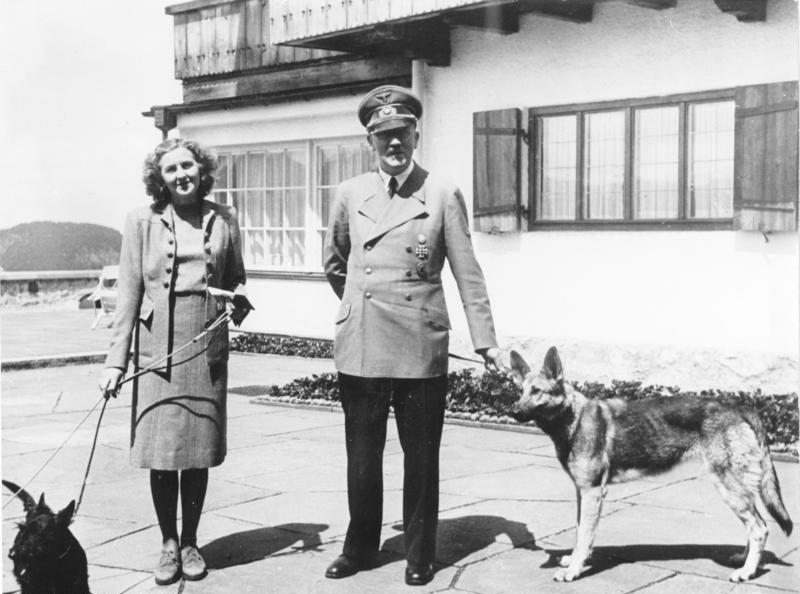
Mein Hund

Hitlerdogs

A short history of the dictator's relationship with dogs:

[Hitler] was a romantic—a twisted, demonic romantic of the most dangerously delusional kind, but a romantic nevertheless. Even his brutality grew out of a belief in a racially and culturally pure Edenic state bearing no resemblance to reality. As such, he was a great lover of mystical signs, and he deeply appreciated the fact that his name Adolf translated from Old High German as "noble wolf." Wolves were considered the purer manifestation of dogs’ original warrior nature, and German Shepherds were bred to be closer to their lupine source. Hitler chose to go by the nickname Wolf, which was the basis for the name of his massive military bunker in Poland, the Wolf’s Lair. As a dedicated self-mythologist who read personal meaning into everything, he took this connection to wolves, the "pure" dog, seriously.

The best retort to this comes from a probably too-good-to-check anecdote about a Jewish Holocaust survivor in Austria who chose to call her own dog "Hitler". It became a kind of therapy for her to order the canine fuhrer-substitute around. "Sit, Hitler!" she would command. "Heil, Hitler" became "Heel, Hitler!"

It's the little things …

(Image of Braun and Hitler with their dogs via Wikimedia Commons)

Face Of The Day

Michaelmapesroom622

From "Specimens" by Michael Mapes:

[His pieces] are comprised of hundreds of dissected photographs and fragments of ‘personal/biographical DNA’ (such as hair, fingernails, tears, calender dates and geographical references) contained in various forms. … The encased specimens suggest various narratives, including the nature of captivity and transcendence and the passing of time.

Emily Temple steps back:

The portraits make the viewer feel at once the scientific observer and the observed, both the mad scientist and the shattered subject. 

(Image courtesy of the artist)

Dying To Live

Tim Kreider sees the fear of death as enhancing life:

I’m convinced these are the conditions in which we evolved to thrive: under moderate threat of death at all times, brain and body fully integrated, senses on high alert, completely engaged with our environment. It is, if not how we’re happiest — we’re probably happiest in a hot tub with a martini and a very good naked friend — how we are most fully and electrically alive.

The Praying Sex

According to a 2008 Pew survey "two-thirds of all women surveyed pray daily, while less than half of all men surveyed do." Tanya Luhrmann's theory as to why:

Women pray more because women are more comfortable with their imaginations, and in order to pray, you need to use your imagination. Let me be clear. I am not suggesting that God is a product of the imagination. I am instead noting that to know God intimately, you need to use your imagination, because the imagination is the means humans must use to know the immaterial. This, by the way, is something the church fathers knew well. For Augustine, the road to God ran through the mind. It is our own peculiar era that equates the imagination with the frivolous and the unreal. That is why contemporary Christians sometimes get nervous about the word imagination. But they shouldn't. C. S. Lewis knew so well that the imagination was a path to God that he entitled a chapter of Mere Christianity "Let's Pretend." "Let us pretend," Lewis writes, "to turn the pretence into a reality."

Earlier coverage of Luhrmann's book here. More on the neuroscience of prayer here.

Why Not Give Up On Fiction?

Robin Hanson rounds up studies on fiction distorting our understanding of the real world. He challenges atheists:

A few days ago I asked why not become religious, if it will give you a better life, even if the evidence for religious beliefs is weak? Commenters eagerly declared their love of truth. Today I’ll ask: if you give up the benefits of religion, because you love far truth, why not also give up stories, to gain even more far truth? Alas, I expect that few who claim to give up religion because they love truth will also give up stories for the same reason. Why?

Obama’s Christianity, Ctd

3375614507_c433c0ebf4_b

Jay Michaelson expands on the religious message in Obama's marriage announcement:

[His announcement] says that values like introspection, compassion, and justice support, rather than oppose, equality for LGBT people. We can interpret Leviticus, Romans, and Corinthians ten ways from Sunday. But what we can’t ignore are the calls to justice and compassion.

Rachel Held Evans calls on evangelicals to change their tactics:

When asked by The Barna Group what words or phrases best describe Christianity, the top response among Americans ages 16-29 was "antihomosexual." For a staggering 91 percent of non-Christians, this was the first word that came to their mind when asked about the Christian faith. The same was true for 80 percent of young churchgoers. (The next most common negative images? : "judgmental," "hypocritical," and "too involved in politics.") … So my question for those evangelicals leading the charge in the culture wars is this: Is it worth it?

Nicholas Beaudrot shakes his head:

The once near-universal brand of American Christianity is being associated with an ever-shrinking size of the American public. Like Burger King and Axe Body Spray, you may wake up one day and find that the overwhelming majority of the public has simply tuned out everything you have to say. Now, it's always possible that the leaders of the major American churches may want it this way. But for those who don't, the window of opportunity where people might be willing to consider a more relevant form of modern Christianity is closing.

Ed Kilgore reminds us that Obama's former church supports marriage equality:

So Obama has pretty strong authority for saying there’s no conflict between his faith and support for same-sex marriage. Indeed, he’s now removed the conflict, so I would hope that conservatives who are forever demanding respect for their own religious motives for thinking the way they do will show Obama a little respect in exchange. But I’m not holding my breath.

Jonathan D. Fitzgerald surveys the reaction on the Christian right.

(Photo of the Washington National Cathedral by Laura Padgett)