Chris Geidner runs down the list – from Harry Reid to Steny Hoyer. The dam has broken.
Month: May 2012
Obama’s Evolution
The conventional wisdom is that he was once for marriage equality and then reversed himself for political reasons. The root of this is a questionnaire his campaign filled out for the gay paper "Outlines" in Chicago in 1996. The statement was typed and signed, but Dan Pfeiffer claimed that Obama himself hadn't overseen the questionnaire. You can dismiss that as pure positioning (and I have no evidence to rebut you), but it does not seem to me to fit Obama's usual caution on matters that could generate a lot of heat. And in 1996, the number of politicians supporting marriage equality was pitiful (it was the year that DOMA passed). Call me a dupe, but I have come to believe that Obama's position in the 1990s was roughly what it was in 2004 in his Senate race and in 2007, when I heard him talk about it in private. He favored civil unions of some sort but not marriage. We can't read his mind, but the kind of politician who attended an anti-war rally and declare that he was not opposed to all wars is not the kind of politician who would have staked out such a radical stance on gay marriage of all things at the time.
Here's a segment of his 2004 debate with Alan Keyes on the subject. I think it captures Obama's conflicts and doubts and general confusion about the whole thing:
“Assault And Battery” By “A Pack Of Dogs”
That’s how one of the witnesses to Romney’s gay-bashing in high school describes the event. Money quote:
“It’s a haunting memory. I think it was for everybody that spoke up about it… because when you see somebody who is simply different taken down that way and is terrified and you see that look in their eye you never forget it. And that was what we all walked away with,” said Phillip Maxwell, who is now an attorney and still considers Romney an old friend.
“I saw it with my own eyes,” said Maxwell, of the anecdote first reported by the Washington Post. Maxwell said Romney held the scissors helping to cut the hair of a student, John Lauber, who was presumed to be gay and who had long hair. “It was a hack job… clumps of hair taken off.” Maxwell said he held the boy’s arm and leg, describing he and his friends as a “pack of dogs.”
Asked if Lauber was targeted because he was gay, as reported by the Post, Maxwell said, “We didn’t know that word in those days… but there were other words that were used. We weren’t ignorant, we just didn’t use the current names for things.” …
“This was bullying supreme,” he said.
Today, Romney actually laughed off the assault. Laughed. We have two options: this man is so callous that, unlike all those others involved in this assault, he has forgotten it. Or he is a liar.
Will The Islamists Fail?
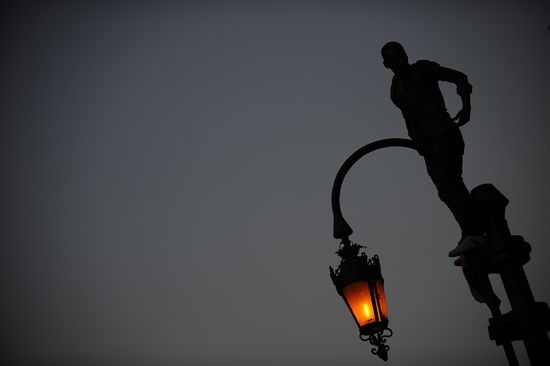
Dalia Ziada thinks the current Islamist ascendance in Egypt is a passing fad:
Members of the Muslim Brotherhood are guilty of plenty of lies themselves, most importantly, violating their promise not to field a presidential candidate. And their on-again off-again alliance with the SCAF – despite the military’s violence against protesters – is another example of the Brotherhood’s dubious moral compass. Growing recognition of the moral shortcomings of Islamists will significantly weaken their support in the presidential race as well as future elections. Despite their deteriorating political capital, Islamists still have sufficient momentum to dominate the presidential election and probably two or three more parliamentary elections to come. However, the rate of support for Islamists will decrease year after year.
(Photo: An Egyptian anti-military protester climbs on top of a light post during a demonstration outside the Egyptian Parliament on May 6, 2012 to demand for the release of hundreds of detained demonstrators. The previous day, Egypt's military ordered 300 people detained after deadly clashes between troops and anti-army protesters in Cairo and imposed a new curfew, as tensions spiral ahead of a key presidential poll. By Gianluigi Guercia/AFP/GettyImages.)
You Have A License For That Job?
A new report (pdf) makes the case against occupational licenses. Adam Ozimek summarizes key points:
Defenders of licensing regularly point to safety concerns, but for a large proportion of the occupations that are licensed somewhere, there are other states where they are not licensed, and in these states we do not witness of epidemic of wildly untrained barbers accidently cutting off ears, for example. In addition, some jobs that clearly do involve safety often require vastly less training than others where the argument is much more tenuous. For instance, cosmologists on average require 372 days of training, while EMTs only require 33.
Focused On Silence
Geoffrey O’Brien celebrates silent films:
[They] foster a different, prelinguistic mode of apprehension. A peculiar kind of attentiveness results that has something of the intensity of meditation, a wordless and intimate absorption in which the flow goes both ways: the spectator completes the people on the screen, inwardly speaks their words for them rather than listening in. It is always surprising to experience, yet again, the sense of loss when a silent picture ends, the sudden awareness of how intently one has been staring at the people who have now vanished into air.
Erik Loomis adds:
One thing I love about silents, particularly those before 1920, is that no one knew what they were doing. By this I mean that the standards of cinema and the creation of expectations on how to tell a story were still developing. So when turning on an early silent, you never really quite know what you are going to get.
Ad War Update
The Obama campaign is running two new spots in Florida:
The following ad leans on the recovery to ask voters to stay the course:
A third highlights the story of Brian Slagle, an Ohio autoworker:
Matt Negrin complicates Slagle's account:
The Toledo Blade reported today that a Facebook page under Slagle’s name says that the auto-parts worker is an employee at Johnson Controls, a company based in Milwaukee that makes car batteries. The Republican National Committee notes that Johnson Controls got $299 million from the stimulus to make batteries. But after getting the money, the company built just one factory instead of two. The Washington Post reported that “because of lower-than-projected demand,” only the first was built and it’s at half capacity. The government fined Johnson Controls for “exposing employees to higher than permissible levels of lead.” And, in early April, the company laid off an unannounced number of workers to cut costs, after it reported weak results from January.
Previous Ad War Updates: May 9, May 8, May 7, May 3, May 2, May 1, Apr 30, Apr 27, Apr 26, Apr 25, Apr 24, Apr 23, Apr 18, Apr 17, Apr 16, Apr 13, Apr 11, Apr 10, Apr 9, Apr 5, Apr 4, Apr 3, Apr 2, Mar 30, Mar 27, Mar 26, Mar 23, Mar 22, Mar 21, Mar 20, Mar 19, Mar 16, Mar 15, Mar 14, Mar 13, Mar 12, Mar 9, Mar 8, Mar 7, Mar 6, Mar 5, Mar 2, Mar 1, Feb 29, Feb 28, Feb 27, Feb 23, Feb 22, Feb 21, Feb 17, Feb 16, Feb 15, Feb 14, Feb 13, Feb 9, Feb 8, Feb 7, Feb 6, Feb 3, Feb 2, Feb 1, Jan 30, Jan 29, Jan 27, Jan 26, Jan 25, Jan 24, Jan 22, Jan 20, Jan 19, Jan 18, Jan 17, Jan 16 and Jan 12.
Gay Marriage: Medieval Style
A fascinating piece of history from the long battle for marriage equality:
In the period up to roughly the thirteenth century, male bonding ceremonies were performed in churches all over the Mediterranean. These unions were sanctified by priests with many of the same prayers and rituals used to join men and women in marriage. The ceremonies stressed love and personal commitment over procreation, but surely not everyone was fooled. Couples who joined themselves in such rituals most likely had sex as much (or as little) as their heterosexual counterparts. In any event, the close association of male bonding ceremonies with forbidden sex eventually became too much to overlook as ever more severe sodomy laws were put into place.
Such same-sex unions—sometimes called “spiritual brotherhoods”—forged irrevocable bonds between the men involved. Often they involved missionaries about to set off on foreign voyages, but lay male couples also entered into them. Other than the gender of the participants, it was difficult to distinguish the ceremonies from typical marriages. Twelfth-century liturgies for same-sex unions, for example, involved the pair joining their right hands at the altar, the recital of marriage prayers, and a ceremonial kiss.
Another excerpt from Sex and Punishment: Four Thousand Years of Judging Desire, by Eric Berkowitz, covers the history of lesbian relationships.
Face Of The Day
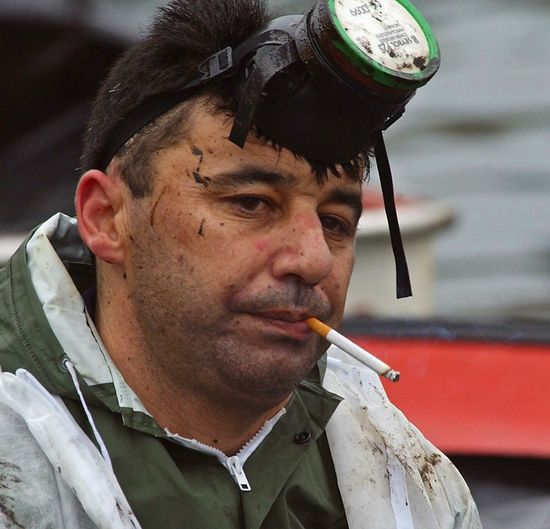
A fisherman takes a break while trying to keep oil slicks from the sunken tanker 'Prestige' with shovels and shrimping nets 04 December 2002, off Aguino, Galicia. Officials in northwestern Spain on Wednesday extended a ban on fishing and shellfish harvesting as far as south as Portugal as stincking thick fuel from the tanker Prestige spread out across the Galician coast. By Pierre-Philippe Marcou/AFP/GettyImages.
America’s Obesity Nightmare
A hefty new report paints an ugly picture:
The new forecast comes from a CDC and Duke University report alleging that within two decades, American obesity rates will top 42 percent, saddling the U.S. healthcare system with another 32 million obese people. Eleven percent of all Americans will be considered "severely obese," with body mass indexes (BMI) of 40 or higher. At a BMI of 40, a 5-foot 9-inch person would weigh more than 270 pounds.
L.V. Anderson notes that obesity forecasts tend to be slightly overstated:
They’re usually too large, but not by much. In 2003, the Centers for Disease Control and Prevention predicted that 40 percent of Americans would be obese by 2010. The actual 2010 adult obesity rate was 35.7 percent [PDF]. … Researchers sometimes have to hedge their bets because they don’t trust people to be honest about how fat they are. A 2009 report [PDF] estimated that American obesity rates in 2018 could be anywhere between 38 and 47.5 percent; the study’s authors attribute that nearly 10-point margin to “the tendency of individuals to understate their weight in telephone surveys.”
The budgetary stakes are high:
Slowing the rising rates of obesity in this country by just 1 percent a year over the next two decades would slice the costs of health care by $85 billion. Keep obesity rates where they are now — well below a 33 percent increase that's been expected by some — and the savings would hit nearly $550 billion over the same 20 years.
 The Dish
