What North Carolina Reveals, Ctd

GT_WEDDING-POSE_120510

A reader writes:

Can you please explain, statistically, your readers' repeated notions that a different voter turnout would have changed the outcome of Amendment One? 958,909 Democrats voted Tuesday, and 966,609 Republicans voted.  You don't have to be Nate Silver to see your readers' false claims; the turnout was split 50/50.  There was NOT over-representation of GOP voters.

Update from another reader, who has a very different interpretation:

Your reader is absolutely wrong in saying that GOP voters were not overrepresented in Tuesday's vote in NC. Using the data he/she linked to, you can see that registered Republicans make up 31% of registered voters in NC, while Democrats make up 43%. In a representative sample, you would expect the absolute number of Democrats voting to be higher than the absolute number of Republicans voting, but the proportion to be roughly the same as the proportion in the total electorate. Additionally, if you look at turnout as a percentage of registered voters in each party, 49% of registered Republicans voted, while only 35% of registered Democrats did. By this metric, a representative sample would include about the same proportion of each relative to the total registered voters.

I'm not sure the difference is enough to swing the outcome, because clearly some Democrats voted for the amendment, but GOP voters were pretty obviously statistically overrepresented in this election. This is particularly interesting because the Democratic primary for governor was more closely contested than was the Republican race, which we thought would impact turnout more than it did.

Another with on-the-ground experience agrees:

I’ve done work in North Carolina, and I can tell you, like Kentucky and West Virginia, NC has a much higher Democratic registration rate compared to its political leanings, left over from a bygone era.  Overall, party registration is 43 percent Democrat to 31 percent Republican.  In reality, the state is now pretty evenly divided, but there are a lot of reliable GOP voters who are registered as Democrats.

Take the last couple elections as an example.  In 2010 Democrat Elaine Marshall lost the Senate race 43 – 55 percent to Republican Richard Burr.  These two candidates were awfully generic, so if party registration was a good indicator of partisanship or ideology, Marshall should have won by 13 points instead of losing by 12.  Similarly, in 2008 with a similar registration advantage, Obama managed to eek out a win by less than a percent even with an electrified base and everyone voting.

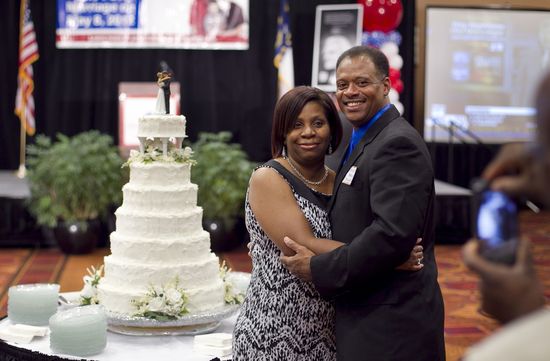
(Photo: Bishop Bruce Rogers of Raleigh, North Carolina, poses for a photo with his wife, Beverly Rogers, beside a wedding cake during an election party at the North Raleigh Hilton on Tuesday, May 8, 2012. Organizers plan to cut the cake if Amendment One – which would ban gay marriage, civil unions and domestic partnerships – passes. By Robert Willett/Raleigh News & Observer/MCT via Getty Images)

The Redefinition Of Marriage

Roderick Long reminds us how the institution has already been redefined – and redefined – and redefined:

It is true that the term "marriage" has traditionally been applied, for the most part, to heterosexual unions specifically (though often polygamous ones, a fact such critics persistently pretend to overlook). But it is also true that the term "marriage" has traditionally been applied exclusively to relationships in which the husband held legal authority over the wife – relationships in which the wife was not only subordinated to her husband but actually absorbed into his legal identity.

If we are going to appeal to traditional usage to deny that same-sex partnerships are genuine marriages, then by the same argument we will have to deny that relationships between legal equals can count as marriages. In the traditional meaning of "marriage," then, there are no married couples in the United States today.

Will Backing Marriage Equality Cost Obama Votes?

Not according to Jonathan Bernstein:

At the margins, Obama’s new position makes him slightly more prepared for the fall campaign; should marriage hit the headlines (say, from a major court decision), it’s probably easier for him to talk about it now than it was under his old position. And I'm not saying that social issues overall are not important politically. They certainly can be — but their importance, so to speak, has already happened; those who care about these things have sorted themselves by party long ago. So mostly, as far as November is concerned, this new wrinkle just doesn’t seem likely to have any effect at all.

Electionate agrees:

Obama’s coalition is far more resilient to opposition to gay marriage than any Democrat in history. If Obama was trying to reassemble the old Democratic coalition, which required Democrats to win a near majority of the white working class vote to win the Presidency, gay marriage would be a terrible proposition for Democrats electoral chances, since winning half of the non-college white vote would require winning many opponents of gay marriage. Today, Obama would be thrilled with 40% of the non-college white vote, and can probably win beneath 35%. This more modest feat will require winning far fewer conservative, white gay marriage opponents. Similarly, gay marriage would be far more threatening to a Democrat who couldn’t count on historic levels of support and enthusiasm from African American voters.

Amanda Marcotte argues along the same lines:

With the gay rights issue, the don't-care factor is rising rapidly alongside the open support for same-sex marriage. Which is to say that a lot of people who oppose gay marriage do so in a softer way than before. They will hold on to their belief, but they also see the writing on the wall and are adjusting their commitment to this issue accordingly. They'll vote against gay marriage in a special election, sure, but they've also decided they're not going to lose any sleep if the courts declare same-sex marriage a right.

Another good indicator: Intrade hardly budged.

Gutting Defense

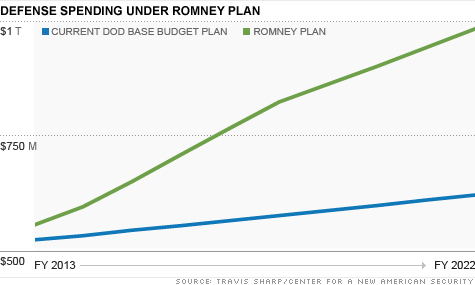
Chart-romney-defense-spending.top_

Is popular

According to the survey, in which respondents were told about the size of the budget as well as shown expert arguments for and against spending cuts, two-thirds of Republicans and nine in 10 Democrats supported making immediate cuts — a position at odds with the leaderships of both political parties. The average total cut was around $103 billion, a substantial portion of the current $562 billion base defense budget, while the majority supported cutting it at least $83 billion. These amounts both exceed a threatened cut of $55 billion at the end of this year under so-called "sequestration" legislation passed in 2011, which Pentagon officials and lawmakers alike have claimed would be devastating.

Chart from Charles Riley, who comments:  

Romney's plan to spend more at the Pentagon adds yet another layer of complexity to a set of proposals that would remake the fiscal landscape. Romney has proposed a slew of tax cuts, and plans to cap federal spending at 20% of GDP. But in both cases, the Romney campaign hasn't fully explained how those provisions will be paid for. The lack of detail means that Romney's claim of moving toward a balanced budget requires a great deal of trust.

Mataconis has more

Obama Would Have Evolved On His Own?

That's what John Dickerson is hearing:

White House and campaign officials have been talking about it for months. According to several sources involved in the campaign, the president was going to make his announcement soon, before the convention (and maybe even very soon) if for no other reason than to avoid a fight over the party platform and to rally gay supporters. Biden stepped on his plan, making it look like the president was backing into a decision and controlled by events.   

The Tide Turns, Ctd

Funny, isn’t it, how this campaign, supposed to be entirely about the economy, keeps slipping back to social issues, from contraception to marriage equality. Funny, also, how Obama has gained on Romney during the first part of this year. If this is a choice election, and social issues are salient, then Romney’s in trouble. Every day he loses his economic message, his referendum on Obama gets shunted back a bit. So no surprise that Romney would rather not discuss immigration, gays, or marijuana. The part of the interview where he gets testy:

Allahpundit has two questions:

One: Why is he okay with domestic partnerships but not civil unions? Is there some principled distinction he has in mind or is that purely a minor strategic concession to pro-gay-rights Republicans? Two: Andrew Kaczynski makes a very good catch. Watch to the last seconds of the clip and you’ll hear Romney say, almost offhandedly, that gay marriage and marijuana are state issues. Is that really his official position? Didn’t he sign a pledge supporting a Federal Marriage Amendment?

That’s his first flip-flop against Christianist orthodoxy. He’ll flip back soon enough. But I do think Allahpundit is absolutely right. If Romney is against civil marriage and civil unions, what rights does his view of domestic partnership contain? Or rather some reporter needs to ask: which rights, in Romney’s view, should heterosexual couples have that homosexual couples shouldn’t? Could I be compelled to testify against my husband in court, for example? Would domestic partnership guarantee inheritance rights? Access to hospital rooms? What specific variety of inferiority does Romney propose for gay couples? First Read explains Romney’s caution:

The challenge for Romney in next 48 hours will be making sure that the same thing that happened on contraception doesn’t happen on gay marriage. He doesn’t need the Rush Limbaughs of the world going bonkers on this today and Romney having to defend comments from the rhetorical extremes. That’s Romney’s internal challenge – and one he has little control over — that his party doesn’t go down the rabbit hole on this.

Romney: A Gay-Basher In High School, Ctd

Romney has now apologized. He claims he didn't know the classmate was gay:

“I certainly don’t believe that I thought the fellow was homosexual,” Romney told Kilmeade. “That was the furthest thing from our minds back in the 1960s.”

But I thought he had no memory of this incident? That was his position this morning. And there was no homophobia in the 1960s? Seriously: Etch-A-Sketch. Regardless, Chait analyzes:

The story does give the sense of a man who lacks a natural sense of compassion for the weak. His prankery seems to have invariably singled out the vulnerable — the gay classmate, the nearly blind teacher, the nervous day student racing back to campus. It’s entirely possible to grow out of that youthful mentality — to learn to step out of your own perspective, to develop an appreciation for the difficulties faced by those not born with Romney’s many blessings. I’m just not sure he ever has.

I conclude two things: Romney was a high school bully of gay or effeminate kids and is also a brazen liar.

Romney: A Gay-Basher In High School

The difference becomes starker still, as this multiple independently sourced story indicates:

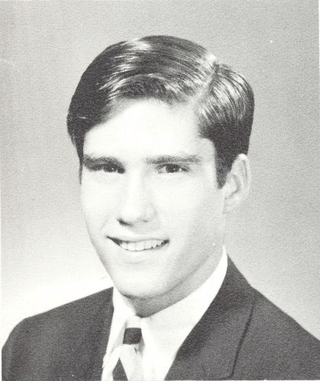
Mitt Romney returned from a three-week spring break in 1965 to resume his studies as a high school senior at the prestigious Cranbrook School. Back on the handsome Screen shot 2012-05-10 at 12.01.28 PMcampus, studded with Tudor brick buildings and manicured fields, he spotted something he thought did not belong at a school where the boys wore ties and carried briefcases. John Lauber, a soft-spoken new student one year behind Romney, was perpetually teased for his nonconformity and presumed homosexuality. Now he was walking around the all-boys school with bleached-blond hair that draped over one eye, and Romney wasn’t having it.

“He can’t look like that. That’s wrong. Just look at him!” an incensed Romney told Matthew Friedemann, his close friend in the Stevens Hall dorm, according to Friedemann’s recollection. Mitt, the teenaged son of Michigan Gov. George Romney, kept complaining about Lauber’s look, Friedemann recalled.

A few days later, Friedemann entered Stevens Hall off the school’s collegiate quad to find Romney marching out of his own room ahead of a prep school posse shouting about their plan to cut Lauber’s hair. Friedemann followed them to a nearby room where they came upon Lauber, tackled him and pinned him to the ground. As Lauber, his eyes filling with tears, screamed for help, Romney repeatedly clipped his hair with a pair of scissors.

That's an assault on someone whose only crime was being gay. Then this:

In an English class, Gary Hummel, who was a closeted gay student at the time, recalled that his efforts to speak out in class were punctuated with Romney shouting, “Atta girl!” In the culture of that time and place, that was not entirely out of the norm. Hummel recalled some teachers using similar language.

Romney says he has no memory of this incident, although five others have not just memories but vivid, guilt-ridden recollections. As for the victim, he did not forget. How could he? Years and years later, one of the bullies Romney rounded up bumped into his victim at an airport and felt the need to apologize:

“I’m sorry that I didn’t do more to help in the situation,” he said.

Lauber paused, then responded, “It was horrible.” He went on to explain how frightened he was during the incident, and acknowledged to Seed, “It’s something I have thought about a lot since then.”

Lauber died in 2004, according to his three sisters.

Yesterday was a day for all those who didn't live to see it. Including Romney's young victim.

Ask Maggie Anything: Gay Marriage vs Interracial Marriage?

Previous videos of Maggie Gallagher here, here and here. A reader writes:

In response to Maggie, I was once part of a proud “unnatural family”. In 2003, as a single adult, I adopted my son Josh. Josh’s natural family – his birth mother and birth father – had had their parental rights terminated by the court system in Minnesota because they had been unable to provide Josh with a safe environment. Josh first entered into foster care in 1999. So after four years in foster care he was further “deprived” by being placed permanently in an unnatural family. I’d be interested in hearing what Maggie would tell my Josh son about what all he was deprived of having been forced to live in an unnatural family. (I did get married in 2008, so Josh does now have a mother and father – though I still wonder if we would qualify as a natural family.)

We actually asked Maggie a related question submitted by a reader:

Q: Is extended foster care for children preferable to adoption by homosexual parents?

A: I don’t think so; most likely no.

“Ask Anything” archive here.