Romney’s Immigration Dilemma

Kornacki lays it out:

To have any chance of cutting into Obama’s massive Hispanic advantage, Romney needs to move to the middle on immigration, which explains why he’s backed away from some of his most extreme primary season pronouncements. So far, this hasn’t caused a revolt on the right, but the real test – when Rubio unveils his watered-down Dream Act and Romney is forced to say “yes” or “no” – is still to come.

Relatedly, Michael Scherer sizes up the Romney campaign's outreach to Latino voters.

Did The Tea Party Sink Lugar?

How Mourdock framed the election:

Ramesh Ponnuru's reaction to Lugar's loss:

In short: The tea party may be losing popularity, but its power inside the Republican party appears to be growing.

Conn Carroll agrees:

If Mourdock loses the general election, Republican moderates and their lobbyist friends on K Street will paint the Tea Party as extremists who can’t win elections. They will will try and define the Tea Party movement as the party of Christine O’Donnell, Sharon Angle, and Joe Miller. But if Mourdock wins, the Tea Party will be the center of the Republican Party, embodied by Sens. Marco Rubio, Ron Johnson, Rand Paul, Scott Brown. 

Chris Cillizza and Aaron Blake counter that narrative:

At its heart, Lugar’s defeat was attributable to the fact that he broke the political golden rule: Never lose touch with the people who elected you. “A strong majority of GOP primary voters felt that Lugar had served too long and was too old and should retire,” said Christine Matthews, a Republican pollster who conducted several bipartisan surveys in the state. “Three-fourths of voters supporting Mourdock said their reasons centered around Lugar’s longevity, age, and lack of residency.”

Noah Millman doubts Mourdock will be an "ideological purist of any sort":

What Murdock has made clear is that he’d be more of a partisan than Lugar was. So, had he been sitting in the Senate when TARP or Medicare Part D or No Child Left Behind were up for a vote (all initiatives of a Republican Administration), there’s every reason to believe that Murdock would have voted the way the party leadership wanted him to – that is to say: in favor. But he’d be less-likely than Lugar to work on high-minded bi-partisan initiatives of one sort or another. Whether that’s a loss or a gain depends greatly on whether you think such initiatives are generally productive or generally pointless.

Chait fears that Republicans will become ever more extreme in response: 

The social norm against blocking qualified, mainstream Supreme Court nominees is one of the few remaining weapons the Republican Party has left lying on the ground. But if Republican Senators attribute Lugar’s defeat even in part to those votes for Kagan and Sotomayor, which seems to be the case, what incentive do they have to vote for another Obama nominee? And then what will happen if he gets another vacancy to fill – will Republican Senators allow him to seat any recognizably Democratic jurist?

Jennifer Rubin is more upbeat:

It is far from clear whether Republicans have slit their own throats for the general election, as they did in Nevada and Delaware in 2010. Indiana remains a red state, one that Mitt Romney is expected to win, thereby boosting down-ticket Republicans. Moreover, Mourdock’s opponent, Rep. Joe Donnelly (D-Ind.), is vulnerable insofar as he has voted with the White House on legislation that is hardly popular back home (e.g., Obamacare, the stimulus).

Bob Wright applauds Lugar's career:

I think the ultimate tribute to Richard Lugar's career lies in what he said about several Senate votes that had come back to haunt him in the primary: "It was apparent that these positions would be attacked in a Republican primary. But I believe that they were the right votes for the country, and I stand by them without regrets." Of course, members of congress often talk as if they vote only for things they consider "right for the country," without any thought of political fallout. And of no one in congress is that entirely true. But I think it's a lot closer to being true of Richard Lugar than of most Republicans, and of most Democrats as well.

Nate Silver counts the remaining moderate Republican senators:

Overall … [the GOP] have very little of a moderate coalition left, and the Republican Senate is starting to grow as conservative as the Republican House.

“Like A Hand Job In A Bangkok Bathhouse”

Matt Taibbi predicts the election:

The people who work for the wire services and the news networks are physically incapable of writing sentences like, "This election is even more over than the Knicks-Heat series." They are required, if not by law then by neurological reflex, to describe every presidential campaign as "fierce" and "drawn-out" and "hotly-contested."

But this campaign, relatively speaking, will not be fierce or hotly contested. Instead it'll be disappointing, embarrassing, and over very quickly, like a hand job in a Bangkok bathhouse. And everybody knows it. It's just impossible to take Mitt Romney seriously as a presidential candidate. Even the news reporters who are paid to drum up dramatic undertones are having a hard time selling Romney as half of a titanic title bout.  

Kilgore counters. Dan Amira mocks:

The power of precognition must be both a gift and a curse for Taibbi. On the one hand, it allows him to foretell with certainty the outcome of a presidential election that won't be decided for half a year, but on the other hand, he also knew Bruce Willis was dead the whole time.

Black Studies And The Chronicle’s Cowardice

Naomi Schaefer-Riley, a blogger at the Chronicle of Higher Education, recently wrote in part: 

If ever there were a case for eliminating the discipline, the sidebar explaining some of the dissertations being offered by the best and the brightest of black-studies graduate students has made it. What a collection of left-wing victimization claptrap. The best that can be said of these topics is that they’re so irrelevant no one will ever look at them.

The post prompted a torrent of left-wing outrage and, ultimately, Riley's sacking - which brought out the right's counter-outrage. This time, it seems clear to me that the right is right. Riley's commentary is well within the bounds of provocative opinion writing. Firing her was an act of cowardice and an assault on intellectual freedom. Jonathan Tobin argues:

The dissertations she mentioned speak volumes about the low level of discourse that passes for academic achievement in this field. That topics such as black midwives being left out of natural birth literature, the notion that the promotion of single family homes is racist and the branding of black conservatives as opponents of civil rights are the work of the best and brightest in black studies tell us all we need to know about why Riley is right about the need to eliminate this form of academic fraud.

The PhD students Riley attacked, in turn, defend their own work:

Riley displays breathtaking arrogance and gutless anti-intellectualism by drawing such severe conclusions about our work and African-American studies as a whole based on four or five sentence synopses of our dissertation projects.  In fact, Riley has never read our dissertations, as they are in process.  Nor has she read a chapter or even an abstract of our work, but that does not stop her from a full throttle attack on our scholarship and credibility.

Dreher moderates somewhat:

Thousands of people wrote to the Chronicle to protest the racial insensitivity, etc., in Schaefer Riley’s essay. Gosh. I don’t know how she manages to keep up her racist chops, given that she’s been married for some time to a black man. Anyway, shoot one, teach future bloggers that they can never make fun of  "scholarship" if the scholars are part of an official victim class. …

Riley’s blog post was not a sterling example of the genre, and she left herself open to strong criticism. I have no problem with that. But firing her for an ill-considered blog post? Really? That’s not about upholding the Chronicle blog’s standards. It’s about heretic hunting.

Jonathan Last nods:

If Naomi’s post was self-evidently egregious, she would have been fired immediately. Instead, on May 3, McMillen defended the post as being part of the blog’s intellectual ferment and encouraged readers to debate it. Which makes it obvious that the reason they gave Naomi the boot wasn’t because of anything she wrote, but rather the effect her writing had on their readers, who generally reacted as though they were suffering from a case of the vapors. One of her fellow Chronicle bloggers accused Naomi of committing "hate speech" and an online petition called for Naomi’s firing. In fact, McMillen admits as much, saying that Naomi’s post "distressed" readers and made them feel "betrayed."

Even Lauri Essig, a Chronicle blogger who calls Riley's post "hate speech", isn't on board with the firing:

Partly I have not signed the petition because I am not sure The Chronicle should fire someone because they are nearly universally reviled. There are all sorts of people who believe I should be fired from The Chronicle‘s Brainstorm blog and some of them go so far as to call my institution and suggest I be fired from there as well. Which leads me to believe that editorial decisions about who stays and who goes should not really be in response to public pressure since no unpopular views would ever be published, at least not for long.

What European Austerity?

Vero2

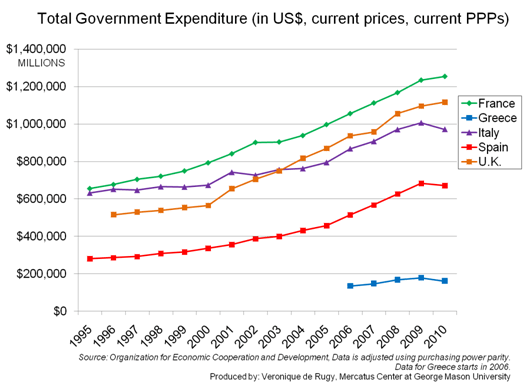
Veronique de Rugy throws down:

First, I wish we would stop being surprised by what’s happening in Europe right now. Second, I wish anti-austerity critics would start acknowledging that taxes have gone up too–in most cases more than the spending has been cut. Third, I wish that we would stop assuming that gigantic “savage” cuts are the source of the EU’s problems. 

Wilkinson reframes the debate:

I suspect the entire debate hinges on a difference in assumptions about the relevant spending baseline. If your theory prescribes significantly ramping up spending during recession, low or flat spending growth can look perversely “austere,” even if absolute spending as a % of GDP is very high.

Tyler Cowen adds:

It is fine to argue “due to automatic stabilizers, spending should have increased more than it did.”  That is not how people phrase it, rather they are complaining rather vociferously about “spending cuts,” many of which are either imaginary or extremely small.

Some of this is above my paygrade. But surely some of the increased spending comes from the cost of unemployment and other "automatic stabilizers." Drum argues that De Rugy's chart is wildly misleading:

There are, obviously, some problems here: the figures are in nominal euros/pounds, there's no adjustment for population growth, and anyway, the whole point of the anti-austerity Keynesians is that during a massive recession spending should be sharply higher, especially in the face of relatively tight central bank policy. Spending that's flat or slightly down is massively contractionary.

Ryan Avent nods

The supposed absence of austerity in Ms de Rugy's figures is mostly a product of poor graph scaling and a reliance on nominal, absolute figures …The spending cuts are there, in spades.

Brad Plumer echoes:

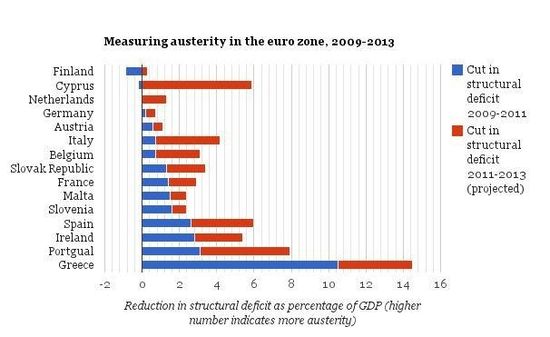
[A]usterity really is happening in Europe. The best way to see this is to look at the change in the “structural budget deficit” for each euro zone country — that’s the amount of deficit countries have once you factor out economic conditions. In other words, this is the part of the deficit that governments have direct control over. And, according to data from the IMF’s World Economic Outlook (see table B-7), most euro zone countries have been sharply cutting their structural deficits since 2009.

Plumer produces this chart as proof:
Austerity_eurozone

Martin Wolf has an excellent primer on the question of whether austerity actually increases debt in the long term. His bottom line:

The first and most obvious point is that the fiscal impact of the crisis is forecast to have overwhelmed the impact of tightening, over this period. Thus, between 2008 and 2012, the actual fiscal deficit is forecast to improve in only three countries: Italy (marginally); Malta and Greece. In no country, is the actual improvement forecast to be more than 2.5 per cent of GDP (namely, Greece).

Yglesias argues that "the debate over austerity in Europe has been mapped onto the American partisan debate in a weird way." Howard Gleckman takes the debate in another direction:

[T]here is only real lesson for us to learn from the recent European experience:  The U.S. needs to fix its long-term budget program as soon as it can, and on its own terms. Because you never, ever, want to find yourself at the mercy of the bond vigilantes. If you don’t believe me, just ask the Greeks.

My view, for what it's worth, is that Obama's infrastructure spending and tax cuts have worked well to avoid a depression – but without a clear long-term deal to cut the structural deficit, we remain in deep trouble. Worse: the US is likely to make European austerity look mild next year if there's deadlock and all the Bush tax cuts are ended, along with sequestration in entitlements and defense. I have no idea how deep the austerity would be under the Ryan plan as diligently executed by Romney. But to plunge into immediate austerity just as the recovery is gathering some steam strikes me as a very good reason to be skeptical of the GOP this fall.

We need smart long-term entitlement reform, revenue-enhancing tax reform and defense cuts. What voters have to figure out is which combination of partisan forces can bring this about. My fear is that the GOP is now so extreme we will eventually be delivered to the bond vigilantes. Even with a reserve currency – a luxury the Europeans do not have.

Will Obama Evolve In A Few Hours? Ctd

I said I didn't care. But as I reflect on what such a statement would mean to those brutalized by what happened last night, and as I think about my own hopes about this president's character and integrity, I realize I do care. Maybe I am just braced for disappointment. Maybe I have become cynical – thinking this may have to do with gay money, with Wall Street disappointing. Time to snap out of it. I stand by my view that this is an issue for the states and the Congress. But a president actually openly committed to full civil equality for gays and lesbians? I should read my own sign offs.

Know hope.

The Politics Of Spite, Ctd

Spite

A North Carolina reader adds some local context:

Your post was right on, but I think you are missing a couple of key elements in the maneuverings here.

The Amendment ballot was taken during a primary (a primary that was thought, at the time they scheduled it, to be a hotly contested GOP presidential contest – many thought NC would be a decisive state in the GOP primary). Thus, the NC GOP was stacking the vote for the amendment. Now, look at the 2008 totals in the General for NC:  70% turnout. If you put this issue on the general ballot in NC even this year, facing a 70% turnout (or better as projected), it would be defeated.

We know this because Speaker Tillis and Rep. Stam basically admitted as much when they called the schedule to vote.  Please don't go around saying a majority of North Carolinians support this.  A majority of about 1/3 of the registered electorate supported it.

The other element, is that this amendment was written by Rep. Stam (R-Apex, NC).  Stam has been the American Legislative Exchange Council's state legislator of the year, and has participated in their conferences for several years.  His signature achievements to date have all been ALEC inspired legislation, much of it transcribed chapter and verse from ALEC's "model" legislation.  It is not a stretch to think that Stam's role in pushing Amendment 1 was a direct result of his participation with ALEC.  Everything he does has ALEC's fingerprints on it.

So ask yourself these questions, why does (or why did) ALEC want Amendment 1 in NC?  Which sponsors of ALEC are popping champagne corks today?  Why was the amendment written in such broad language, affecting even un-married heterosexual health insurance benefits?  In short, which pecuniary interests are served by this legislation?  I respectfully suggest this has less to do with politics, and more to do with the bottom lines of insurance companies.

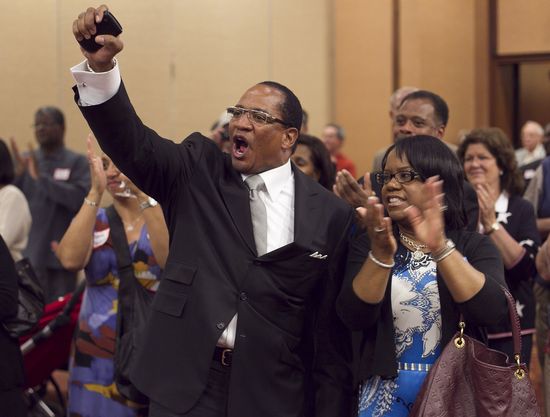
(Photo: Dr. Patrick Wooden, senior pastor of the Upper Room Church of God In Christ and his wife, Pamela Wooden, celebrate early returns that show strong support for Amendment One during an election night party at the North Raleigh Hilton on Tuesday, May 8, 2012. By Robert Willett/Raleigh News & Observer/MCT via Getty Images)

Farting Didn’t Kill The Dinosaurs

Fox News misreads a new study. Daniel Stone corrects the record:

[N]o one ever said anything about extinction—except for the news outlets that picked up the story for its obvious headline potential. Researchers had looked at global climate change, and found that, yes, such a massive amount of methane expulsion "could have been significant in sustaining warm climates." But reports  that the warming was what killed off the animals? Blatant sensationalism, says Paul Myers, a biology professor at the University of Minnesota. 

Glad we cleared that one up.

Quote For The Day II

“Maybe it’s time for another kind of Freedom Summer. Is it too late to organize one?

I think instead of moving the Democratic Convention out of North Carolina and shunning the state we should shame them by descending on it in massive numbers. LGBT people and our friends and families and supporters from all over the country should invade that place and plan peaceful demonstrations and nonviolent resistance in the spirit of Dr. King and Gandhi. Tens of thousands of us should target the most virulent homophobic counties according to voting data,” – Kevin Sessums, Facebook.