Alas, one bit him and he died.
Month: May 2012
Quote For The Day
"When they debate, Barack will smoke Romney," – Sidney Barthwell, Romney's classmate at Cranbrook and Obama's at Harvard Law.
The Politics Of Eurovision
The Hathos–inducing song competition just concluded. Fareed Zakaria reads into it:
[T]he fascinating thing about Eurovision is not the performances or the music. It's the politics and public psychology. Here at GPS, we plotted the capital cities of the winning countries from the past two decades on a longitudinal graph – yeah, that's the kind of thing we do in our spare time. We found that in the 1990s, the winners tended to be from Western Europe – Dublin or London. But by the late 2000s, the winners mostly came from the East – Moscow and Kiev. Europe's center of gravity is clearly moving East. And these voters have interesting tendencies. In 2003, Britain got exactly zero votes – that was the year the Blair government supported the war in Iraq.
Hayley Sweetland Edwards profiles this year's host (and last year's winner), Azerbaijan. The above video, Rambo Amadeus (Montenegro)'s performance from this year's contest, is on Lois Parshley's list of worst Eurovision songs.
The Outrageous Acts Teens Don’t Commit
Nick Gillespie rounds up drug and sex panics involving teenagers. Among them:
In 2007, the Sheriff's Office of Collier County, Florida perpetrated one of the most ridiculous frauds in the annals of police work when it reported that kids were getting turned on by a "new drug called 'Jenkem,'" which was made from fermented urine and feces. Sure, kids today are into do-it-yourself culture, but given that real drugs are reportedly easier to score than ever, who exactly would be into what the cops averred was known by slang terms such as "butthash" and "fruit from crack pipe"?
Along the same lines, news outlets are still claiming that teens are getting drunk off of vodka-soaked tampons, despite the extraordinary lengths Danielle Crittenden went to in debunking the urban legend.
How Hard Do Greeks Work?
Not very, say its neighbors:
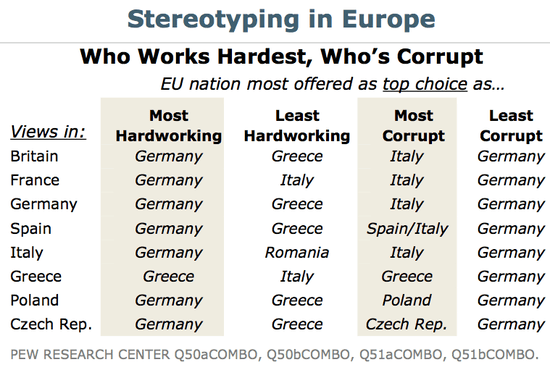
Leonhardt captions:
In most large European countries, a plurality of people say Germans are the hardest-working Europeans, with a substantial share also saying that Greeks are the least hard-working. Greeks, on the other hand, say Italians are the least hard-working — and view themselves as the hardest working.
But Greeks do work more hours than Germans. Brad Plumer notes the decline of goodwill:
[W]hat’s perhaps most significant about the Pew surveys is that most Europeans now have a very low opinion of Greece. Back in 2010, 65 percent of the French public felt more or less favorably disposed toward the Greeks. Today, that’s down to 45 percent. Voters in Germany, Spain and Italy take an even dimmer view of their Aegean neighbors. That doesn’t bode well for any future attempts to salvage Greece’s place within the E.U., given that most of the ideas involve handing Greece more free money.
A Test City

One is being built in New Mexico. Its creators hope the functional but empty city "will be used to test everything about the future of smart cities, from autonomous cars to new wireless networks":
CITE will intentionally be an imperfect place, one where everything won’t always work properly, where researchers will find more frustration than they ever do in a lab. CITE will not be a "smart" city in the desert, as many planners and engineers may dream of constructing from scratch. "We’re a dumb city,” Brumley says, "and we bring smart technology to the dumb city, or the ‘legacy’ city, to see how its IQ can be elevated. If you think of it that way, 99.9 percent of all American cities are dumb–they’re all legacy."
And this, he says, is one of the big questions of our times: How do we effectively spend billions of public dollars needed to make our cities smarter, more efficient, and sustainable, if we don’t know for certain exactly which technologies will do the job? Those questions, he hopes, can be answered here.
Yglesias Award Nominee
"Conservative bloggers led the charge in denouncing [Chris] Hayes. They shouldn't have. Hayes wasn't attacking the war dead. He wasn't even concluding that we shouldn't use the word "hero" to describe them. He was using his feelings — discomfort rooted in concern that the label applies a positive pressure towards U.S. entry into more wars — to open a discussion. … More contemporary biases ought to be questioned, not fewer. Conservatives, the minority in the media and academic elites, ought to be the first to defend those who raise uncomfortable questions or stake out unpopular views," – Timothy Carney, The Washington Examiner. Previous commentary here and here.
The Daily Wrap

Today on the Dish, Andrew demanded an analysis of Romney's foreign and domestic policies in light of Mormonism's stated doctrines on the topics, wrote a message playbook for the Obama team, put a torture apologia under the microscope, found Mitt willing to say anything to win, and noted an irony in Jonah Goldberg's anti-Millenial rant. We waded into the Chris Hayes heroism controversy, examined Romney's support among veterans, kept up with Paul and the Paulites, watched Mitt sink in Michigan, tracked supporter Trump's birther tendencies, wondered how he could possibly buck the right once in office, compared the challenger to the incumbent on job creation, reframed the spending debate, discovered GOP Keynesianism, and debated Obama's hypocrity on drugs. Ad War Update here.
Andrew also worried about the future of journalism, confessed his no-deoderant rule, and was appalled by the West Bank road system. We memorialized the Syrians killed in the Houla massacre (follow-up here), asked Obama to think about saving the euro, looked to one idea for the Europeans to do it themselves, and saw some signs of doom. Farrakhan bashed equality, young Mormons started to embrace it, a writer championed the wedding complex, a reader sounded off on 50 Shades of Grey's protagonist, American women worked super-hard, a business card invited you to "call me maybe" (sidebar: does anyone not love that song?), and Facebook provoked family infighting. The flag's meaning spawned much discussion, assault weapons slipped through a loophole, schools diminished biking rates, and backpackers carried too much. The South provided American Idol winners, time challenged doctors, cars shaped television, and mold fascinated (follow-up here). Ask Eli Lake Anything here, Quotes for the Day here and here, Creepy Ad here, Yglesias Award Nominee here, Map of the Day here, VFYW Contest Winner here, VFYW here, MHB here, and FOTD here.
– Z.B.
Quote For The Day
“I don’t want my son to play football. I play football so he won’t have to. With what is going on, I don’t know if it’s really worth it. . . . I don’t want to have to deal with him getting a concussion and what it would be like later in life,” – Jets linebacker Bart Scott. Hat tip: TNC.
What Does The Flag Mean To You? Ctd
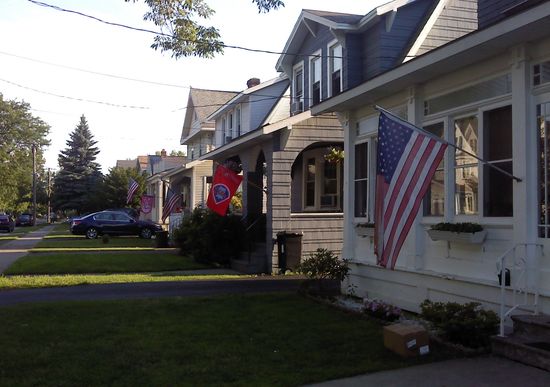
Readers continue the thread triggered by this VFYW from Memorial Day:
I'm sure you'll get a lot of mail on this, but let me just say that the letter you printed (from the self-professed liberal who doesn't display the flag) is a very good description of liberals today: They overthink even the simplest thing to the point where they lack the confidence in virtually anything anymore – even the things they say are important to them. There is really something wrong with believing in the flag but then refusing to fly it because others might think you are doing so because you've fallen prey to nationalism, or others might think you are doing so for the wrong reasons. We fly our country's flag because we are proud of the things it stands for. And we are proud of our country not because we agree with everything done on her behalf (and certainly not the nasty things that we would never agree with), but because we think of our country in the same way we do our family. We're proud of it, happy to demonstrate our pride to others, and don't think, for a moment, that our pride in our family reflects in any way some kind of put down on other families.
I'm a mostly progressive Democrat, and a proud flag flyer. And I'm absolutely comfortable in my love of country.
Another differs:
You can call me an unredeemable snotty Eurotrash transplant but personally, I find all this flag waving incredibly tedious. It seems very conformist, shallow and perfunctory, just like sending a bunch of hallmark cards on Christmas to all the people you don't care about but feels obligated to out of a misguided sense of propriety. To be honest, the single coolest moment of USA flag waving I've ever seen, the only time it was really, really, actually worth it, the only time it really meant more than just the USA but humanity as a whole – it's this pic of Neil Armstrong and Buzz Aldrin setting up the flag on Tranquility Base.
An Iraq veteran writes:
So I know this thread was mostly wrapped-up yesterday, but I keep thinking about it. And then reading the amazing Letter of Note from Kurt Vonnegut, Jr. really drove home why I'm so uncomfortable around things like Memorial Day.
I'm an Iraq war veteran, though I very rarely tell people that. Partly because I never kicked in any doors or anything – I had about the cushiest of war zone duties possible, although being in Kirkuk in 2006-2007 meant lots of random motar/recycled rocket attacks and stuff. But the other reason I never tell anyone about it is the reaction, like everything about me being there was unambiguously positive.
Which brings me back to the idea of mandatory reverence around the flag, Memorial Day, July 4, etc. Part of the reason that Vonnegut letter hits me so hard is that it makes me angry when people are just unable to have two thoughts in their head at once – that we should be respectful of those who do the things no one else really wants to do, like kill people, and that sometimes, just maybe, the stuff we ask them to do is terrible. (Although the experience of reading Slaughter House 5 to the soundtrack of actual air-raid sirens probably has something to do with the letter's impact.)
Maybe it's that I grew up in a world run by Baby Boomers (I'm 30), who seem especially incapable of understanding nuance of any sort, but it seems that most people who "fly the flag" and "support the troops" subscribe to this uncompromising approach to patriotism. I don't know how exactly to fold some self-reflection into these holidays, but I think it would sure help those of us who see a lot more gray in the things we've done.
A reader in Albany who sent the above photo writes:
I'm liberal. I don't own an American flag (not one I can fly, anyway). But what's more American than baseball? I got one of those flags. And the colors are right.
Another:
Today in the neighborhood I saw a house with an American flag and a rainbow flag, side by side. I woulda taken a picture for you, if I'd known it was a topic right now. I was a mite jealous that the gay resident had a clear way to say in flags: "I'm a patriot, but not one of *those* patriots."
Another:
Strangely, in my neighborhood the non-conservatives did take back the flag, it led to less display of the flag. The more conservative four houses on our short street used to display the flag on every appropriate occasion. Then we, the gay couple, moved in and did the same out of habit from our previous residences. About two years latter a Muslim family moved in next door, proudly displaying the flag and bunting celebrating the day of naturalization. The following fall, Barrack Obama was elected president. Now, not one flag will be found on the reliably Republican houses. It is almost like they need to take their flag and country back.
Last but certainly not least:
Six years after I left the United States because its freedoms do not include the basic capacity to reside with the love of my life (my same-sex, foreign spouse). Your Memorial Day flag question made me pause. I realized that to me, the flag means barely more than the flag of any other country. It stirs no contempt but also no meaning above negligible. If anything, it seems to conjure some vague previous life, before this life crisis so ransacked my brain.
Memorial Day evokes more. It makes me grateful toward those who enabled the Americans I love – parents, sibling, friends – to live well. So it's a third-party gratefulness, and boy, is all of this just unforeseeably strange.
 The Dish