Technical difficulties erased large parts of the draft post. The results will be posted at 2 pm. Stay tuned.
Month: May 2012
Hewitt Award Nominee
“I look at what happened between President Obama and President Karzai as a 1930s, Chamberlain, Hitler moment. There is not going to be peace in our time,” – Congressman Allen West.
West has already accused many Democrats of being closet communists (with no reprimand from the GOP). The question here is who exactly is Hitler and who is Chamberlain? Or when you're dealing with someone whose grasp on reality is as fragile as West's, does it really matter?
What North Carolina Reveals
It reveals that the anti-marriage equality peeps are not simply anti-marriage. They are against any civil recognition of gay couples' commitment, responsibility and equality. The Amendment today would ban any relationship rights whatever to gay couples in the state. No domestic partnerships, no civil unions – nada. It renders spouses strangers at hospitals, it ensures no legal stability for shared homes or shared children. It is in many ways a simple declaration that gay relationships are anathema to the people of North Carolina. That's what drives the anti-marriage equality movement: the removal of gay people from full family life.
Bibi’s Big Win Reax

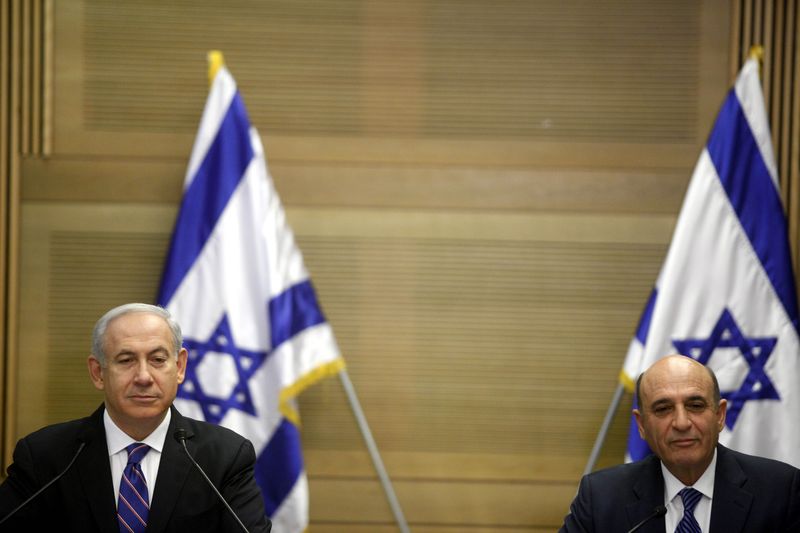
Michael Koplow summarizes everyone's reaction to the bombshell news that Israel's opposition leader, Kadima head Shaul Mofaz, has joined Bibi's government:
First of all, wow. The deal to form a Likud-Kadima government is a master stroke by Bibi Netanyahu, who now gets to avoid dealing with elections and having to make a bunch of imperfect choices in putting together a coalition, while also seizing on the fact that nearly 3/4 of Israelis want to see the Tal Law [exemption from military service for the ultra-orthodox] gone for good. He isn’t giving up anything, gets to cut Yair Lapid off at the knees, and strengthens his bid as the most dominant Israeli politician of his generation. This is an enormous win for him.
Noam Sheizaf gives essential context:
What made this move possible? In my opinion, there were two elements at play: Kadima crashed in the polls after Mofaz’s victory in the party’s primaries a couple of months ago, and the new party leader was under considerable pressure to give its 27 Knesset members another year in the parliament. Mofaz probably hopes that the coming months will help him position himself as a national leader, but I am not sure that the Israeli public will ever look favorably upon someone who changed his position so many times. Still, stopping the steady rise of other opposition leaders – most notably, former Channel 2 anchorman Yair Lapid – probably makes this move worthwhile for Mofaz.
JJ Goldberg declares victory for the peace camp:
[The deal] gives Mofaz a seat in the inner security cabinet, which gives him a voice in shaping policy toward both Iran and the Palestinians. If you haven’t been following, Mofaz has been defending Meir Dagan and Yuval Diskin in their criticisms of Netanyahu’s policies over the past year. He’s outspokenly opposed to attacking Iran at this stage. His own Palestinian plan, announced in 2009 and lately gaining increasing favor among fellow security types, calls for immediate recognition of a Palestinian state with provisional borders, controlling 60% of the West Bank for now, followed promptly by state-to-state negotiations toward a final-status agreement. To allay Palestinian suspicions that the provisional borders would be the final ones, Israel would deposit a pledge with the United States that the final borders will be based on the 1967 lines with agreed swaps.
Dalia Scheindlin nods:
The main towering advantage of postponing the elections until late 2013 is that it ensures only another year and a half of one of the worst governments Israel has ever had – a government that drove hundreds of thousands to the streets in economic desperation, pushed the Israeli-Palestinian conflict past the point of no return, and explicitly set out to mutilate Israel’s democratic process and what remained of its democratic character. If elections were held in four months, all polls bar none showed a resounding Likud victory, the same majority for the right-wing bloc, and ergo – probably a very similar government for another four years. Whatever terrible damage a super-sized coalition majority can do – it’s better to have this for 18 months, than for up to four more years.
Aluf Benn isn't so sure:
Now, Netanyahu is at his most comfortable. Instead of been dependant on the mood swings of Foreign Minister Avigdor Lieberman and the Likud's right-wing representatives, he has a coalition with two wings, between which he can maneuver. At times he'll break right, at others left, all according to the needs of the moment. He can throw a bone to Lieberman and then to Mofaz; build a settlement and evacuate illegal structures. At times he’ll indicate that war with Iran is near and at others he'll give U.S. President Barack Obama's diplomatic overtures a chance. No politician can dream up of a more perfect situation.
Goldblog, who also runs down seven theories about Bibi's motivations, looks east:
If the reports out of Israel are true, this means no election September 4, and it means that Netanyahu can proceed apace with whatever he's thinking about doing re: Iran's nuclear sites.
Jonathan Tobin gloats:
As for relations with the United States, while this development puts an end to the October surprise scenario in which a re-elected Netanyahu would have had two months to hit Iran while President Obama was still running for re-election, as I had already written, there wasn’t much chance that would happen. But with a unity government and the polls giving him overwhelming approval, Netanyahu has all the backing he needs to fend off any pressure from Washington in the next year and a half on either the Palestinian or the Iranian front. Liberal Zionists and Obama administration officials who have dreamed of Netanyahu’s defeat are just going to need to learn to live with him.
Robert Danin points to a potential point of weakness in the new coalition:
Netanyahu’s greatest challenge could emerge from elements within the country not represented in the Knesset: the social protest movement. Last summer, Israel witnessed unprecedented social protests that brought hundreds of thousands of Israelis to the streets for a number of months. These demonstrators rallied against skyrocketing housing and living costs, government corruption, and increased income disparities. In recent days, the grass-roots leadership of the social movement had begun to be courted by some of Israel’s political parties in the hope that these largely unaffiliated demonstrators could be mobilized behind the traditional parties. With elections no longer impending, the social activists may see the only alternative open to them this summer as being a return to the streets. Such a development will be no boon to Netanyahu’s free-market oriented Likud could leave the prime minister wishing he had proceeded with his plan to hold early elections at a time when a relatively easy victory appeared almost assured.
Brent Sasley throws up his hands:
[I]t’s hard to predict at this point how things will go. Much depends on whether the coalition partners can keep it together; on the American elections; on developments in Iran; and so on. We need a little more time to make durable arguments about the future.
(Photo: Israeli Prime Minister Benjamin Netanyahu (L) and centrist Kadima party leader Shaul Mofaz (R) attend a joint press conference in the Knesset to announce a coalition deal between the parties, on May 08, 2012 in Jerusalem, Israel. The pair announced that their Unity government would bring stability to Israel and the peace process. It is expected that Mofaz will become deputy prime minister. By Lior Mizrahi/Getty Images.)
Ask Maggie Anything: What Harm Has Same-Sex Marriage Caused?
A reader responds to the yesterday’s video from Maggie:
“We’re already seeing an unfolding of an America in which people are afraid to stand up in the public square and say that the ideal for a child is a mother and a father and this is why marriage is important.” First, it’s obviously untrue that people are afraid to say such a thing. Second, it makes anyone who does so brave and resolute. It’s simultaneously self victimizing and self congratulatory. Those who seek equal rights? Oppressors. Those who deny equal rights? Martyrs. Up is down, down is up.
Update from a reader who helpfully transcribes the above video and adds his own thoughts:
I did my best to transcribe Maggie’s response so I could properly appreciate it in its fullness. Here it is:
Question: In states where same-sex couples have been allowed to marry, what harm has been brought to individuals or society at large?
Answer: Well, I think we’re in the early stages of seeing my primary concern which is a transformation of the public understanding of marriage and the separation of it from its roots in the natural family. I think you see schools, for example, beginning to teach about marriage in ways that are contrary to the views of their – of many parents and many grandparents. And you see the idea and the ideal that children need a mother and father beginning to be redefined as an equivalent of a racist or mean or hateful idea. That’s on top of the problem of the silencing or the – which I already talked about, or the way religious institutions and religious people who in good conscience can’t treat same-sex unions as marriages begin to be treated as pariahs. So I think you see all of these things that – the problem, of course, is that the heart of the concern that I have about what’s happening to marriage isn’t limited to the states that actually passed gay marriage, that the heart of marriage is an idea, it’s not a set of legal benefits and as that idea shifts in one state or two states or three states, as more and more people get on board the gay marriage train you see less and less willingness to articulate, work for, support effectively the traditional understanding of marriage, so I do think it’s a zero-sum game, that gay marriage is not just adding a couple of people onto an existing institution, it requires re-norming the whole institution and making it serve new purposes instead of its classic purpose across time and history and culture, which is to bring together male and female so children have a mom and a dad.
Essentially, Maggie Gallagher is concerned about the affect of same-sex marriage on people like Maggie Gallagher. She cites no data or statistics or study which shows how any heterosexual marriages or children in families with same-sex parents have been damaged. She makes no claim that any such damages has occurred, only that people like her have been made social pariahs instead of the gay people who ought to be the pariahs. I’m sure there’s a social science term that describes what she is doing, but I guess I just find the complaint that “you’re making other people not like me” to be a rather petty and self-absorbed. Where, I wonder, is her concern about the affect on people other than Maggie Gallagher?
“Ask Anything” archive here.
Punishing Wives And Children
The Netanyahu government has decided to revive a policy – abandoned in 2005 – of razing the homes of Palestinians convicted of terrorism. In this case, the perpetrators were barbaric – killing three children and their parents in their sleep by cutting their throats. I certainly understand the impulse in the face of such evil. But I do not understand the rationale. The perpetrators are in jail; making their wives and children homeless by such an act of destruction is not, shall we say, conducive to peace, or allowed under Geneva Conventions (not that the US or Israel abide by those any more). The IDF is opposed. After the incident, violence did not erupt, mercifully. So why the brutality now?
With Israelis poised to go to the polls in September other critics accused Mr Barak of naked electioneering, suggesting that he had succumbed to pressure from the settler lobby to avenge the deaths.
Ah, yes, the settlers. More powerful than any Israeli prime minister or any American president.
Quote For The Day
“I can’t name a single Romney foreign policy adviser who believes the Iraq War was a mistake. Two-thirds of the American people do believe the Iraq War was a mistake. So he has willingly chosen to align himself with that one-third of the population right out of the gate,” – Christopher Preble, Cato Institute. Ari Berman has the staffing details to prove it.
You want a reprise of Bush-Cheney? You know who to vote for.
Romney, Mormonism, And Greater Israel
It's not just pandering to evangelicals. It's part of his Mormon faith as well:
The concept of dual Zions was first expressed 170 years ago—a half century before the First Zionist Congress, held in Basel, Switzerland in 1897. In Joseph Smith’s 1842 “Wentworth Letter”—a document in which Smith outlined the history and beliefs of his new Church of Latter Day Saints—the Mormon prophet wrote to his followers that:
We believe the Bible to be the word of God, as far as it is translated correctly; we also believe the Book of Mormon to be the word of God. We believe in the literal gathering of Israel and in the restoration of the Ten Lost Tribes—and that Zion will be built on this continent.
Smith’s ideas about the “literal gathering of Israel” did not remain in the realm of speculation. Rather, he acted on them with great haste.
In the following year, 1843, Smith sent his emissary Orson Hyde to Jerusalem, a quite arduous journey in those pre-steamship-travel days. Smith instructed Hyde to bless the holy city and to pray for the return of the Jews to it. A visitor to Jerusalem today can visit the spot where Hyde made this prayer. The Jerusalem branch of Brigham Young University (formally known as the BYU Center for Near Eastern Studies), located on the slopes of Mount Scopus and overlooking the Temple Mount/Haram al-Sharif, was constructed in the 1980s directly above the spot from which Hyde blessed the city. And Mormons worldwide continue their advocacy for what, in Smith’s time, was termed “the restoration of the Jews” and was later, within fifty years of Smith’s murder in 1844, termed Zionism.
The conservative Christian “pro-Israel” agenda has become a permanent part of the Republican primary campaign and will likely continue through the general election. American Christian Zionism is as old as Jewish Zionism, but in Romney’s case, the roots are even deeper.
More on the Mormon-Zionist connection here. The faith is officially neutral in the Israel-Palestine controversy, and some Mormons are actively pro-Palestinian. One nugget that drew my eye:
The LDS church has two congregations in Israel: the Galilee Branch in Tiberias and the Jerusalem Branch in Jerusalem. Latter-day Saints in Israel hold their worship services on Saturday, the Jewish Sabbath. Mormons do not proselytize in the area and are discouraged from proselytizing, as proselytizing in Israel is illegal.
The Right’s Cultural And Sexual Panic

Edward O. Wilson zooms out from our current politics to tectonic shifts in a social world:
We are entering a new world, but we’re entering it as Paleolithic brains. Here’s my formula for Earth’s civilization: We are a Star Wars civilization. We have Stone Age emotions. We have medieval institutions — most notably, the churches. And we have god-like technology. And this god-like technology is dragging us forward in ways that are totally unpredictable.
We have not gotten beyond the powerful propensity to believe our group is superior to other comparable groups. However, we are draining away the instinctual energy from nationalism — that’s a big help. I think we’re seeing the beginning of the draining away from the dreadfully dissolutive, oppressive institutions of organized religion. Seeing what’s happening is part of the reason for the Tea Party and the populist revolt now that has kidnapped the Republican Party. There’s a resentment about the old bonds and the old groups dissolving and new groups being formed.
I think his psychological analysis of the current reactionaryism in the GOP is dead-on. It's a form of cultural and sexual panic, as the world globalizes and miscegenates, above all in the chaotic melting pot of America. What conservatives need to be doing, to my mind, is not screeching ideology but figuring out ways to mitigate the disruption of inevitable change, and carefully adjust our institutions and policies to coopt it. Instead, they are standing athwart history and yelling "Backward!"
(Photo of "Field", an installation of 200,000 clay figures by Antony Gormley. Hat tip: My Modern Met.)
The Upbeat Populist
Alec Macgillis detects in Obama's first campaign speech over the weekend a populism that is "upbeat and aspirational rather than caustic, that harkens more to the Progressives than the Bryan-style Populists, that ties fairness to growth and opportunity, that warns against excessive inequality without dwelling on it":
All in all, the message Obama unveiled Saturday comes off as less “us versus them” than “all together now.” … We built this country together. I'm pretty sure we'll be hearing even more of this line in the months ahead than the “people are people” line. (And it's surely no accident that Obama's new post-speech theme song is “We Take Care of Our Own,” from Springsteen's latest album.) This is the kind of populism that is suited to Barack Obama—that evokes the warm glow of the 2004 convention speech while also drawing a clear distinction with the eat-what-you-kill ethos of Bain Capital and the Ayn Randianism of Romney's Washington ally, Paul Ryan. It summons to action the 99 percent in a way that does not traffic in class-warfare rhetoric (though he'll still be accused of that, of course.) Most importantly, it has an inspirational cast for a candidate who has far less potential be conjure a spark than he did four years ago, but must find a way to do so nonetheless.
 The Dish