Romney: Stronger Than He Looks

Sean Trende examines the swing state polls and Romney's path to Electoral College victory. An important point:

[M]ost state polls are presently sampling registered voters, not likely voters. Last cycle, moving from a registered-voters screen to a likely-voters screen resulted in a six-point difference in the Republicans’ favor. While the difference will probably be more in the three-to-four-point territory this time, that is nevertheless enough to move a number of the current "lean Democrat" states into the "tossup" category.

How Cities Produce Creativity

1582-architecture-design-muuuz-web-magazine-blog-photographies-art-serie-Amsterdam-Ile-de-Re-New-York-Prague-Paris-wall30-anne-laure-maison-2

Jonah Lehrer believes that cities "pry the mind open" by forcing us "to interact with strangers and with the strange":

I think we need to ensure that we don't surrender too much of our cities to the loveliness of upscale boutiques, fancy espresso bars and high-end restaurants. Money in a metropolis typically buys isolation – we get a little peace of mind and our very own parking space – but the creativity of a city depends on our constantly mixing and mingling.

('Tableaux d'intimité' by Anne-Laure Maison via Notcot)

Email Of The Day

A reader writes:

I am a professor at the University of North Carolina. I am a Westerner by birth and temperament, but after nearly two decades in this gentle, Southern state, I was until recently proud to call it home. 

Today, it looks likely to be the case that my beloved home will pass an amendment to its Constitution that will make me a permanent second-class citizen. Last night, I talked with my husband of 12 years what we should do. Should I look for a job elsewhere? I love UNC. I love its students. But it is clear that a majority of its voters will carve in large, bloody letters hatred into the Constitution.

Should I uproot myself? I plan on writing the Chancellor of the University on Wednesday to let him know that I will start the years-long process of finding a new job. I am heartbroken. American Theocracy is a real thing – and the machinery of a pluralist, democratic state has been hijacked. 

Truly, my heart breaks.

Mine too.

A Drop-Off In Voter Registration? Ctd

In part because of this unsettling news, liberal PACs and Super-PACs are focusing less on advertizing binges and more on get-out-the-vote grass-roots organization:

“You can dump 10 or 20 million in TV ads in Ohio and try to reach the persuadable swing voters there, or you can up voter turnout among Latinos in Colorado and Arizona and win that way,” Mr. Phillips said. “It’s much cheaper.”

The Isolation Of Republicans On Marriage Equality

For the second year in a row, Gallup has found a majority of Americans favor marriage equality for gay people. Its lead has narrowed a tiny bit, from 53 – 45 to 50 – 48, with a margin of error of 3 percent. What interests me is the partisan breakdown:
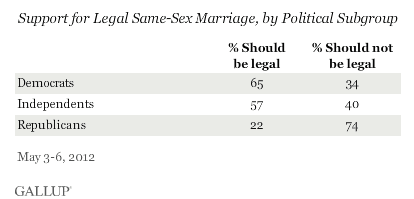
Screen shot 2012-05-08 at 9.30.14 AM

What you're seeing is the slow beaching of the elderly, white GOP on the shore of a multi-cultural and increasingly tolerant America. The difference between Dems and Indies is small; between those two groups and the Christianist party, there's a gulf. To be honest, I don't much care of Obama or Biden or any presidential candidate feels about this subject. What I care about is what they can do. And all they can do is stop defending DOMA in federal courts, and, er, that's it. The rest is for the Congress, to repeal DOMA, and let the federal government return to its long pre-1996 position of recognizing all marriages that are legal in any state, and applying full federal benefits to them.

Can we please stop this absurd game of wanting presidential candidates or presidents to solve this problem? They cannot. It is not within their constitutional powers. And we do not need their approval. History will provide the judgment.


The Country’s Biggest Company

Paul Pillar ponders Steve Coll's new book on ExxonMobile:

A corporation such as ExxonMobil that has interests that do not coincide with any one country—even its home country—and is as large and powerful as many states, needs to be treated in many respects as if it were a state. Like Australia, Colombia, or France, it shares many interests with the United States. As an ally, it can be a partner in mutually worthwhile endeavors. But as with other allies, the respects in which its interests diverge from those of the United States also must be kept in mind as public policy is made. That the biggest corporation of today is not anything like the General Motors of Charles Wilson’s day is not to be grieved or welcomed—just recognized as a reality to be dealt with.

Joseph A. Pratt, a University of Houston oil-industry historian, sizes up Private Empire:

Coll’s data-rich case studies of oil-related political infighting in both the U.S. and oil-producing nations are the most important contribution of his book. But the book’s major weakness is the lack of analysis of two linchpins of Exxon’s long-term success and power: Its near-obsession with financial controls, and its historical leadership in using new technology in ever-larger projects to find and produce oil and natural gas. These two factors have served as the company’s calling cards in negotiations with governments, and they deserve fuller treatment than Coll gives.

The Problem With Sitting

A designer's screed against chairs:

ChairNo one even knows what a "good" chair would have to do, hypothetically, let alone how to make one. Some ergonomists have argued that the spine should be allowed to round forward and down in a C-shaped position to prevent muscular strain, but this pressurizes the internal organs and can cause spinal discs to rupture over time. Others advocate for lumbar support, but the forced convexity that this creates is not much better in the short run and can be worse in the long: it weakens the musculature of the lumbar region, increasing the likelihood of the very injuries it’s meant to prevent. There are similar debates over seat height, angle and depth; head, foot and arm support; and padding. Galen Cranz, a sociologist of architecture and perhaps the world’s preeminent chair scholar, has called ergonomics "confused and even silly." For designers without a scientific background, it’s a clusterfuck.

Previous Dish on why sitting is killing us here and here.

(Image: by Astrid Bucio. Hat tip: Colossal)

Magical Thinking Is Universal

No one is immune to its charms:

Still skeptical that you’re a believer? OK, see if you recognize these behaviors. You yell at your laptop. You value a family heirloom or piece of celebrity memorabilia more than you would an identical duplicate. You care about your legacy after you die. Even though your computer isn’t conscious, objects can’t carry nonphysical essences, and you won’t be around after your death to care about your legacy. It’s all magical thinking. Which is not to say it’s always harmful or even foolish. It’s just part of being human.

North Carolina Votes Today

The final pitch by opponents of Amendment One:

PPP's final poll (pdf) finds that Amendment One is likely to pass with the "yes" percentage "somewhere in the 57-59% range." Voter ignorance is a big part of the problem:

In some sense North Carolinians are voting against their own beliefs. 53% of voters in the state support either gay marriage or civil unions, yet a majority also support the amendment that would ban both. The reason for that disconnect is even with just 24 hours until election day only 46% of voters realize the proposal bans both gay marriage and civil unions. Those informed voters oppose the amendment by a 61-37 margin but there may not be enough time left to get the rest of the electorate up to speed.

Earlier posts on the amendment are rounded up here.

A Drop-Off In Voter Registration?

According to the WaPo, the number of registered minority voters has declined significantly since Obama was elected in 2008. Adam Sorensen sounds the alarm

Most people lose their registration when they move between communities, and those likeliest to pick up and leave town are young, a slice of the population Obama won by 34 points in 2008, and those displaced by economic hardship. Obama beat McCain among voters making less than $50,000 a year by 22 points, and only narrowly lost whites in that income bracket by 4 points. So on both counts, the registration losses fall hard on Obama.

The Obama campaign insists that "[r]egistration among Latinos and African Americans has never been higher." More on the importance of Hispanic turnout here