The Daily Wrap

6a00d83451c45669e20168eaf541de970c-550wi

Today on the Dish, Andrew assessed the implications of Sarko's loss and the rise of the European left and explored a deeply disturbing proposal for resolving the Israeli-Palestinian conflict from Rep. Joe Walsh. We compiled reax to Hollande's victory, delved into Greek coalition negotiations, psychoanalyzed Britain's Foreign Secretary, noticed the guarantee of marriage equality in the UK by 2015, profiled Salaam Fayyad,  listened to an insider account of the Chen Guangcheng affair, compared the European labor force to its American equivalent, debated the ethics of foreign adoption, reminded ourselves that we were still at war, and aired a poignant message to KSM.

Andrew also apportioned some blame to the states for our marijuana debacle and mocked Mark Levin's wafer-thin understanding of the history of political philosophy. We also pooh-poohed the idea that swing state polls mattered, guessed about the kind of job creation Obama needed to keep his own job, figured Obama couldn't be swift-boated, noted Obama's problem with Wall Street, counted Ron Paul's delegate gains, bet Romney would push for some kind of stimulus, and debunked "Big Government Obama." An Obama official clearly endorsed marriage equality and put up a debate on TSA profiling. Ad War Update here.

We also called for a challenge to college football, examined the links between American diet and health, opened up to the idea of giving addicts a place to shoot up, and worried about social jet lag. An argument about Jesus' existance was weak and agnosticism was compatible with atheism. The internet rewired your brain (like everything), an app replaced greeting cards, figured AI beings would really be our children, recycling incentivized consumption, and the internet created new image copyright images. Pregancy resulted in carrying cells for years, psychology explained argument, and the Scrooge dive required an extraordinary amount of gold. Ask Maggie Gallagher Anything here, Hewitt Nominee here, Quotes for the Day here, here, here, here, and here, VFYW here, MHB here, and FOTD here.

Z.B.

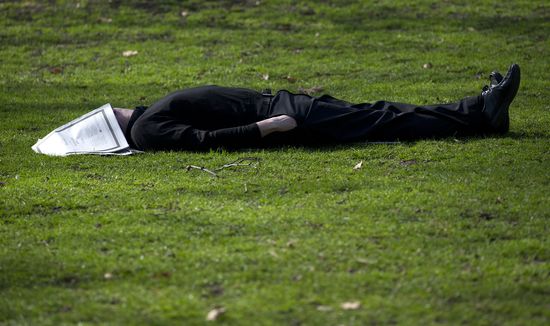
(Photo: A man sleeps with a newspaper on his face in the grass enjoying the warm weather in a park in central London on March 15, 2012. By Carl Court/AFP/Getty Images.)

Marriage Equality Guaranteed In Britain By 2015

That's the word from the Coalition government's Equalities Minister, Lynne Featherstone:

"In the aftermath of a tough set of election results for both Conservatives and Liberal Democrats, I couldn’t help but notice a few naysayers popping up in the media and uttering dire warnings about a government that needs to concentrate on core issues rather than same sex civil marriage," she said.

"For goodness sake – it’s not either/or. The economy is clearly the No 1 priority – but the Coalition can multi-task! There will be no u-turn on equal marriage – we are committed as a government to legislate by 2015.”"

By then, president Obama may have come around. After the British Conservatives and Liberal Democrats.

Why Choose Agnostic? Ctd

A reader writes:

Nb2moscientific worldview. The default position for a scientist is to not believe something unless there is a compelling reason to do so – the default is not to be neutral until the weight of evidence tips things one way or the other. For example, if you ask a scientist if s/he believes in unicorns or alien abductions, the answer would be no – not "I don't know". Of course the "no" is not absolute and unchangeable; if compelling evidence is brought forth, then positions can and will change. But if a hypothesis currently fails to be persuasive, then the answer is "no".

This holds for the god question as well. While minds must be open to persuasion, the unpersuaded mind responds "no – I do not believe in god", not "who knows?". Since all scientific knowledge, both positive and negative, is always conditional, relative to evidence, the "who knows" is everpresent in the background. Atheism and agnosticism are synonymous in the scientific worldview.

Another writes:

I'm sure you're going to be deluged by people making similar points, but there's no contradiction between being an agnostic and an atheist (or an agnostic and a theist, for that matter).

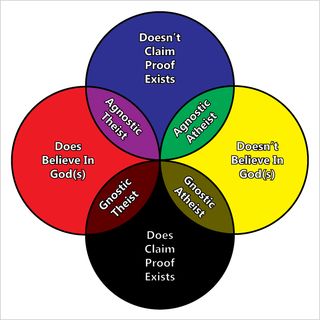
Contrary to the popular perception that agnosticism sketches out some middle ground between atheism and theism, which pertains to belief or non-belief in any deities, agnosticism is an orthogonal position that pertains to whether or not it's possible to know whether or not any gods exist (which is why it's antonym is gnosticism).

If you asked either Neil deGrasse Tyson or Richard Dawkins if they believe in any gods, I'm fairly certain that both of them would say no without any hesitation – hence they're atheists. If you asked them whether it's possible to conclusively prove or disprove the non-existence of gods, however, they would both state that such proof is outside the realm of science – thus they are agnostics.  I'm also fairly positive that Dawkins, at the least, is perfectly familiar with the distinction and is using the term agnostic with precision.

I think that the confusion that people have over the term comes from the misconception that atheism requires an active and uncompromising assertion that gods do not exist. In philosophical circles, there is a distinction made between positive atheism, which positively asserts that gods don't exist, and negative atheism, which pertains to a simple lack of belief in gods. Unfortunately, the latter – which is, in my experience, where the vast majority of self-identified atheists fall – is too often mistaken for agnosticism by people who aren't familiar with the word's history and its technical meaning.

Another:

If you look beneath the whitewashing of skepticism that is the timid brand of "agnosticism" claimed by Neil deGrasse Tyson, you'll find a belief system that is far more dangerous to religion than most exclusively atheistic perspectives are. In particular, the class of  agnosticism articulated by T.H. Huxley, who coined the word agnosticism, is a rejection of false certainty, an abnegation of pretense. In fact, this is what Huxley had to say during one particularly amusing exchange with the Catholic apologist W.S. Lilly who was trying to pigeonhole Huxley (amongst others):

The foundation of morality is to have done, once and for all, with lying; to give up pretending to believe that for which there is no evidence, and repeating unintelligible propositions about things beyond the possibilities of knowledge.

In this understanding of agnosticism, those who do not accept the limits of knowledge are liars lacking a foundation for their moral beliefs. The reason why virtually all skeptics, especially scientists, will readily accept a formal label of agnosticism is precisely for this reason. They accept that knowledge is limited. Notably, this is not contradictory with atheism.

Another:

If you don't believe in the existence of a God, you're an atheist, but that doesn't mean you have to be a movement Atheist. If you can name yourself a Christian without being tagged as a religious-right evangelical, why can't you admit to being an atheist without people assuming you're a ranting, card-carrying Dawkins disciple?

One more:

The embarrassing crowing about Dawkins actually "being an agnostic" pretends that he has either changed his position (he hasn't) or that his beliefs are not actually those of most atheists (they are). Dawkins and Tyson represent very prominent examples of self-described atheists and agnostics everywhere. At their core, they hold the same position, but they disagree about nomenclature. We are hardly the only community with mostly unproductive controversies about definitions (ask any person in the LGBT movement to define "queer"), but this disagreement should not normally be held as evidence of a deep philosophical difference because, most of the time, it's not.

Tyson responded to some pushback on his Big Think appearance here.
Why We Argue

Chris Mooney's theory:

There would surely have been a survival value to getting other people in your hunter-gatherer group to listen to you and do what you want them to do — in short, a value to being persuasive. And for the listeners, there would have been just as much a premium on being able to determine whether a given speaker is reliable and trustworthy, and should be heeded. Thus, everybody in the group would have benefited from an airing of different views, so that their strengths and weaknesses could be debated — regarding, say, where it would be a good place to hunt today or whether the seasons are changing.

Considered in this light, reasoning wouldn't be expected to make us good logicians, but rather, good rhetoricians.

More on Mooney's book, The Republican Brain, here and here.

Should We Fear A.I.?

Pete Mandik shakes his head:

I think our best guide to what we should think about any future beings that surpass us is to think about our current attitudes to beings that already surpass us. On the individual level, I’m not bothered, that is, I don’t feel the value sucked out of my life, by the knowledge that there are lots of individuals that are smarter than me. On the species level, I don’t feel that humans are devalued by the knowledge that other species are faster runners, better swimmers, etc. I think, then, by analogy, we should try to take similar attitudes to any post-humans (mechanical or biological) that outperform us. We should continue to value our own lives on our own terms. And also, you know, root for them, since they’ll be our children.

Recent thoughts about our robot future here.

“A Mixture Of Friendliness And Self-Interest”

Bagehot profiles William Hague, the British foreign secretary:

Britain is no longer a superpower? Get over it, he says—at the age of 51, his is the first generation that cannot remember the empire in its pomp. Britain is not loved by every European nation? Stop worrying about it—though he argues for continued EU membership, hailing the value of the single market and a united European front on trade, diplomatic sanctions and the like.

Britain is a smaller power than before. More interestingly to Mr Hague, it remains a serious power that is good at some hard things. Among other assets, he cites Britain’s armed forces, its counter-terrorism know-how, universities, legal and financial firms, civil service and—in a rebuke to nativists in his own party—its commitment to overseas aid and fighting climate change.

Towards A Gluten-Free America

Gary Taubes endorses the kind of hunter-gatherer diet I'm now on: 

The latest clinical trials suggest that all of us would benefit from fewer (if any) sugars and fewer refined grains (bread, pasta) and starchy vegetables (potatoes). This was the conventional wisdom through the mid-1960s, and then we turned the grains and starches into heart-healthy diet foods and the USDA enshrined them in the base of its famous Food Guide Pyramid as the staples of our diet. That this shift coincides with the obesity epidemic is probably not a coincidence.

As for those of us who are overweight, experimental trials, the gold standard of medical evidence, suggest that diets that are severely restricted in fattening carbohydrates and rich in animal products—meat, eggs, cheese—and green leafy vegetables are arguably the best approach, if not the healthiest diet to eat. Not only does weight go down when people eat like this, but heart disease and diabetes risk factors are reduced. Ethical arguments against meat-eating are always valid; health arguments against it can no longer be defended.

Is It Unethical To Adopt From Foreign Countries?

The WSJ examines Ethiopia's adoption surge:

E.J. Graff offers advice:

Here's the rule of thumb: If you can get a healthy infant or toddler within a year, don't adopt from that country. Adopt, instead, from American foster care, or from countries that send abroad very few children, and when they do, the children who are available are older, or disabled, or come in sibling groups, or otherwise have had trouble finding new local homes. Or if you're adopting for humanitarian reasons, donate that money an organization that helps children stay with their families, or brings clean water and mosquito nets and medicines to their villages.  It's far more rewarding to love an individual child than to give to anonymous foreigners. I know; I'm parenting an adopted child. But no one wants to be complicit, even unknowingly, in defrauding a father out of his daughter.