Buzz Bissinger writes at the intersection of two popular Dish threads:
If the vast majority of major college football programs made money, the argument to ban football might be a more precarious one. But too many of them don't—to the detriment of academic budgets at all too many schools. According to the NCAA, 43% of the 120 schools in the Football Bowl Subdivision lost money on their programs. …
There are the medical dangers of football in general caused by head trauma over repetitive hits. There is the false concept of the football student-athlete that the NCAA endlessly tries to sell, when any major college player will tell you that the demands of the game, a year-round commitment, makes the student half of the equation secondary and superfluous. There are the scandals that have beset programs in the desperate pursuit of winning—the University of Southern California, Ohio State University, University of Miami and Penn State University among others.
For me, the NYT story about Ray Easterling's widow, Mary Anne, is one of the more haunting about pro-football's devastating impact on long-term mental health:
No adverse aftereffects surfaced through the 1980s. Ray’s engaging personality, discipline and diligence proved a good formula in the financial services field. What followed was a downward spiral during which he flipped to being argumentative and  forgetful, as if a personality transplant were mixed in with the two dozen orthopedic operations he endured.
Business ventures slid off the rails when Ray, for whom punctuality was a practiced virtue, appeared tardy for appointments. In many settings, he would blurt out offensive remarks, the filter in his brain no longer functioning at full tilt. Realizing this, he became disengaged, even from his mother, who died a month before he did. At family events, he would show up in running shorts when more formal attire was appropriate. Staring into space wistfully, Mary Ann said, "I didn’t feel like I was with the person that I married." …
On the morning of April 19, along with her husband’s lifeless body, Mary Ann discovered a note, written with his increasingly numb and quivering hands. It was addressed to her, sprinkled with "I love yous" and containing evidence that his faith had not wavered. Quoting from the letter, she said, "I’m ready to meet my Lord and savior."
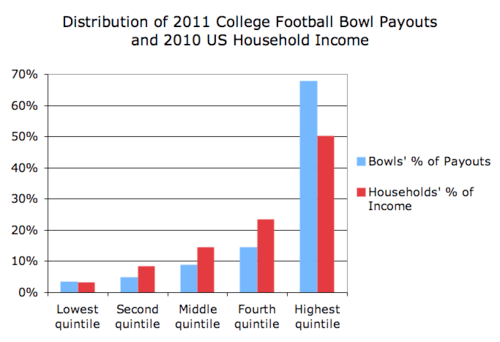
The above screenshot is from a short video of Easterling not too long before his death. Chart by Tumblr user "interstices", who explains:
The BCS games have a huge payout to the teams while most of the bowls put together a rather modest payout. The teams that play in the games don’t necessarily get rich in the process, in fact some schools and conferences actually lose money. … The distribution of household income in the United States in 2010 and the 2011-12 college football bowl game payouts are very similar for the lowest quintile: the 20 percent of the households and 20 percent of the bowl games account for just over three percent of the total. At the other end the top 20 percent of households account for 50 percent of the income. Meanwhile the top 20 percent of the bowl games account for about 68 percent of the payouts.

 retaliate with ugliness, poverty, and disease. The crisis of this line of thought is the realization that we are at once limited and unendingly responsible for what we know and do…
 The Dish