How Dumb Is Mark Levin?

I always knew Mark Levin’s books were reactionary screeds, but until this scathing review, I didn’t realize he incorporated embarrassingly stilted accounts of the history of political philosophy into them. Carlin Romano’s review in the Chronicle of Higher Education wades through the ignorance so we don’t have to:

Ameritopia, like many po­lem­i­cal bad books in po­lit­i­cal phi­los­o­phy, teems with mis­used ab­strac­tions and con­tains few em­piri­cal ex­am­ples. In chap­ters de­vot­ed to the Re­pub­lic, Le­vi­a­than, U­top­ia, and The Com­mun­ist Man­i­fes­to, Lev­in of­fers Cliff’s Notes-like cap­sules of the works. His for­mu­la is to of­fer a brief phrase like, “as Locke ex­plains,” fol­lowed by long quo­ta­tions that some­times go on for a page. (He also adores his own prose, as when he writes, “As I wrote in Liberty and Tyr­an­ny,” then quotes him­self for near­ly half a page.) That’s one way to pad a book…

In ex­pli­cat­ing Pla­to, Lev­in op­er­ates as if he’s Sir Karl Pop­per’s cam­paign man­ag­er, run­ning against an an­cient guy in a toga. Lev­in men­tions ev­ery line that sup­ports Pla­to as pro-tyr­an­ny and ex­cludes ev­ery one that doesn’t. While Pop­per cer­tain­ly had some sharp ob­ser­va­tions a­bout Pla­to, Lev­in’s de­pic­tion of the au­thor of many di­a­logues be­sides the Re­pub­lic as a con­sum­mate hat­er of in­di­vid­uals is just dis­tor­tion. (One won­ders, too, what Pop­per would have made of Lev­in’s claim that “it’s not dif­fi­cult to find the germs” of “Islamicism” in the Re­pub­lic.)

The Labor Force Contraction

Labor_Force_Participation

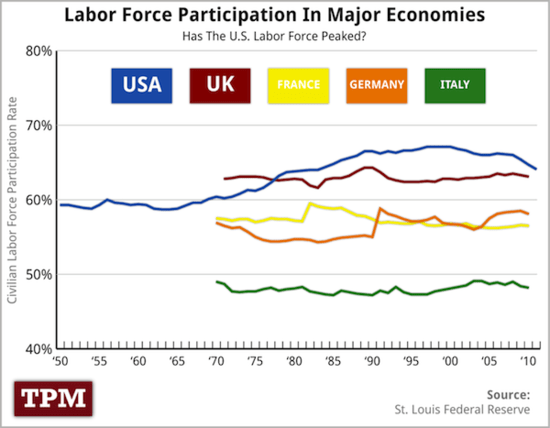
TPM puts it in context:

There’s no single, tidy explanation for what triggered the increase [in the labor force] in the first place or why it’s come to an end, but the single clearest factor is that last century women began pouring into the work force — a phenomenon that came to an end in the last decade. “The women who are going to enter have entered,” says Dean Baker, co-founder of the Center for Economic and Policy Research. All else being equal that explains why the labor force participation rate would flatten.

Brad Plumer explores other possible explanations, such as mass boomer retirement. Meanwhile, Yglesias points out that the employment population ratio is a bad predictor of economic growth:

Conventional wisdom has it that the labor market in low unemployment Germany is currently quite healthy. But emp-pop says that there's been no time in all of recorded history when the German labor market has been as healthy as the U.S. labor market was at the depth of the recession. Conventional wisdom also says that Sweden made a comeback from the Nordic Financial Crisis of the early 1990s and learned valuable lessons that helped it whether the Panic of 2007 much better than the world's larger industrialized countries. What emp-pop says is that Sweden has been in a persistent depression for the past twenty years.

Where Will Obama’s Big Donors Come From?

Nick Confessore delves into the difficulty Obama fundraisers are having with Wall Street:

If Romney were the nominee, [former Goldman whiz kid Eric] Mindich asked, how would the Obama campaign go after him? Would it attack his record at Bain Capital? Would it attack the private-equity industry? Near him sat Blackstone's [Hamilton E.] James, who, just a few weeks earlier, had called attacks on private equity "vicious . . . inaccurate and unfair." Mindich and James are friends, and some in the room speculated that Mindich's question was for James's benefit.

Our target, [Obama campaign manager Jim] Messina assured the room, would be Mitt Romney and his record, not the private-equity industry. But the campaign, he added, couldn't control what the president's surrogates – like Priorities USA – might do.

James ultimately did not attend the fund-raiser, nor did Mindich. Others were also unpersuaded. Obama's finance team had already realized that if Wall Street was going to give less – potentially far less – than last time, other constituencies would have to give more. Hollywood, a reliable source of Democratic campaign cash, was looming larger in Obama's fund-raising calculations. So were tech entrepreneurs and gay donors.

Relatedly, Alec MacGillis recently reported on the about-face from many hedge-funders who supported Obama in '08:

For all the brashness and bravado that goes with their world, it seems the managers are oddly insecure about their purpose. For years, "most people in the financial service sector were viewed with enormous, out-of-the-box respect and adulation," says [Bill] Daley [former Obama chief of staff and J.P. Morgan Chase executive]. "These guys were on pedestals, and now that pedestal’s gone, and now, in a lot of people’s minds, the industry doesn’t have that glow, and that bothers them, and now they join that with the president and his theoretically bashing the wealthy. They’ve got to blame somebody, and they blame him because he is representative of that group of people who ‘aren’t us.'"

Cry me a river.

Le Changement: Reax

French_President

Walter Russell Mead looks ahead:

Hollande now has a delicate few weeks. French legislative elections are scheduled in June, and Hollande must steer between twin dangers. On the one hand, if it turns out that all his talk about reform and growth was just so much election verbiage and once he’s in office he plans to continue French policy more or less as before, then disillusioned voters could turn on him next month. On the other hand, if he pushes against Germany and the financial markets too forcefully, a crisis of confidence in France and in Europe could develop in the markets. That, also, would not be good for his prospects in the legislature.

Markets are down this morning, but Buttonwood blames Greece, which also voted over the weekend:

Mr Hollande's victory was expected … and it is the Greek result that is rattling investors today. It would seem to bring the prospect of a euro exit much closer. In addition either the Greeks will attempt (and probably fail) to renegotiate their bail-out or new elections will be called; either outcome will provoke another period of uncertainty. Time for the traditional European summer of crisis?

Yglesias lowers expectations:

If the [European Central Bank] signals that it will only support the French banking system and the French economy if Hollande sticks with the status quo program, then Hollande may well have no choice. Elections in Europe aren't necessarily what they used to be. Nobody's crying over Silvio Berlusconi but he was Italy's elected Prime Minister and he lost power not in an election but it a made-in-Frankfurt call by the central bank.

Christopher Dickey reminds us:

France is going to have to borrow about €180 billion ($240 billion) before the end of the year. Under Sarkozy it already lost its AAA credit rating. If borrowing rates start to climb dramatically, the hope of clawing out of the slump will fade very quickly.

Ezra Klein adds:

Perhaps the reality of the euro zone right now is that this isn't just about what Hollande does now. It's about what Merkel wants to do now, and what the ECB wants to do now. The old consensus is no longer politically sustainable. The regime changes in France and Greece, and Hollande's presence at the negotiating table, offers an excellent opportunity to change course if that's what the euro zone's leaders want to do. But is it? What do the euro zone's leaders want to do now?

Tyler Cowen thinks trust between Eurozone nations has taken a beating:

It is painful to admit this, but things still could get much worse and now they are likely to do so.

A seventeen-member currency zone (scary just to type those words) has to be based on trust and this one isn’t, least of all now.  There is little reason to think that Hollande can browbeat the Germans into picking up more of the bill, and if the Germans perceive their former French partner as an unreliable ally, this becomes all the less likely .

Joyner compares Sarkozy's situation to Obama's:

The Eurozone crisis is front and center in France; it should be here, but it’s an afterthought in the minds of the voters. Sarkozy was in office when the global financial collapse hit; Obama was merely running for office–and the opposition party was there when the crisis started. Obama can claim several foreign policy successes, whereas Sarkozy’s leadership in the Eurozone situation hasn’t paid off–and was saddled with the Afghanistan mess. And Obama is well liked whereas … Sarkozy irritates even his supporters.

And Yannis Palaiologos sees Hollande's election as a possible gift to the US president: 

[Hollande] is expected to announce the withdrawal of French troops from Afghanistan by the end of 2012, a year earlier than Sarkozy’s plans envisaged. Barack Obama, who has already invited Hollande to the White House, will likely not be thrilled by this. But if the new French president can be a catalyst in pushing Europe away from its asphyxiating austerity regime and towards a vigorous recovery, Obama will be more than compensated for, given that the weak European economy is one the main threats to his re-election in November.

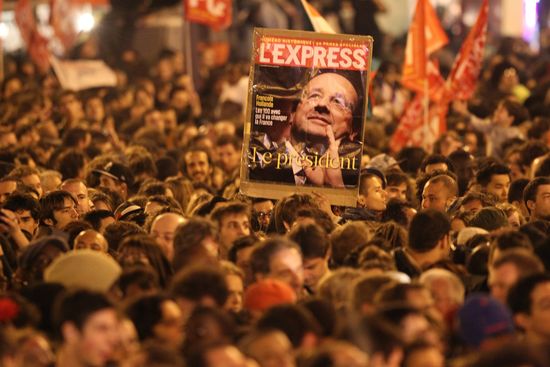
(Photo: Francois Hollande supporters celebrate at Place de la Bastille after Francois Hollande wins the French Presidential Elections on May 6, 2012 in Paris, France. By Sean Gallup/Getty Images)
Did Jesus Exist? Ctd

Not everyone likes Bart Ehrman's latest. To put it mildly:

I cannot recommend books that are so full of errors that they will badly mislead and miseducate the reader, and that commit so many mistakes that I have to substantially and extensively correct them.

Did Jesus Exist? ultimately misinforms more than it informs, and that actually makes it worse than bad. Like the worst of mythicist literature, you will come away after reading it with more false information in your head than true, and that makes my job as a historian harder, because now I have to fix everything he screwed up. This is why I don’t recommend anyone ever read bad mythicist literature, because it will only fill your head with nonsense that I will have to work harder to correct. Ehrman’s book ironically does much the same thing.

Therefore, it officially sucks.

The Unlikely Hollande

Talleyrand notes the man's immense good luck:

Getting even, it is said, is the best revenge. François Hollande has many reasons to celebrate his victory in France. He has prevailed, not only over Nicolas Sarkozy, but also over Dominique Strauss-Kahn and every other politician who claimed the mantle of political glory ahead of him – including his long time ex-partner, Ségolène Royal, who lost to Mr Sarkozy in 2007. For a ‘nice guy’ from central casting, life doesn’t get better than this.

Which means to say it is now likely to get much worse. Money quote from the socialist winner:

“Europe is watching us. The moment that I was announced president, I am sure in many European countries there was a relief, hope at the idea that at last austerity is no longer inevitable, and my mission is to give to European construction the dream of growth. Europe is watching us, austerity can no longer be the only option.”

I don't quite buy the line that we are now likely to see a brutal European clash between Keynesianism and austerity. As the Guardian notes in a celebratory editorial today:

He has set himself just one year longer to balance France's budget than the man he defeated.

The truth is: the French government is as vulnerable to international bond markets as anyone else. Some easing of austerity will only be possible if Hollande were to implement the kind of labor market reforms that Germany instituted over the lastScreen shot 2012-05-07 at 10.29.15 AM decade to appease the global bond markets. And yet he appears to be going in the opposite direction. Germany, for good measure, has already insisted that the recently negotiated fiscal pact is not up for re-negotiation.

Nonetheless, the Tories just got whalloped in Britain's local elections, Merkel's CDU barely survived a regional election in Schleswig Holstein, the austerity-bent Dutch government has fallen, and the Greeks have voted for the far right and far left against German-imposed austerity. It's not clear to me that the EU can remain fiscally sound while remaining democratic – unless some glimmer of growth returns to somewhere other than Germany. Cameron and Merkel would provide a natural pro-austerity axis, if Britain had actually signed the fiscal pact. What I expect from London is pure anti-French schadenfreude:

A senior Conservative source told The Daily Telegraph that fears France was about to reverse course would cause turmoil and uncertainty: “Clearly it’s going to focus a lot of market attention on the French public finances, which are nothing to write home about. I don’t think it is going to make life in the bond markets any easier next week. We haven’t chosen austerity because it’s fun. We have to do austerity, and so does France. He will have to be very careful about his public spending commitments and the lack of welfare reform.”