A lie worth pointing out.
Month: May 2012
Quote For The Day
Faux Status
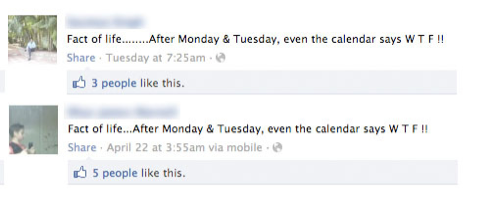
Jack Stuef considers the rise of Status Shuffle, a Facebook app that lets users pick from pre-written updates and post them as their own:
[I]t’s clear people who use the app for their status are using it like one would use a greeting card, to express a mood better than they can in their own words. "Everything I’m feeling they have something for it," Sammie_69 wrote this week. "In love using status shuffle because I’m not good with words myself," wrote Missy09/02/09. As [the app’s creator, Oz Solomon] put it, users come into the app after a certain "life event," looking for "a piece of text that embodies how they’re feeling." According to Solomon, this status has been used over 116,000 times: "I am strong because I know my weaknesses. I'm alive because I'm a fighter. I am wise because I've been foolish. I laugh because I've known sadness."
The Paradox Of Recycling
The presence of bins means we consume more:
Newly published research suggests the presence of that receptacle may inspire you and your officemates to use more paper than you otherwise would, depleting natural resources in the process. "Consumers may view the ability to recycle a product as a ‘get out of jail free card’ that makes consumption more acceptable," write Jesse Catlin of the University of California, Irvine and Yitong Wang of Tsinghua University in Beijing.
Who Should The TSA Give A Pass?
Sam Harris argues for some racial profiling at the TSA for efficiency's sake:
Some semblance of fairness makes sense—and, needless to say, everyone’s bags should be screened, if only because it is possible to put a bomb in someone else’s luggage. But the TSA has a finite amount of attention: Every moment spent frisking the Mormon Tabernacle Choir subtracts from the scrutiny paid to more likely threats. Who could fail to understand this?
Josh Rosenau lobs a multi-tiered attack on Harris' logic, including research which suggests that profiling doesn't work:
[T]errorists aren't stupid. If you create a system that predictably makes certain people less susceptible to screening, terrorists will see that and find ways to exploit that opening. If you screen folks from certain countries more thoroughly, terrorists recruit people from other countries to make your attack. If folks with Arabic names are being given extra screening, terrorists recruit guys with names like Jose Padilla. …
[N]ot only doesn't it work, it's also immoral.
It's immoral for the same reasons that apartheid, Jim Crow laws, and the internment of Japanese-Americans were immoral. Using those broad markers as a basis for how we treat individuals means that we ignore the person, reducing that person to whatever stereotype we choose to impose. It's bad public policy, and it's bad police work. I would argue, in fact, that the practical ineffectiveness of such policies is an inevitable result of their moral failings.
Hemant Mehta takes the long view:
Would the ramifications of specifically profiling Muslims do more harm than good? Wouldn’t we be giving young Muslims a reason to distrust (and despise) the American government?
Chris Stedman chastises Harris for not using his own atheism to recognize the damaging effects of being singled out:
Over the last few years, I've watched with despair as an increasing, increasingly-less-subtle xenophobic anti-Muslim undercurrent has spread throughout the atheist movement, cloaked by intellectual arguments against Islam's metaphysical claims and practices and rallying cries in defense of free speech. Though it has been spreading throughout our broader culture, I'm especially disheartened to see it among my fellow atheists.
In an addendum, Harris responds to critics but stands by his larger point:
When I speak of profiling "Muslims, or anyone who looks like he or she could conceivably be Muslim," I am not narrowly focused on people with dark skin. In fact, I included myself in the description of the type of person I think should be profiled (twice). To say that ethnicity, gender, age, nationality, dress, traveling companions, behavior in the terminal, and other outward appearances offer no indication of a person’s beliefs or terrorist potential is either quite crazy or totally dishonest. It is the charm of political correctness that it blends these sins against reasonableness so seamlessly.
A round-up of recent TSA absurdities here.
Does The Internet Rewire The Brain?
Yes. A very large caveat:
The truth is that everything you do changes your brain. Everything. Every little thought or experience plays a role in the constant wiring and rewiring of your neural networks. So there is no escape. Yes, the internet is rewiring your brain. But so is watching television. And having a cup of tea.
The Scrooge Swim
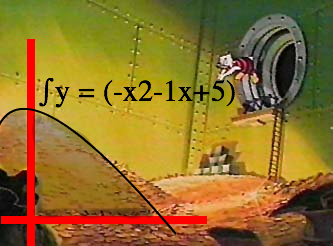
Matt Powers calculates how much money you would need to dive into a pile the size of Scrooge McDuck's:
Looking at some of the best pictorial evidence of the McDuck vault, it is evident that this large pile of gold on the left appears to be five feet tall. This is deduced under the
assumption that the average duck 14 inches tall, which is then used comparatively to quantify the pile (5 ft = 4.3 duck heights). … The assumption will be made here that one cubic inch is roughly one ounce of gold. To convert that into a dome shape the value is simply cubed, which becomes 97,366 ounces. Given that 1 ounce of gold is roughly $5.00, it can extrapolated that each large pile of gold in the vault is worth $486,830.
However, Scrooge McDuck was first drawn in 1947, therefore inflation must be adjusted for which totals a whopping 5.2 billion dollars per pile. In the picture, there are two smaller piles which roughly equal the larger doubling the total to 10.4 billion. However, the shadows in the corner suggest that the room is a least three times as large as it is. Therefore, Scrooge was privy to a cool 31.2 billion dollars.
This means that only the six richest people in the world could afford to pull off the Scrooge swim.
Update from a reader:
Hopefully I'm not the only reader writing in protest about the Scrooge McDuck calculation. I quite enjoy it when people devote ridiculous amounts of time and energy coming up with plausible calculations, and thought since you were sharing it this would be one of those moments. Instead when I read the article I was treated to bullshit piled atop made-up numbers. Every time he has to give a number, it's wrong. And it's not just wrong by a small estimation factor. It's so far off it's clear that he made no attempt to combine his wit with any mathematical acuity. There are so many errors I'm just going to number them:
1) "The assumption will be made here that one cubic inch is roughly one ounce of gold." Wrong. It's not actually very difficult to calculate how much a cubic inch of gold weighs, and it's around 11 regular ounces (of course gold is generally measured with troy ounces).
2) "Given that 1 ounce of gold is roughly $5.00." I'm not a monetary expert, but it seems pretty easy to check this online. A (non-troy) oz of gold appears to cost around $1400.
3) The worst thing that he does is the only part that has even a veneer of math, when he calculates the volume of the big gold pile. He calculates the area under an integral and then, to get the volume, cubes it, giving an answer with units of inches to the sixth power. Perhaps the implication is that Scrooge is so wealthy he has six dimensional gold, but it seems unlikely. If he wanted to calculate the volume of a single pile, he could do so with a double-integral (but Powers didn't make it to multivariable calculus). In any event, these calculations are just flash, because the better estimate of the gold would be to treat it's volume like any other rectangular solid, since the fluctuations at the top will mostly even out.
If we were to assume that the room is 25 ft by 25 ft and that if the gold had a uniform surface, its depth would be 10 feet, then we get a total volume of 6250 ft^3. I think this is actually a bit small, but I wanted to be conservative. This is 10.8 million cubic inches. This is around 7.52 million pounds of gold (figuring .69663 lbs/cubic inch). This would be worth around 180 trillion dollars (using the avoirdupois pound value I got here). Of course, my calculations assume solid gold, which obviously isn't possible since Scrooge is swimming in it, so we would need to work in some factor to account for airspace, maybe assuming that 60% of it is gold and the rest is air, money bag material, etc, so to my reading, a conservative estimate of his wealth is 108 trillion dollars.
It's amusing that the people who comment on Powers article are either people pointing out how wrong he is or people calling those people pedants (although I do love the one who misspelled it "pendant"). One last error that I just noticed. I don't think Powers understands how inflation works. The value of McDuck's gold in 1950 (easier to find than 1947) dollars is not done with some bullshit inflation calculation, but by multiplying the weight of gold by is 1950 value, which is also easy to find on the internet: $41 per troy oz. Again, note that this is not the $5 Powers originally claimed as the value of an oz of gold. But most of this comes from his ass.
Pregnancy Leaves A Mark
Mothers can carry their children's cells for years after giving birth. It's unclear whether these cells are a health hazard:
Fetal cells seem to help out with bad livers, but show up at arthritis and rheumatism sites and look like they might be on the attack. There are hints that cells can go both ways, helpful, then hurtful.
What produces these behaviors? Dr. Johnson sighed and said the list of explanations keeps getting longer. It could depend on the disease. It could depend on the type of fetal cell (they can be different). It may depend on the mother's age, how many conceptions she's had, or who the father was. (Fathers can be genetically similar to the mother or genetically very different, and that variance seems to matter.)
A new RadioLab episode digs deeper into the science.
Social Jet Lag

Is driving us slowly insane:
Simply calculate the difference between the midpoint of your average night’s sleep on a workday and a day off. Say on workdays you fall asleep at eleven and wake up at six: Your midpoint is 2:30 a.m. On weekends, you fall asleep at one and wake up at nine: Your midpoint is 4:30—and you’ve got two hours of social jet lag. You might as well fly from New York to Utah. Social jet lag, unlike real jet lag, is chronic. Its chief symptom is sleep deprivation, and sleep deprivation is—surely I do not need to tell you this—ghastly. It leaves you with the equilibrium of a despot, the attention span of a toddler, and the working memory of a fire hydrant.
Along the same lines, modernity hasn't been kind to our circadian rhythms.
(Photo: A man sleeps with a newspaper on his face in the grass enjoying the warm weather in a park in central London on March 15, 2012. By Carl Court/AFP/Getty Images.)
Should We Give Addicts A Place To Shoot Up?
Paul Hiebert visits Vancouver's supervised injection facility InSite, open since 2003. Last September, a Canadian Supreme Court ruled that InSite should remain open indefinitely. Other Canadian cities such as Montreal, Toronto, and Ottawa are considering opening their own facilities. Hiebert spoke to Tim Gauthier, InSite's clinical coordinator:
The participants come in with their own drugs. In case a participant overdoses or has a heart attack, someone is there to help. If we can intervene timely and quick, there's no reason anyone should ever die. That's our primary function.
… Participants at InSite have their own booth, which is clean and sanitary. We offer them new needles, alcohol swabs, a sink to wash their hands and medical care. We can dress their wounds and address chronic health issues. We can also link them up with income assistance and housing.
At our front desk, people can pick up equipment such as condoms, lubrication, needles, cookers, filters and everything you need for injecting safely. We give out as much as people think they need. You could take hundreds of needles if you want. There's no limit.
Drug courts are perhaps the closest equivalent here in the US.
 The Dish