Marc Lynch believes Egypt's transition has failed:
Weeks before the SCAF's scheduled handover of power, Egypt now finds itself with no parliament, no constitution (or even a process for drafting one), and a divisive presidential election with no hope of producing a legitimate, consensus-elected leadership. Its judiciary has become a bad joke, with any pretence of political independence from the military shattered beyond repair.
Tony Karon labels SCAF's actions a "coup":
The events that saw Mubarak unceremoniously wheeled off stage-left in February 2011, and later imprisoned, were more of a palace coup than a revolution. A junta of generals responded to the crisis presented by the massive protests in Tahrir Square and elsewhere to ease out the helmsman in order to save the regime. They weren’t guided by a clear plan or even a coherent strategy; the generals and their allies have simply improvised their way through the political turmoil of the past 18 months to emerge in an improbably dominant position.
Zeinobia, who's live-blogging in Egypt, concurs. Max Fisher is unsure:
Is it a coup? A number of the more liberal-minded Egyptians who dominate its social media seem to think so. Members of Muslim Brotherhood, who just saw their power-hold on Parliament dissolve and have to wonder if their candidate will get a fair race against Shafiq, are unlikely to be happy…. But calling it a coup might be giving the military and its pawns a little too much credit. Whatever the motivation behind the dissolution of Parliament, like so many of Egypt's painful post-Mubarak moments, it looks less like a master-mind conspiracy and more like the kind of panicky, by-the-seat-of-their-pants stumbling that has long characterized the still-creaking Mubarak machine.
Michael Koplow unfavorably compares Egypt's situation to Turkey's coup-prone past:
There are no serious outside influences pressuring it to democratize, and it is not dependent on the U.S. and other Western democracies to the same extent that Turkey was. It is not joining the EU, it does not need protection from the Soviet Union, and its military aid from the U.S. is not ever going to be really endangered because of the way in which it is bound up with the peace treaty with Israel. In short, Egypt in 2012 looks very little like Turkey from 1950 onwards, and the pressures that existed on the Turkish military that ensured quick handovers to civilian governments following military coups do not apply on anything like the same scale to the SCAF. It is understandable that those who are disappointed with today’s events might look to Turkey as a ray of hope for what can eventually happen after the military intervenes in politics, but the comparison is an unsuitable one. Turkey had a democratic head start and a host of reasons to ultimately consign the military to the barracks for good, and Egypt unfortunately has neither of these things.
Robert Mackey is live-blogging.
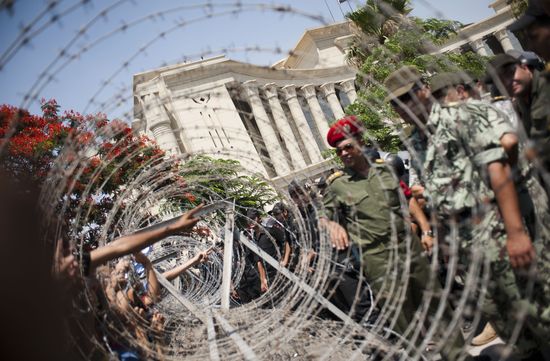
(Security forces guard Egypt's Supreme Constitutional Court in Cairo as demonstrators gather outside on Thursday, June 14, 2012. In a highly anticipated ruling that put the legitimacy of Egypt's legislature and future constitution in question, Egypt's Supreme Constitutional Court ordered the dissolution of one-third of the nation's first democratically elected parliament and allowed former Egyptian President Hosni Mubarak's last prime minister to run in this weekend's presidential election. By James Lawler Duggan/MCT via Getty Images)
 The Dish