The Slippery Slope To Self-Parody

Bingo

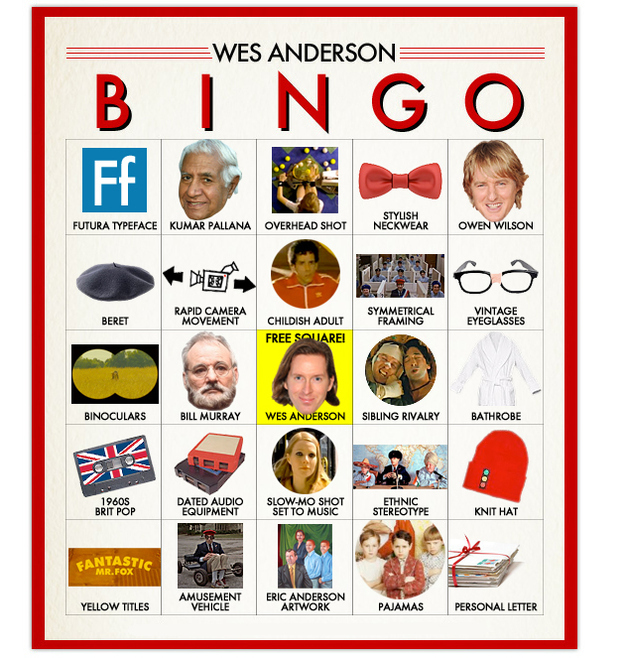
Hadley Freeman accuses directors Tim Burton and Wes Anderson of becoming "not just derivative but self-derivative":

Neither Dark Shadows nor Moonrise Kingdom is terrible. But they are predictable and both show Burton and Anderson pillaging their own catalogue to diminishing returns. (Suzy in Moonrise Kingdom is so similar to Margot Tenenbaum from The Royal Tenenbaums that the later film could be a prequel.) They take the stylised surface of their old films, yet forget the emotional wallop beneath that made Rushmore, Bottle Rocket and The Royal Tenenbaums (Anderson) and Edward Scissorhands, Ed Wood and Batman (Burton) so special.

Ryan Gilbey pushes back:

[I]t is not Freeman’s specific argument that I found interesting so much as the general tendency to take traits once celebrated as auteurist (a recognisable voice, a continuity of theme, a discernible visual style, a repertory company of actors) and to use them as a stick to beat those auteurs we find lacking. … It’s a thin line between a director who produces a different meal each time from the same set of ingredients, and one who reheats the leftovers. And it’s a danger, I think, that we can mistake consistency for complacency when we can’t quite express what it is about a film that displeases us. 

(Wes Anderson bingo via Buzzfeed)

Why Occupy Fizzled

Michael Kazin, perhaps the best historian of the American Left, dissects the promise and failure of the left-populist movement. Its promise was a uniting, inclusive message progressives had been struggling to persuasively articulate for years. Its downfall was a lack of organization and strategic acumen:

The signal achievement of the Occupy movement, at least so far, is to challenge the conservative reasoning and the narrative that accompanies it. “We are the 99%” conveys a deeply moral, democratic message that represents a leap beyond what most left activists have been saying since the 1960s. Gender equality, multiculturalism, opposition to military intervention, and global warming are all worthy causes. So was the sometimes disjointed attack on the World Bank and the International Monetary Fund that briefly shut down Seattle in 1999. But each represented the passions of discrete groups whose opponents were able to belittle them as “special interests.”

For all their virtues, each cause was either absorbed into the political culture (feminism) or (as with environmentalism and the movement against the invasion of Iraq) confronted powerful enemies able to wage a grossly unequal fight… But the very breadth and openness of this proudly leaderless uprising make it difficult to sustain. Even if it endures, such an insurgency is unlikely to grow into a movement that can bend politics in its direction.

Syria’s Russia Problem

Katherine Boom pinpoints one of the central dynamics sustaining Syria's crisis:

In the Syrian case for example, what many know but few discuss is that in 2011, Russia sold nearly $1 billion in arms to Assad’s government. After months of standing their ground Russian officials have finally agreed to temper weapons sales, yet this incident raises broader questions about the role that states should have in preventing crimes against humanity. Russia’s decision to limit its material support of Assad may be telling of the effects that pressure from the United States and others can have, which is not insignificant. The fact remains, however, that as they are currently interpreted the existing legal mechanisms are insufficient to ensure that accomplices to human rights abuses are likely to be held accountable. And Russia’s role in Syria is only a recent example of a long-standing problem…Studies indicate that outside support, even in the absence of effective control, exacerbates crimes against humanity. 

Daniel P. Sullivan runs down what the US is trying to do to bring Russia on board. Walter Russell Mead explores a novel explanation for Putin's intransigence:

The roots of Russia’s support for Butcher Assad go deep. This is much more than nostalgia for Russia’s last Middle East ally from Soviet days. This is about getting back in touch with Russia’s pre-communist foreign policy traditions, and about Putin’s relations with one of his most reliable and important bases of support: the Russian Orthodox Church.  The Church has historically exerted a strong pull on Russian policies overseas, especially in defense of Christian minorities in the Balkans and Middle East. Throughout the events of the Arab Spring, Russia has been reluctant — to put it kindly — to join the efforts to unseat dictators like Hosni Mubarak and Bashar Assad. Though these tyrants have often been brutal toward many of their citizens, Christian minorities have, by and large, thrived under their rule.

Too Soon?

Cancer_deaths

Aaron Carroll worries that the US health system is too focused on early diagnosis:

The simplest explanation for [the pattern in the above chart] is that many of the cases of cancer we are detecting might not really benefit from early, let alone any, diagnosis. I’m not denying that there is likely some number of people who benefited from early detection and treatment. But, looking at the above, that number is likely small. I can almost guarantee that all of those diagnosed, however, suffered from life-changing anxiety and fear, not to mention surgery, chemo, and/or radiation. I won’t even mention the cost.

Don Taylor suggests the only solution is to rethink our view of healthcare.

(Chart by Ray Moynihan et al)

Hope For The Economic Future?

Keep Calm and Carry On Wallpaper Poster 3

After breaking down the component parts of our current "economic perfect storm," Jack Goldstone suggests the history of capitalist adaptation gives us reason not to panic:

Yet I do expect capitalism to survive and adapt, as it has done before.  I expect a new round of progressive legislation to improve the position of workers, coming after 2014; I expect a new round of education (perhaps internet driven) and emphasis on personal and craft skills to reshape labor markets in advanced economies; I expect an adaptation to population aging that involves greater integration of global labor markets and rich/poor country labor exchanges; and I expect China will shift to greater democracy, better conditions for its workers, and a healthy internal market.  Europe is harder to predict, as we are too close to the peak of the crisis; but one way or another Europe will go on.

Emails Of The Day

A technical snafu screwed up our Typepad and RSS feed for a while earlier this morning (fixed now). But it gave us these two priceless reactions from the same reader. At 9.10 am:

So it seems The Dish has moved to the dark side and is only publishing snippets in the RSS feed. Usually this move is about ad revenue. Can't you just embed ads in the RSS feed, rather than making a slow bloated web page the only viewing option? 

This is a sad day. Well, it was great reading you all these years. I guess I'll be more productive now…

And a few minutes ago:

Damn. I thought I was going to suddenly emerge as the dark horse wiz kid at my company. Back to mediocre productivity for me …

The Dish: doing our best to lower work productivity since 2000.

How Romney Will Turn Out The Base

McKay Coppins unpacks the strategy: 

His aggressive tactics stand in for the sort of policy compromises that could damage him in November; better, his advisers argue, to court conservatives with a press conference shouting match than with a high-profile fight over abortion or gay marriage. What’s more, they say, the media obsession with Romney “pandering” to the right represents a misunderstanding of conservatives, who can live with Romney’s moderate record – as long as he’s a fighting moderate. "I thought we were going to see John McCain all over again,” said Brad Thor, a bestselling novelist and popular figure on the right who supported Santorum. “But you know what? That fire I've felt for previous candidates, I'm starting to feel it. And that surprise presser at Solyndra was like pouring accelerant on the fire.

Waldman calls it the "Howard Dean strategy," but qualifies: 

I wouldn't take the Dean analogy too far, because his aggressive posture toward George W. Bush was almost entirely about policy, especially the Iraq War, which was the defining issue of 2004. For Romney, on the other hand, this new posture seems to be entirely about things that aren't issues at all (like playing footsie with birthers) or things that have some relationship to policy but are really just barely relevant distractions (like Solyndra).

The stupid, policy-irrelevant spats of anti-Obama aggression seem Breitbartian to me. Or should that be Alinsky-like? But for all that, they are effective against a stalling economy.