Bills, Bills, Bills

James Surowiecki defends paper money against Gold Standard fervor:

We cling to the belief that money needs to be backed by something “solid.” In that sense, we’re just like Marco Polo—still a bit amazed by the thought that you can base an entire economy on little pieces of paper.

And yet we do. For more than 80 years, we’ve been living in a world in which money can be created, in effect, out of thin air. … There is, to be sure, something a bit eerie about all this, and periods like the recent housing bubble, when banks made an extraordinary number of bad loans, should remind us of the dangers of runaway credit. But it’s a mistake to yearn for a more “solid” foundation for the monetary system. Money is a social creation, just like language. It’s a tool that can be used well or poorly, and it’s preferable that we have more freedom to use that tool than less.

Hating On The Millennials, Ctd

Image

A reader writes:

Matt Labash seems to believe that proliferation of Internet memes is some sort of cultural revolution.  It isn't.  People do it because they think it's funny.  Have you ever heard someone say that a meme changed their life?  No, because you look at them and move on.  We're not talking about books or music or Monet here.  So if a guy can make money off of captioned cat pictures with weird spelling, more power to him.

Another also responds to Labash's letter:

There are examples of Internet culture that are trite and derivate? Oh my. Some people focus more on traffic generation via aggregation than real content? Dearie me. Every generation's culture has Bouguereaus and Van Goghs, Andy Warhols and John Lennons. The derivative entertains, while the truly creative stimulates. What remix culture has taught us is that making derivative works can be a form of real originality, not that all derivative works are original. The Internet is, alternatively, hilarious, brilliant, thoughtful, vapid, disgusting, stupid, and boring. Railing against smart people making a quick buck by exploiting cultural trends is about as thoughtful or original as complaining about dishonest politicians or crooked car mechanics.

Another:

I dunno, I think Labash brings up a lot of salient points about the relative worth of adding text to a picture. I think he's spot on about some of the companies, like Cheezburger, who have institutionalized the practice to the point of stifling creativity. But I think he misses the forest for the trees though when it comes to the overall value of memes.

When Matt says he can crank out 25 Scumbag Steve memes in two minutes and they'd be worthless, he's probably right. The thing is, the value isn't in the Scumbag Steve memes; it's in the Scumbag Steve meme. The art is not in the iterations, at least not for the most part. The iterations establish the archetype, and the art is in boiling down popular sentiment or comedic potential or familiar paradigm into an avatar.
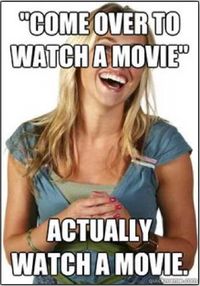
Screen-shot-2011-08-17-at-1.39.21-PMFriend Zone Fiona [seen right] is the crystalizing of a common relationship into a stock photo. Business Cat is a comedic idea to explore, gifted to the net as a shared intellectual exercise instead of exhausted by a single comedian before it is presented. Ultimately, that is the art of the Internet: resonance and participation. It produces a lot of crap, the same way attending an improv acting class does. But here and there, something happens, and when you zoom out and view the whole, you find that entire conventions have been created and you have crowdsourced art.

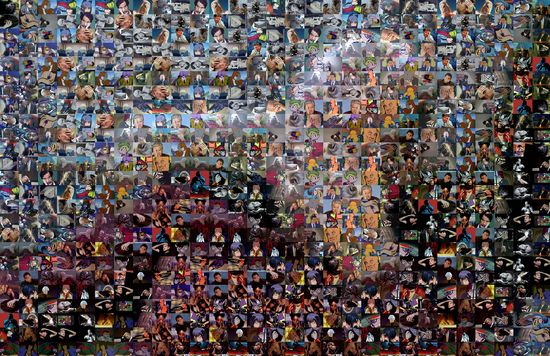
Have you ever seen the mosaics that are made up of many small pictures? Of course you have. There's a very nice Jean-Luc-Picard facepalm one out there I'm certain Matt is familiar with [seen at the top of this post]. That is Internet art both in metaphor and realization. A picture of an exasperated person palming their own face is a picture. Ten pictures is derivative crap. Ten thousand pictures is a new picture, and that picture is the art.

Another:

In the '70s and early '80s, Britain was similarly besieged by similarly woeful unemployment, and a large population of unemployment youngsters. The result? Monty Python’s Flying Circus and The Young Ones. Someone besides me has to already have had this realization, but those comedy shows may have prefigured 21st century Internet comedy culture. They were surreal, trivial, ridiculous mash-ups of different media and themes. Irreverent, goofy, and without any pretense at all of appealing to or caring about "culture". They were also notable for their constant switching frames, storylines, settings – all very ADD – all very Internet.

Another circles back to the broader debate:

I'm a Boomer and I don't hate the Millennials.  I admire their digital chops and their adaptability in a world they didn't expect.  I wish they didn't hate me, because I had nothing to do with "pissing it all away," if indeed that has happened.  The world is going through a rough economic patch, mostly owing to right-wing economic blunders and endless appetite for war. 

News flash: this has happened before.  I graduated college in 1973, when the expensive fiasco of Vietnam began to be felt in the economy, the same year the Arab oil embargo ushered in the famous decade of "stagflation." Job prospects were dismal.  But the economy crawled back, and by the time I reached my peak earning years, I was able to succeed beyond my wildest dreams.  If we can avoid a return to the past (the insanity of Hoover-esque austerity) and embrace the future (new forms of energy, investment in technology and infrastructure instead of war), Millennials may yet have a chance at the good life.  I hope so.

One more:

The only thing more tiresome than Goldberg/Labash complaining about "kids these days" is 23-year-olds insisting that, trust them, they really are smarter than their parents. Just like your readers who blame the Boomers for climate change and the debt, boomers blamed the Greatest Generation for nuclear weapons and the war on drugs. And eventually, when the Boomers are grey-haired and wrinkly, we'll speak about them in awe while we credit them with civil rights and the sexual revolution. And eventually, when the Millennials get old enough to spawn a new breed of whatever, some of them will complain about all the weird shit those kids do.

Can we all just agree that every generation is equally awful?

Peter “Mother-In-Law” Beinart?

An explanation for the backlash against Peter’s book from the “center-left” American Jews:

More than anything, it’s the spirit of ­Beinart’s criticism that many of his critics find off-putting. The American-Israeli rabbi David Hartman is fond of telling American Jews that when they criticize Israel, they should do so like a mother rather than a mother-in-law. In other words, they should do so out of love, not to belittle. To many of Beinart’s detractors, he sounds like a ­mother-in-law. “I came to the book as a friend of Peter’s and as someone wanting to see it succeed and see it have a major impact on people’s thinking,” says Peter Joseph, a prominent liberal Jewish philanthropist who gave Beinart money to help launch the Open Zion blog, “but unfortunately what I’ve seen is the book has led to greater polarization, and that doesn’t serve Israel’s best interests.” Beinart’s critics on the ­center-left don’t actually seem to disagree with him much; his biggest sin has been in not choosing to talk about Israel the way they expect Israel to be talked about.

Mosquito Season

Is upon us. Why cities often get hit the hardest:

Between the metal grate you see on street corners and the pipe below that carries water from the grate into the sewer system is a peculiar structure called a catch basin—a chamber designed to catch debris before it clogs our pipes. At the bottom, each catch basin can hold a few feet of water, perfect for mosquito eggs to float in, with air warm enough to keep female mosquitoes alive throughout the winter. These creatures not only don’t mind water that is not exactly pure like a mountain stream; they prefer it.

The catch basin is one of those things we think help separate us from natural ecosystems, when in fact it only expands them. If God, say, were to ask humans to create a system with which to breed mosquitoes, a sewer system relying on catch basins to filter debris might be it. God did not ask us to do that, but we did it anyway. We also went and created an entire landscape filled with cracks and crevices and ditches and underground chambers with hardly any mosquito predators in them.

Why Do Some People Hate Raw Tomatoes?

GT_TOMATOFEST_120529

Jennifer Ouellette scours the science:

People like me just lack certain key taste receptors, preventing us from appreciating the rich, sweet, meaty flavor of raw tomatoes that the rest of you are always rhapsodizing about. The problem is that tomatoes have something on the order of 400 volatile compounds and who knows which one of those (or combination thereof) might be responsible for the harsh reaction many of us experience in response to raw tomatoes?

It may be the same reason some people hate cilantro:

[Behavioral neuroscientist Charles J. Wysocki] conducted an experiment involving gas chromatography, a device that uses heat to separate the various molecules in something like cilantro, so subjects can take a whiff of each separate compound. People who like cilantro first detected the soapy scent, followed by the stronger citrus-y herbal scent we savor; but cilantro haters couldn’t smell the latter. At all.

(Photo: A reveler is splattered with squashed tomatoes during the 'Tomatina' fight in Bunol, near Valencia, on August 31, 2011. Tens of thousands of revellers splattered each other with 120 tonnes of squashed tomatoes in a gigantic annual food fight known as the Tomatina. The streets ran red with slippery juice as nearly 40,000 people, many stripped to the waist and drunk with sangria, pelted each other in the Plaza Mayor square and nearby streets of Bunol, eastern Spain. By German Garcia/AFP/Getty Images.)

Transportation Tribalism

Justin Davidson defends driving in New York City:

America’s transportation-policy wars play out as if people were born into different modes of travel—as if the allocation of dollars for roads, bridges, and public transit were a Darwinian struggle for habitat. But like many New Yorkers, I am a transportation omnivore. I walk several miles most days, bike to meetings when I can (reserving the right to show up slightly mussed), ride the subway when it’s cold, hail a cab as a last resort, and take my own car when the parking-tolls-traffic-­distance-weather-cargo calculus tells me that it makes sense.

The Psychology Of Starbucks

Starbucks

Alice G. Walton puts the coffeehouse on the couch:

[T]he coffee house plays the central role of “Third Place” in our lives – home being the first and work being the second – and Starbucks has always been vocal about its desire to be this third place for its customer. What’s interesting is that humans actually really need this place, and we’ve needed if for practically our whole existence, according to some. About 20 years ago, Ray Oldenburg, PhD, who wrote a book called The Great Good Place, argued that there are a number of attributes that make a third place a third place: It has to be convenient, inviting, serve something, and have some good regulars (which, he says, is actually more important than having a good host).

Recent store renovations seem to discourage sitting for too long:

“Changing the business model from third places to speed lane stops will not change the underlying human psychological need,” says Suzanne Roff, PhD, an industrial psychologist. “The value added to a cup of Starbucks coffee is the safe, unhurried comfortable environment that is not home or the workplace. This has become its brand identification.” If Starbucks continues to standardize its stores and shave down their comforts, its “third placeness” will continue to dissolve, and “urban consumers in particular will lose an informal social network (that emerges without a plan) that is an important antidote to loneliness and isolation."

(Discarded sign found next to a dumpster behind a Starbucks in Roanoke Rapids, Va via I Heart Chaos)

The Science Of Cereal

Corby Kummer explores it:

Taking out sugar is hard. As with sodium in soups and fat in breads, sugar is not just for taste but also plays a functional role, affecting a food’s texture, color and bulk. Home bakers know that it’s often harder to cut down on sugar than butter or shortening, and so do cerealmakers. Cerealmakers’ strategy is to move sugar from the inside of cereal pieces, as they’re called, to the coating, and to rejigger the sugar’s crystal size—all to increase the sensation of sweetness while reducing the actual weight of sugar used. The problem is the “bowl life,” a term I loved upon hearing—how long before cereal in milk gets soggy or slimy. General Mills wants three minutes of bowl life.