Daniel Kahneman examines why we love them:
We can't help but look at life retrospectively, and we want it to look good in retrospect. There was once an experiment in which the subjects were supposed to evaluate the life of a fictitious woman who had had a very happy life but then died in an accident. Astonishingly, whether she died at 30 or 60 had no effect whatsoever on their evaluation. But when the subjects were told that the woman had had 30 happy years followed by five that were no so happy, the scores got worse. …
And, from the evolutionary point of view, that makes sense. The duration of an experience is simply not relevant. What matters for survival is whether it ended well and how bad it got.
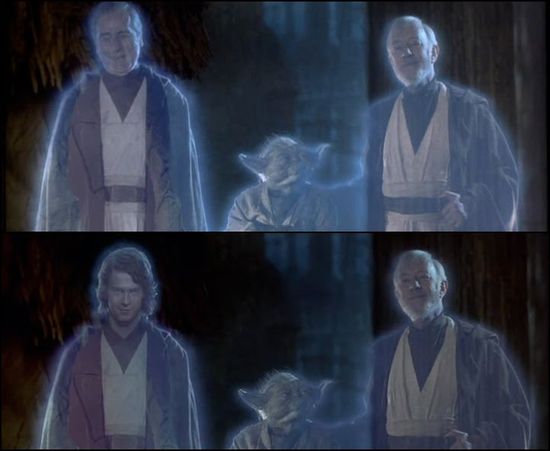
Blogger Apostropher assesses the screenshots seen above:
[Star Wars] Special Editions that made their way onto DVD were different to those already released on VHS. To be fair though, this time the changes weren't just indulgent tinkering, but an attempt to make connections between the classic trilogy and the new prequel trilogy which was busy crashing down around us. But once again, what started out sounding like a good idea resulted in confusion and disaster.
Anakin Skywalker's ghost, for example, which appears at the end of Return of the Jedi, was changed from Sebastian Shaw's time-of-death visage to the youthful, Prequel-era Hayden Christensen. What?! What's the significance of that? How come Yoda and Obi-Wan's ghosts didn't get to visit the Force fountain of eternal youth? Is Hayden somehow meant to represent a redeemed Darth Vader, perhaps? This is the same Hayden who slaughtered all those adorable little Jedi kiddies, right? Sigh.


 The Dish