Strange Things At The Cato Institute, Ctd

Luke Mullins offers a helpful account of the Crane-Koch struggle. A snapshot: 

Charles Koch began pushing for Cato to adopt a management philosophy he had developed, Crane says. The approach—which Koch called “market-based management”—aims to improve performance by creating market forces within a company. Koch was proud of market-based management, Crane says. For many years, he personally taught it to Koch Industries’ executives in front of a blackboard. His 166-page book, The Science of Success, spells out the philosophy, and he even trademarked the phrase “market-based management.” Sometime in the mid 1980s, engineers from Koch Industries arrived at Cato to teach the staff market-based management. As the engineers clicked through a PowerPoint presentation, Cato staffers were puzzled by their recommendations. For example, Crane says, the engineers said they could improve performance by stopping every 15 minutes to write down everything they had done.

“We’re all just looking at each other like, ‘What the hell is this about?’ ” Crane says.

“These guys were engineers, and you could tell that they didn’t even understand what they were supposed to be teaching.” After the engineers left, Crane told Koch he wasn’t adopting market-based management at Cato. “I knew that would be your reaction,” Koch replied, according to Crane. Crane now thinks his rejection of market-based management may have offended Koch more than he realized at the time. “Charles has always been fascinated with academics,” Crane says. “He likes to hang out with them, he funds them, and it may well be that he wanted to be one of them and that he thinks his contribution to academia was market-based management.”

Earlier thoughts on the contretemps here, here, here and here

The Problem For Print

Screen Shot 2012-05-30 at 6.26.25 PM

Derek Thompson outlines it: 

According to this chart — adapted from a Mary Meeker slideshow excerpted by Bill Gross — we spend more time engaging with mobile devices than reading print. But print publications still get 25-times more ad money than mobile. Either the eyeballs are moving faster than the advertisers, who will eventually stop paying for print … or the ad teams don't think a minute spent around mobile ads is worth a minute spend around print ads. Those aren't mutually exclusive. 

Jeff Sonderman has more.

The Chemistry Of A Wedding

For his book, The Moral Molecule, Paul J. Zak drew blood from a bride, groom and their parents, before and after the vows, to measure the oxytocin levels:

The bride's oxytocin level shot up by 28% after the vows, "and for each of the other people tested, the increase in oxytocin was in direct proportion to the likely intensity of emotional engagement in the event." Bride's mother: up 24%. Groom's father: up 19%. The groom: up only 13%. Why? It turns out that testosterone interferes with the release of oxytocin—and Mr. Zak measured a 100% spike in the groom's testosterone level immediately after the ceremony.

The guests are affected as well:

It looks as though humans have devised this ritual that induces oxytocin release in a way that bonds people to the wedding party. It provides this social support system, so that this couple presumably can be successful at reproducing.

In a long and worthwhile interivew, Zak expands on the interaction between testosterone and oxytocin:

I already mentioned that stress hormones can inhibit oxytocin, but the favored hormone of half the human race, testosterone, is a potent oxytocin inhibitor. So in the experiments where we administer testosterone to men, we find that they become more selfish and more entitled. So: Who are the most selfish and entitled people on the planet? Teenage boys, which you and I used to be—and we can attest to that. But at the same time, we find that high-testosterone men are much more likely to spend their own resources to enforce social norms of sharing. That is, if given a chance to punish, it’s these high-testosterone individuals who will enforce the rules and punish others for not cooperating. So we have this sort of yin and yang of morality right inside our own beings. We have oxytocin that makes us care about other people, makes us feel empathy—it’s hard to hurt people you feel empathy for—and then we have testosterone, which lets us enforce the rules.

Nanny State Watch, Ctd

Alex Koppelman's uninspired defense of Bloomberg's soda ban:

[T]he ban doesn’t have to work that well, or really at all, to be a success. Even if the ban does nothing but shift the discussion about what the government can do to protect the health of its citizens in his favor, Nanny Bloomberg will have won, and we’ll be better off for it.

Shorter Koppelman: Bloomberg's ineffective government nannying will be a success if it leads to more ineffective government nannying. John Cole, like so many others, is against the ban:

Stupid, paternalistic, and completely unenforceable. My old platoon sergeant once told me that when it comes to keeping the guys in line, you never make a rule you won’t enforce, you never make a rule you can’t enforce, and you never make a rule you shouldn’t enforce. This new ban fails on at least the first two.

Bettina Elias Siegel, no fan of the soda industry, also disagrees with the ban:

[W]hile it's true that Bloomberg's other, similarly coercive health measure – the banning of smoking in restaurants – was controversial when announced but is now widely accepted, one key difference is that smoking in restaurants not only adversely affects the smoker, but also the non-smokers around him. With soda, though, there is no immediate harm to bystanders that might otherwise justify the proposal in the minds of many New Yorkers.

Should Sex-Selective Abortion Be Legal?

Yesterday, the House voted against banning abortions performed because of the sex of the child. Allison Benedikt lumps all reasons for getting an abortion together to argue against such a ban:

Strategically, it makes no sense to give in to this idea that there’s somehow something a little queasier about having an abortion for gender than, say, for money. These are equally legitimate reasons (or, if you are on the other side, equally illegitimate). One might make you uncomfortable in your gut, but it can’t make the movement hesitate. Because that hesitation—that pause of, well, yes this one is complicated—makes it that much easier for so many of those other reasons (money, timing, work) to seem a little not-OK too.

Douthat takes on attempts to minimize the issue by linking it to a small minority:

Here Milbank is addressing the substance of the matter, and he’s saying … what? That if a deplorable practice mainly affects Asian immigrants, it’s not really worth criminalizing?

I'm more with Ross here in principle. I'm just deeply skeptical of how legal authorities could determine such a motive if the women do not say so. Banning explicit advertizing or marketing for sex-selective abortion would be another thing. But my sense is that this is all underground anyway, very hard to root out, and the kind of government power that would be unleashed in trying to figure it out is not compatible with a free country. I mean, how do you prove motive in such cases? Noah Millman counters Douthat and tries to reframe the debate:

I suspect that most people who are pro-choice would be creeped out by a woman who had had 20 abortions, or by a woman who was planning to have a child but had an abortion because her pregnancy interfered with a planned vacation. They would be creeped out for reasons that Douthat would probably have sympathy with, reasons that have something to do with the notion that these hypothetical women are treating pregnancy with insufficient gravity. But it doesn’t follow that those reasons imply that those who harbor them are closet pro-lifers. 

Douthat sparked a similar Dish thread on sex-selection abortion last year.

The Unvetted Canard

Jim VandeHei and Mike Allen have decided that Republicans have a point when they claim that "reporters are scaring up stories to undermine the introduction of Mitt Romney to the general election audience – and once again downplaying ones that could hurt the president." Weigel revisits the facts:

You can't compare Obama 2012 to Romney 2012, because Obama's already been his party's nominee and won an election. Go back to Obama's first run. In April 2007, nearly a year before he became a campaign issue, the Times published a 2,593 word Jodi Kantor story (with addtional reporting from Kenya!) about Rev. Jeremiah Wright and his relationship to Barack Obama. The story appeared on A1. On May 11, 2008, when Obama had largely locked up the nomination but still had to fend off Hillary Clinton in tough states, the Times published a 5,024 word story titled "Pragmatic Politics, Forged on the South Side," which delved into Obama's relationship with Bill Ayers and Bernardine Dorhn — "Hyde Park's fringes," and "unrepentant members of the radical Weather Underground that bombed the United States Capitol and the Pentagon to protest the Vietnam War." This also appeared on A1. …

Here's the issue: the "Obama wasn't vetted" outrage doesn't have any quantitative, factual proof.

If you're angry that Obama won in 2008, it sure feels like the media went too easy on him. It sure feels like the press was so interested in the story of the First Black President that it ignored stories that reflected poorly on him. Feeling isn't proving. Still, don't get me wrong — it's really interesting that Haley Barbour, a Republican lobbyist and former governor, thinks the media is being unfair to his party's candidate. One point to Politico!

Friedersdorf is flabbergasted by the lack of moral perspective: 

So to sum up, one candidate is portrayed, accurately, as being extremely rich, with a wife who has rich-person leisure-time pursuits; and the other candidate is portrayed, accurately, as someone whose secretive policies have wrought dead children, broken promises, violated due process rights, and possibly created more terrorists. And our political culture in the United States is so blinkered that the story about the rich candidate whose wife rides horses is regarded, by conservatives and savvy Politico journalists, as the one that is noteworthy for being negative; whereas the story about the Orwellian turn in the White House doesn't even merit mention. It isn't even raised as an example when "vetting Obama" is discussed.

Devin Gordon adds:

Let's get macro for a moment. This Politico story was written by Jim VandeHei and Mike Allen, two people at the very top of the organization's masthead. It's effectively an unsigned house editorial. And it levied a charge of journalistic malpractice at two of Politico's biggest rivals. The house position of Politico, as evidenced by this piece, is that they are fair and their chief competition is not. It's a thinly disguised, fundamentally craven argument for Politico's superiority in the world of political coverage. Let's call this article for what it was. It wasn't journalism. It was business. 

Drugs Don’t Make You Eat Other People’s Faces

An incredibly gruesome assault in Florida is being blamed on drugs. Maia Szalavitz sets the record straight:

[T]he best predictor of violent behavior is a previous history of violent behavior, which we now know that the Miami man had. He was apparently the first person ever to be tasered by North Miami Beach police. Why? He had beaten and was threatening to kill his mother.

How drugs relate to violence:

When taken by mentally ill people … drugs can dramatically increase the risk of violence. A 2009 review of the research found that while having schizophrenia itself may raise a man’s risk of violent behavior by two to four times, drug misuse may multiply that risk by a factor of 12. By itself, schizophrenia — with or without substance misuse — increases a person’s chance of committing homicide by a factor of nearly 20. And yet, in the press, drugs continue to get the primary blame for such crimes.

Jack Shafer has a primer on the face-eater's drug of choice, bath salts:

Tragically, the media-inspired drug-scare cycle tends to raise the awareness of a "new" drug at the expense of the drugs that have a greater impact on public health (alcohol, tobacco). Even worse, scare stories end up promoting the new drug better than any Madison Avenue campaign ever could, creating a "boomerang effect."

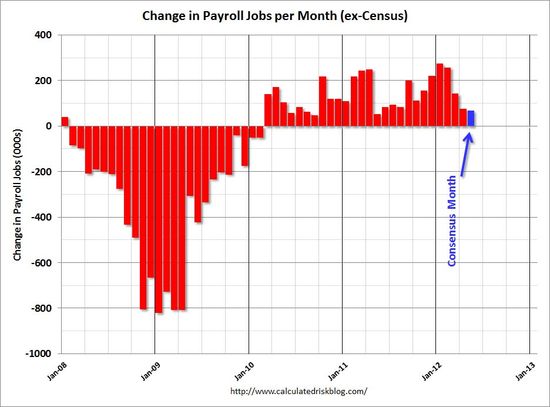
Jobs Report Reax: The Economy Slows, Again

Employment_Report_Bar_Graph

Leonhardt notices a pattern:

Some combination of problems – Europe’s new troubles, the rise in gas prices from several months ago, the continued cuts in government employment, the continued hangover from the financial crisis – has clearly slowed the economy. You can look at either survey that the Labor Department does, of businesses or households, and you can look at any time period. The message is the same. For the third straight year, the economy has fallen into a spring slump.

Daniel Gross sees no silver lining:

Every month, when it reports the figures, BLS goes back and revises the figures it had reported for the prior two months. For much of this recovery, the trend has been for BLS to discover jobs that hadn't been originally reported and revise the prior months' totals higher. But not this month. In May, BLS revised the gains for the two previous months lower. March's figure, originally reported as a 120,000 gain, had been revised upward to 154,000 in April, was revised back down to 143,000. The April figure, originally reported as a gain of 115,000, was revised to a gain of only 77,000.

Brad Plumer digs into the report's details:

Much of the job carnage seems to be driven by the construction sector, which lost 28,000 jobs last month. As Jed Kolko of the housing research firm Trulia notes, construction jobs now make up just 4.1 percent of all employment — the lowest level since 1946. And the United States hasn’t added any new construction jobs, on net, since the beginning of last year. There’s still a massive hangover from the housing bubble.

Mark Perry searches for economic bright spots. Among them:

The jobless rate for college graduates fell to 3.9% in May, the lowest unemployment rate for that group since December 2008, almost three and-a-half years ago.  

Jamelle Bouie considers political consequences:

Obviously, this has political implications, and none of them are good for Barack Obama. In the short term, this gives the Romney team an excellent talking point and bolsters their depressingly effective message of facts (the economy is sluggish) and falsehoods (Obama hasn’t created a single job). Obama can recover from this, but only if summer sees a significant improvement in the employment situation. Right now, Obama is the slight favorite in this election. If this continues to the fall, he’ll almost certainly be the underdog.

Ryan Avent agrees:

Mr Obama will no doubt protest that things would have been worse without his efforts, that additional fiscal stimulus is impossible thanks to Republican opposition, and that trouble abroad, over which he has no control, is largely to blame. On the merits, he'll be mostly right. Voters are unlikely to feel much sympathy, however. Their attention will be overwhelmingly focused on a recovery that has, for a third year running, left the country saddled with far too much unemployment and far too little job growth.

Yglesias dismisses the horserace chatter:

[I]t's important to remember that this is first and foremost a human trajedy for unemployed and underemployed people, and for employed workers who've been stripped of bargaining power due to persistent labor market weakness. If growth stays dismal and Barack Obama loses the election, he and Michelle and Jack Lew and Tim Geithner and all the rest will go on to have happy, healthy, prosperous lives. Other people's careers are much more in the balance. 

Jared Bernstein blames the economic weakness on Washington:

The economic reason the job market is once again downshifting is because we as a nation failed to take out recovery insurance in the form of temporary stimulative fiscal policy against precisely the situation we now face. 

Felix Salmon calls for more stimulus:

The government can borrow at 1.45%: it should do so, in vast quantities, and invest that money back into the economy itself. Take a few hundred billion dollars and use it to fix our broken infrastructure, to re-hire all those laid-off teachers and firefighters, to provide some kind of safety net for the millions of Americans who have been out of work for more than a year. Even if the real long-term return on any stimulus package was zero, the nominal long-term return would be well over 1.45%, making the investment worthwhile.

Buttonwood points out that more stimulus is politically impossible and is watching the Fed instead. Binyamin Appelbaum likewise keeps his eyes on Ben Bernanke:

Senior officials have said repeatedly in recent months that the bar for additional action is unusually high at the moment, because any additional steps to encourage growth would have to be huge to be meaningful. Many analysts also feel that the Fed is more reluctant to take action during a presidential campaign.

Chart from Calculated Risk.