The hypocrisy staggers.
Month: June 2012
A Unilateral Two-State Solution?
Michael Koplow thinks through Gaza part deux:
An Israeli withdrawal from the West Bank certainly is fraught with dangers both known and unknown. That does not, however, mean that it will automatically carry with it the same consequences as the Gaza withdrawal did. Barak is right in noting that Israel at some point is going to have to do something, since holding onto the West Bank indefinitely is not a real option and Palestinian intransigence in negotiating needs to be met with some sort of response. The immediate PA attack on the idea itself gives you a good idea of whether Palestinian officials think that a unilateral withdrawal is in their best interests, and perhaps the credible threat of withdrawal will give them the kick they need to resume negotiations. In any event, the idea of unilateral withdrawal should not be so casually dismissed with facile comparisons to Gaza.
Hussein Ibish counters:
Secretary of State Hillary Rodham Clinton is correct in warning that unilateralism runs counter to the whole framework of a negotiated agreement. Rather than calming the situation on the ground, this could greatly inflame an already tense situation. Whatever the professed or real intentions behind such a move, Palestinians and other Arabs will assume that what is enacted as “temporary” will be at least semi-permanent (if not, indeed, permanent). They will believe that Israel is imposing unilaterally, by force and fiat, what it could not get Palestinians to accept at the negotiating table.
That's true enough, if Israel tries anything other than the 1967 lines with land-swaps. But if they arrive at a border that is in line with US and European views, or the contours of the 2000 proposal, I think it would be a great idea to withdraw unilaterally. It would, for example, automatically mean the unraveling of the illegal settlements, walls and road barriers than impede a Palestinian state on the West Bank. In that sense, wouldn't it in some way comply with the Palestinians' understandable request that construction be stopped before negotiation? My suspicion, alas, is that this is a feint, engineered to foster the impression that the current Israeli leaders are still interested in a two-state solution, even though their actions prove they aren't. But any move to get a real partition off the ground seems welcome enough to me.
The End Of Landfills?

Terry Tamminen wonders if zero-waste is possible:
With a global population that now exceeds 7 billion and a rapidly growing middle class, especially in developing economies such as Brazil, China, and India, resources are becoming increasingly scarce and we can no longer afford to waste anything. Many communities are also running out of practical places to bury waste, and neighbors fight expansion of existing landfills. … A better solution is to make landfills a thing of the past by challenging our imaginations and ingenuity to devise more zero-waste strategies that convert garbage into gold.
(Photo: A horse stands in the Jardim Gramacho landfill, the biggest in South America, in Rio de Janeiro on May 15, 2012. The landfill is set to shut down next June 1st. By Christophe Simon/AFP/Getty Images.)
Happy June!
Try to remember your words, ok?
Home News
The Dish had 1.3 million unique visitors last month, one of our highest totals ever. Thanks for being a part of this. When I remember first blogging to a handful of friends twelve years ago, I have to scratch my head in amazement at what technology has done.
The Blockbuster Goes Bust?
Jonathan V. Last ponders Hollywood's recent bombs:
If this summer is indicative of anything, it may be that people are rebelling against transparent blockbuster economics. Make a quality movie about a property people care about — “The Avengers,” “The Hunger Games” — and audiences respond. But simply throw $200 million at the screen for explosions and robots and a warmed-over half-idea because hey, it’s summer? Tumbleweeds.
What To Do About Syria?

Foreign Policy recently hosted a roundtable on the question. Bilal Saab's contribution pushes back against the idea of simply ushering Assad out:
Preserving an oppressive and minority-led regime means that the Alawites will retain their political dominance over others, a condition that is guaranteed to cause more sectarian violence and further alienate the Sunnis, who represent the majority of Syrian society. While former Yemeni President Ali Abdullah Saleh personified the state in his country, Assad is not the only problem in Syria. It is the fascist and security-oriented regime that the Baathists built in 1963 and Hafez al-Assad — Bashar's father — remodeled in 1970. Syria needs new leaders, but it also needs a new system and a new identity and role in international society.
Fareed Zakaria suggests harsher sanctions:
Syria is not an oil state; the regime does not have unlimited resources with which to buy off elites. Were truly crippling sanctions to be put in place, including an embargo on energy, it is likely that the regime would begin to crack. That might result in a brokered exit for the Assad family or a full-scale collapse of the regime. It seems unlikely that the regime could persist without some source of cash.
Daniel Serwer hopes the status quo will eventually bring change:
The fact is that no one has come up with anything demonstrably better than pursuing the Annan plan for Syria, though Andrew Tabler’s suggestion of an arms quarantine against the regime certainly merits consideration as a supplement. The key to making the Annan plan work is moving Bashar al Assad out of power so that work can begin on a political process. The Iranians and Russians will do this once they see him teetering on the brink. He is not far from that point. I still think the best way to put him there is through nonviolent means, like the general strikes that have recently plagued Damascus and other cities. It is very hard to crack down on large numbers of merchants for not opening their shops in the souk. The Syrian people still hold the key to Syria.
Shashank Joshi compares Syria to Iraq:
Syria is not sliding towards a civil war — it is in the midst of one. There is little international appetite for a military intervention, although this could change if, say, Syria's chemical weapons are displaced or — worse — used. In the medium-term, there will be more massacres and more suicide bombings. That will sharpen the grievances of the largely Sunni opposition, strengthen extremists, and amplify the fears of Alawites and Christians fearful of regime change. As in Iraq and Lebanon, such a trajectory would leave Syria's society and politics with permanent scars.
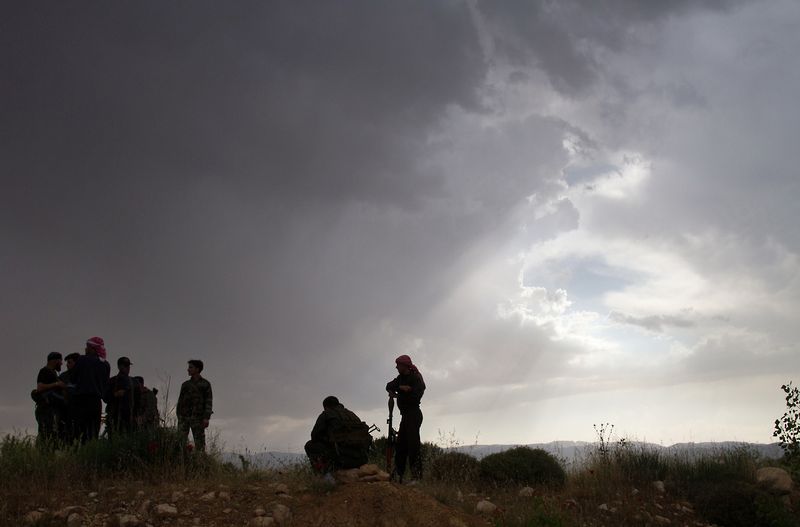
(Photo: Syrian rebels take position near Qusayr, 15 kms (nine miles) from the flashpoint city of Homs, on May 10, 2012. Monitors say more than 13,000 people have been killed in the Syrian unrest that started with peaceful protests in March 2011 before turning into an armed revolt, faced with a brutal crackdown which has cost dozens of lives each day. By STR/AFP/GettyImages.)
The Drug War Is Hooked On Cocaine
Alejandro Hope's reality check:
Two inescapable facts about the drug problem in Latin America are that it is mostly about international trafficking, which dwarfs domestic consumption, and it is mostly about cocaine, which provides the bulk of illegal drug revenue. But cocaine legalization in the United States, while it would provide huge benefits for Latin America, has very little support.
Kleiman reads other opinions about drug violence in Latin America and notices that "no one has a practical suggestion about a legal successor to the illegal cocaine market."
TV’s Minor Leagues
Alyssa Rosenberg wants more web series adapted into cable series:
I really think the networks would be smart to start using web television as a farm system. A season of web television usually adds up to about the length of a pilot. If a motivated web audience finds a show and proves willing to keep coming back for the bits and the pieces of a pilot over a period of time, that might be a good indicator that a core audience exists for a show that a network can build on, rewarding legacy viewers with higher production values, and putting a promising concept in front of an audience that didn’t even know it was out there to hunt for.
Yglesias Award Nominee
"It’s understandable that most House Republicans are skeptical of environmental reforms championed by inside-the-beltway environmentalist lobbying groups. But not everything supported by environmentalist groups or the Obama Administration is a bad idea. Catch shares for fisheries (which I wrote about for NRO here) are a good example. … Yet some fishing interests don’t like catch shares, and earlier this month these interests convinced a majority of House Republicans to support an amendment barring further implementation of catch-share programs in the Gulf of Mexico and along the Atlantic Coast," – Jonathan Adler, NRO. More explanation of why the administration and libertarians alike back catch-shares here and here.
 The Dish