Romney’s Non-Positions On Immigration, Taxes, Spending, Etc.

PlasticCan

This video interview with Mitt Romney's immigration spokesman reveals just how contorted his position is. But he won't pay a price among Republicans. Many don't seem to care what Romney does in office as long as he isn't Obama. Some praise the refusal to provide any specifics at all:

Personally, I'm impressed by Romney's nerve on this. The media is crafty at labeling their traps escape hatches (just do this and we'll stop) and more often than not, Republicans fall for it. Not Romney. He's keeping his powder dry, playing a winning game of chicken, keeping the focus on Obama, and staying on message. Eventually, Romney will of course release policy specifics. But this should be a strategically timed move and an offensive one, not a reactionary one. Stop worrying about that the media thinks. Think about what the media will do. Romney had a choice today between ten days of pain by getting specific or an afternoon of pain for not.

But if you can get away with never reconciling your primary extremism with your general soothing tone, why offer any specifics at any point? This is a campaign that is simply about Obama and the economic doldrums. It will include no details on specific Romney policy whatever, especially on taxes and spending. The math won't add up; the positions won't align; the personal biography will be off-limits. But the anti-Obama propaganda will be overwhelming – and the strategy for Romney one of deliberate obfuscation.

When the issues are as grave as war or peace and the end of the welfare state as it has been known, it seems to me this is a dangerous position for a democracy. Palin forged the path. But Romney is striding forward on it.

(Cartoon by Ward Sutton of the Boston Globe with the artist's approval. More comic book cartoons of Mitt here.)

The Maliki System

Kirk Sowell, author of the Inside Iraqi Politics newsletter, believes – surprise! – that Maliki is becoming an autocrat:

[D]on’t think Saddam Hussein, think Vladimir Putin. I’d say Maliki is presently about 80 percent through with the construction of his own “power vertical.” If he completes it, Iraq will still be a mostly free society in the sense that people can travel freely, get access to information if they make the effort to do so, and compete for spoils and a portion of power within the Maliki system. Maliki’s dominance of the security services, state media, the judiciary, the anti-corruption watchdog and the pillars of the financial system will give it a very “managed democracy” kind of feel. Parliament, the electoral commission and the Central Bank are the three institutions, which remain independent. Maliki has used the Supreme Court to weaken the first, and is currently pressuring the second and third.

“The Sound Of Intelligence” Ctd

A reader writes:

What always struck me about Sorkin's writing was the pace of delivery. When most of us interact, we hear something, process it, develop a response, and say it. A Sorkin protagonist's response is fully formed on the tip of the actor's tongue, waiting for the conversational foil to serve the set-up. The characters seem impossibly intelligent because while the rest of us mortals are still processing the call, the protagonist is already delivering the response.

Another focuses on "The Newsroom":

I did not have high hopes after reading the reviews last week. But after watching the first episode, I have to say that the show is not nearly as bad as the reviews would suggest, and I am wondering why journalists have been so critical of the show. 

I agree with some of the critiques; the characters are preachy and this is probably not an accurate portrayal of cable news journalism. However, the characters in "The West Wing" were pretty preachy and the media tended to let that slide. Could all of the negative reaction stem from the fact that the press knows that it isn't doing a very good job?

On that note, another reader passes along a passage from Noah Gittel's review of the new show's first episode:

"The West Wing" was, of course, a liberal response to Clinton’s move to the center. Many episodes literally recast his decisions while in office, with President Bartlett doing what liberals wish Clinton had done in that situation. It seems that "The Newsroom" is up to the same tricks.

In tonight’s episode, Sorkin replayed the first day of the BP oil spill and showed us the kind of reporting that he wished he had seen. But this is more than liberal wish fulfillment. When Sorkin reveals what news story they are covering, I felt like I had been hit in the gut. I realized that I had not thought about the spill in probably a year. In the midst of a presidential campaign, with its attack ads, surrogate drama, and politically motivated executive orders, it was as if – in my mind – the biggest environmental disaster in American history had not happened just two years ago. This was amazing to me. I consider myself an environmentalist and an animal advocate. And I had forgotten that this occurred.

And that’s exactly Sorkin’s point. By replaying major recent events – and covering them right this time – he is shining a light on the disastrously poor state of journalism today.

Alyssa Rosenberg differs:

The thing that I find genuinely disturbing about The Newsroom is its narrow identification of cable news as the problem and Will McAvoy as the solution. Cable news polarization is a problem, but it’s a problem that ultimately effects a fairly small number of Americans day to day and year to year. The larger problems are ones that affect all sorts of news programs and publications: shrinking staffs and budgets that support less-ambitious reporting, government secrecy and control of information, increasingly stultified and PR-controlled interviews that decrease the possibility of honest conversation and homogenize reporting. Tone and presentation are issues that float on top of this sea of larger challenges.

The Many Ways To A Happy Marriage, Ctd

In a guest post for Savage Love, Jeremy Hooper, author of a new memoir, lends support to monogamous same-sex marriages:

I had made a monogamous commitment to my boyfriend—the first monogamous commitment I had made to any boyfriend—and I wasn't going to break it. Instead, I picked up the phone and broke off the relationship before planting a smooch on my new friend-turning-lover. Looking back, it actually might've been nicer and more sensitive of me to have put off the breakup until we could get together for a face-to-face conversation, even if that would've meant a one-night overlap. But what can I say? My commitment to fidelity was stronger than my capacity to craft a tactful exit strategy.

As the years passed and other relationships ebbed and flowed, that commitment remained unchanged. I did give the other ideas the old college try, allowing my mind to consider an open relationship or flexible setup. I was certainly open to the possibility. The experimentation just never worked for me.

When I met my husband, the whole thing went to an even more clarified place. Andrew and I made a vow to not only be partners for life, but to be on the tightest of teams in every way. In the kitchen, this might mean nothing more than him opening the wine while I bring the water to a boil. In the living room, it can be as simple as instinctively pausing the DVR when the other needs to pee. But in the bedroom? It means knowing that you have a physical and emotional awareness of one another that no one else in the world possesses, and knowing that you share a truly unique space that you both regard as sacrosanct.

Less-conventional marriages profiled here.

How Safe Is Home Birth?

My sister, me and my brother were all conceived and born in the same actual bed – moved around to three different locations. We had a midwife; and some long-burnished anecdotes. I was called David for about a week or so. When I emerged rather swiftly from my poor mother, I am told the nurse said, "Well, he hasn't got blue booties on, but it's definitely a boy." The stories we were told have an innocent quality to them, looking back. Now, apparently, home-birth is making a comeback. Michelle Goldberg removes some of the romance:

For many parents, home birth is a transcendent experience, and they’re profoundly grateful to have been able to have their babies on their own terms. Yet as the number of such births grows, so does the number of tragedies—and those stories tend to be left out of soft-focus lifestyle features. Now, a small but growing number of people whose home deliveries have gone horribly awry have started speaking out, some of them on a blog, Hurt by Homebirth, set up by former Harvard Medical School Instructor Amy Tuteur.

Some numbers:

[Tuteur] points to figures from Colorado, one of the few states that mandates the collection of data from licensed home birth midwives. In 2009, midwives performed 637 deliveries, and transferred another 160 patients to the hospital either before or during labor. Altogether, the midwives’ patients suffered 9 perinatal deaths, almost double the perinatal mortality rate for the entire state, including high-risk and premature deliveries. Three of the nine babies died during labor, which is extremely rare in hospital births.

(Video: Trailer for The Business of Being Born, a 2008 documentary that advocates home birth. Watch the whole film for free here.)

Obama’s Creepy Emails And Ads, Ctd

Former Dish guest-blogger Walter Kirn belatedly comes to my defense in a delightful screed against those excruciatingly personal campaign emails and the lottery invites for dinner with celebrities that come with them. And it's not just the Obama camp:

Tagg Romney sent me a note the other morning that opened with an encomium to fatherhood, the holiest of conservative institutions next to the debt and equity markets themselves ("Dad taught us a lot of lessons, including the importance of having fun as a family, but the most important lesson he imparted to us was the joy in helping others"), and closed with an invitation to wager five bucks on a chance to rub shoulders with his "Papa," a famously tight-fisted, high-stakes gambler who’d never take such lousy odds himself, not even if tickets were a penny a pop. The deal stirred doubts in me about Tagg’s upbringing as well as contempt for his estimation of mine.

Along the same lines, the new Obama event registry troubles William Nomikos.

How The GOP Won The Spin War

Paul Krugman and Robin Wells credit Republican unity:

[W]hy did the right do so much better a job than Obama and company of seizing the moment? We’ve already seen part of the answer: Democrats in general, and Obama in particular, were too close to Wall Street to deal effectively with a crisis that Wall Street had created. [Thomas] Frank also makes an important point: in the recent political climate, ignorance really has been strength. You might think that the hermetic intellectual universe the right has created for itself, a kind of alternative reality walled off from any evidence that might contradict faith in the wonders of free markets and the evils of government intervention, would be a liability for the GOP. And it does indeed wreak havoc with actual policymaking. In political terms, however, it has given Republicans unity and certainty where Democrats have been weak and divided.

Congress Has “A Lower Approval Rating Than Polygamy”

But on average, more than 90 percent of incumbents win re-election. Leo Linbeck, whose Super PAC targets unpopular congressional incumbents in "safe" districts, outlines his case for restoring electoral accountability: 

It is ironic to recall that the Founders gave the power of the purse to the House of Representatives because, being more responsive to the people, it would protect their pocketbooks from the extravagances of the executive branch. For the first 100 years, it pretty much worked that way, with federal spending about 4 percent of GDP. Today the House is a spending machine—it spends $10 billion each day and more than 25 percent of GDP. Money can’t buy love, but it can buy power: in November 2010, Congress had an approval rating of just 17 percent, while the re-election rate in the House was 86 percent. This disconnect between approval and re-election rates is the clearest sign that the congressional accountability system is broken. …  With larger districts, primary elections, the greater influence of money, and a series of reforms that discouraged challengers, House members were freed from the accountability system that had held them in check. Incumbents used to be agents of the local party; today they are free agents. Incumbents used to be controlled by party bosses; today they are the party bosses.

The View From Your Window Contest: Winner #108

Vfyw-contest623

A reader writes:

I see yellow number plates and the special kind of blue that indicates the Med. I also see a beach in the middle of a town on a peninsula. I may be crazy but I also see a bit of land on the other side so I am going with the southern tip of Gibraltar, just south of the rock on Mount Rd. looking south across to Africa.

Another:

Malibu, California? I drove along this part of the West Coast last year, and those houses right along the beach look familiar.  It doesn't get much better than Highway 1.

Another:

This looks like a view of Barcelona from the Collserola hills.  From the angle it needs to be a tallish building, which suggests La Florida, the only ritzy hotel on the hillside.  I spent a lot of time at the nearby Tibidabo amusement park when we lived in Barcelona seven years ago and my kids were little, but we never visited La Florida, so even if this happens to be right can’t suggest a floor, let alone a room number.

Another:

The yellow, Euro-shaped license plates rule out the Americas and most of the coastal countries in Europe.  Nothing about the terrain says England, and everyone in Australia and New Zealand uses white plates except Western Australia and New South Wales, where there are tons of possibilities that match the terrain.  That small beach at the bottom of the hill with a park on the shoreline behind it suggest Tamarama, just south of Sydney.  I'm guessing that the park is Marks Park and the beach is the Gaerloch Reserve.  The attached picture is a closeup of the beach from Tamarama Marine Drive:

Tamarama beach

Another:

Just taking a stab in the dark at one of these contests for once because there was at least the clue of the cars going on the left side of the road. Based on the vegetation in the picture I decided it was a Caribbean territory of British heritage (screw you U.S. Virgin Islands). Based on the topography of the picture I decided it was more on the hilly side than the mountainous side and this pointed me toward Barbados and Bridgetown seemed like it had some hills overlooking more developed parts. And to pin down my guess with a little more specificity I'm going with Government Hill, Bridgetown, Barbados.

Another gets on the right island:

I’m gonna guess New Quay, Wales.  The rooftops are right.  The license plates are right.  The photo would have been taken from on top of the bluffs looking out over the Irish sea:

New-quay

Another:

Last summer around this same time I had a chance to hike for about three days along England's Jurassic Coast, which runs along England's Southwestern coastline, primarily within the county of Devon(shire). This area is absolutely stunning (it's a World Heritage Site) and is definitely worth the time and effort to get there and see it. As to this week's photo, it really reminds me of the area I hiked between Exmouth and Seaton. Based on the geography and the size of the town in the photo, I think the two likeliest options are either Sidmouth or Budleigh Salterton (what a rediculously British name!). However, given the size of the town I'll go with the larger of the two, Sidmouth.

Another zeroes in on the right town:

With cars parked on the left hand side, and having yellow license plates, it strongly suggests that this week’s view is somewhere in the UK. There are probably not that many locations in the UK that have a modest sized town on a small peninsula. So, I started in Cornwall and first had a look at Penzance. Then I noticed the small town of St Ives, just to the north, and everything fell into place. This week’s view is from the Tregenna Castle Hotel in St Ives, Cornwall. The view is looking north from the hotel towards the town and its harbor.

Another sends an aerial shot of St Ives:
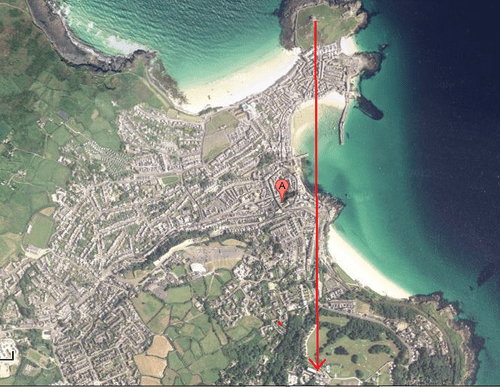
VFYW3

In the distance you can see the chapel of St Nicholas on the Island; to the left, the breakers at Porthmeor Beach. In front of the chapel is another sandy beach and St Ives Harbor at what looks like low tide.

Another's memory is jogged:

Ten years old, the infamous hot, dry summer of '76, down-market bed-and-breakfast in St. Ives, and a nasty case of chickenpox. The stuff of unforgettable family vacations.

Another:

Way back in 1990, my wife and I (living in New Jersey) visited a friend who was working near London. He mentioned we might enjoy a driving trip out of the city and suggested St Ives. We thought it was a good idea, and ventured out for our first big stretch of driving on the "wrong side" of the road. We made it, but by the time we pulled into St Ives we were totally frazzled from the experience, and didn't drive again until we left two days later. But our stay was fantastic. We dipped our toes into the Atlantic Ocean from the other side, and shopped by the beach (wonderful art shops). We returned in 1993, with our 1-year-old son, and in 2000, with our then 8-year-old son and 6-year-old daughter. Particularly, our daughter remembers a seagull stealing her Cornish ice cream right off the cone in her hand as we walked along the beach shops.

Another:

There is an absolutely wonderful Barbara Hepworth museum there and the Tate St Ives is awesome. I've only been once and it was when I was performing at the Minack theatre in nearby Penzance with the Cambridge University G&S society … it's a dreamy part of England. The Minack is especially fantastic. It's on the cliff side and as the first half of a show ends (as far as I remember), the sun sets and as the second half starts the moon rises. It was built by one woman and continues her legacy of allowing largely amateur theatrical performances at what must be one of the most unique and inspring performance spaces in the world. I live in DC now, so thanks for making a fellow British expat extremely nostalgic for home!

Another gets back to the sleuthing:

I'm pretty sure this week's VFYW is taken from the Tregenna Hotel, St. Ives, Cornwall, UK. I've never been there, and the hotel's web site is not giving me that detailed a map, so although I can tell physically, what part of the hotel it seems to be in, I couldn't say what room number. It appears to be either the Bay View self-catering apartment, or one of the two "single room sea view" rooms. I think it's about here on the map:
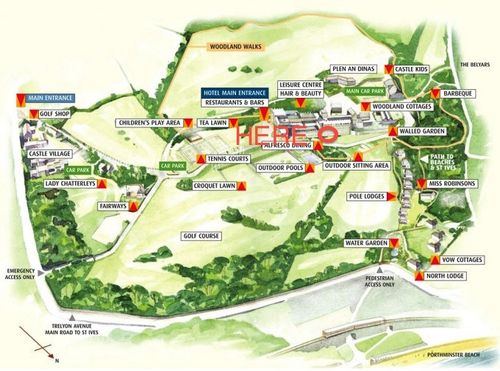
Tregenna map marked

Another:

I recently spent a summer living in the UK, and started searching there based on the combination of the architecture and mix of cars shown in the picture. From there, it was fairly easy to recognize the distinctive promontory shown in the picture, and then to narrow down the view as from Tregenna Castle in St. Ives. No Google Streetview in front of the hotel though!  So now I have to guess.  Based on the tops of the palm trees at the very bottom of the picture, it looks like the view is from the second floor (or first floor, as this is in UK), and based on the angle of the view, maybe the second window from the left, circled in the picture:

VFYW Entry

Another:

The headland in the distance is quite distinctive – it's known as The Island, although it's connected to the mainland. The building on the top is a chapel. Following the angle of the terraced houses in the centre of the photo you soon arrive at the Treganna Castle Hotel. A quick search through Tripadvisor produced quite a similar photo taken from Room 120. I think the window we're looking for must be near that room, on the (UK) 1st floor, judging the view of the parked cars and the treetops in the immediate foreground. It looks like the room may be just in the West Wing of the building but maybe one or two rooms closer to the main part of the building than Room 120.

So very close. Our winner nails the exact room:

Having looked plaintively at the VFYW pictures for the past year at last one I can identify! The view is of St Ives, a fantastic town in Cornwall in the very south west of the UK. A bit of research shows that the picture has been taken from the Tregenna Castle Hotel which overlooks the town. I am sure that an exact window is going to be needed here – a bit of interpolation suggests Room 118 as the most likely candidate.

St Ives is a wonderful place and includes possibly my favourite spot in the world – the Barbara Hepworth sculpture gardens which includes a large number of her fantastic sculptures in the tranquil back garden of what was her home/studio.

From the submitter:

The exact location is Tregenna Castle (now a hotel) which overlooks St Ives, Cornwall (which I think is the least English looking seaside village in the country) and postcode here TR26 2DE. The room number was 118.

I was there because my best friend is Cornish and we were visiting his family for the annual "feast" day in his ancient and tiny home village of St Day. It's a centuries-old Cornish carnival type affair, very surreal and English which brings the whole community together in a day of parades and marching bands and folk dancing. It was great fun and a reminder of an older and often forgotten England.

We couldn’t stay at his parent’s house, so we stayed in this hotel for a couple of days, as it’s a half-hour drive from his parents. The hotel has a fantastic location in great grounds, with the amazing view you can see above, and we spent a lot of time exploring all the arts galleries of St Ives, and the Barbara Hepworth museum (for my money one of the greatest single locations in the world, a fantastic and beautiful garden filled with her extraordinary sculptures – it was actually her working space, and where she tragically died in a fire). One day we came back to the hotel to find that a seagull had somehow sneaked under a tiny gap in the window shown in the picture, and pecked its way through all our free biscuits, leaving a hell of a mess!

One more email:

As you do with these things, once I worked out the answer (which felt pretty cool when you’re sat 5000 miles away) I started googling St. Ives, and found the famous riddle:

As I was going to St Ives
I met a man with seven wives
Every wife had seven sacks
Every sack had seven cats
Every cat had seven kits
Kits, cats, sacks, wives.
How many were going to St Ives?

The answer is of course 1. Unless you are Wikipedia, in which case the answer is either 0, 1, 2, 7, 9, 2752, 2800 or 2802. But not 2753, even though that makes as much sense.

Update from a reader:

It’s a fun riddle, but it’s not about the St. Ives in Cornwall. Rather, it relates to the somewhat less picturesque town I grew up in, St. Ives in Cambridgeshire. The person going to St. Ives was probably on his way to the weekly market or to the annual Michaelmas Fair, which have been held every week for the last 902 years. Or he may have simply stopped off at the Severn Wives pub on Ramsey Road (though, for any intrepid Dishers heading that way, I’d recommend the Nelson’s Head on Maryland instead).

My favourite quote about St. Ives (Cambs.) comes from a more recent source: Rupert Brooke, who wrote in his 1912 poem, The Old Vicarage, Grantchester,

"Strong men have blanched, and shot their wives,
Rather than send them to St Ives"

Says it all really.

(Archive)