There’s a poignancy to this, isn’t there?
Month: June 2012
A SCOTUS “Coup”?
Fallows fears that the GOP, in alliance with a GOP-packed Supreme Court, is subverting democracy:
[W]hen you look at the sequence from Bush v. Gore, through Citizens United, to what seems to be coming on the health-care front; and you combine it with ongoing efforts in Florida and elsewhere to prevent voting from presumably Democratic blocs; and add that to the simply unprecedented abuse of the filibuster in the years since the Democrats won control of the Senate and then took the White House, you have what we'd identify as a kind of long-term coup if we saw it happening anywhere else.
He follows up here. I agree that the Supreme Court – after Bush vs Gore, its modernist interpretation of the Second Amendment and then the coup de grace of Citizens United – is in one of its more aggressively political modes. It's also become trashier: Justice Scalia's dissents are perfectly at home on the Rush Limbaugh show at this point. And all this will not help the Court if it strikes down the Affordable Care Act with a similar partisan rhetorical flourish, or on flimsy, clearly partisan grounds.
Wilkinson quips that this "looks to me more like a list of things Mr Fallows finds upsetting than the slow-motion demise of American democracy." Jonathan Adler also counters Fallows:
The problem with these characterizations of the court is that if by “judicial activism” one means a willingness to overturn precedents and invalidate federal laws, the Roberts Court is the least activist court of the post-war period. As a recent NYT analysis showed, thus far the Roberts Court has overturned prior precedents and invalidates federal at a significantly lower rate than its predecessors.
And when you look back at how the Court tried to sabotage the New Deal under Roosevelt – under far more desperate economic circumstances – you see that naked politics has never, alas, been absent from the Court. What's different now is a reversal of roles in which the president is acting according to the old norms and the court is actively reactionary. Under Roosevelt, the Justices were being conservative, trying to preserve the old order under radically changed circumstances. Under Obama, they are reactionary, seeking to undo a century of precedent for federal power. If the ACA is struck down on these radical new grounds, the stakes will be very clear. If the Tea Party keeps control of the GOP and the GOP wins another presidential election under Romney, the next appointees are likely to be more radical still. If there's one thing Romney will aggressively pander on (is there anything he won't aggressively pander on?) it's the Court.
So this is not a coup. It's just the system at work, when one side has gone rogue. When that happens, the answer is not to call the refs but to win the presidency and win back the Congress and reshape the court through the constitutionally appropriate way: by appointing new Justices. After his disastrous attempt at Court-packing, that's what FDR did. It's what Obama has to do. He's in that rare position of being a president whose entire legacy depends upon being re-elected. And as each day passes, the historical importance of that re-election becomes clearer.
The Splintering Of America
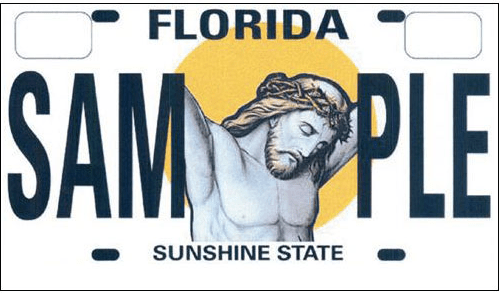
Not even our car license plates tie us together any more. Great pecs on that Jesus, by the way.
If Obamacare Is Ruled Unconstitutional
Ezra Klein imagines the Democrats' new strategy:
I … don’t think it’s particularly controversial to say that if the Affordable Care Act falls apart, the next time Democrats get a crack at passing universal health insurance, they’re going to want to do it in a way that avoids Republican obstruction and can’t be questioned by the Supreme Court. The most obvious policy path that achieves both goals is to expand public programs like Medicare and Medicaid, as that can be done through the filibuster-proof budget reconciliation process and it can’t be touched by the Supreme Court.
How To Survive A Plague, Ctd
More readers share their stories:
The picture one of your readers submitted, of a section of the AIDS Memorial Quilt, had one of the panels I remember seeing the first time I saw the quilt, when I was 18 and I volunteered at the quilt's exhibition in Houston during the first national tour. It's the one with the Edward Gorey quote, "Last night it did not seem as if today it would be raining." That couplet stuck with me, usually making me think of the waves of grief that came with deaths of my fellow ACT UP and Queer Nation activists, my own partner in 1994, and a dear friend who survived to the age of the triple cocktail but who experienced nothing but complications from one combination to another until he died in 2000. It's only been lately that I've been able to see that the rain that comes upon us unexpectedly can also be a good thing, washing away pain and fear that we've carried too long.
Another reader:
What a great thread. However, there is one notable group that you won’t be hearing from: the people that are HIV+ and don’t know it yet. The CDC says that 20% of those infected aren’t aware of it. (How do they know that?) I was one of them for awhile and thought I’d share my story.
I first came out in 1979, well before anyone knew what was going on. As I watched the horrific stories unfold in the early '80s, I quickly adopted safer sex practices. But I was terrified about what I had done unknowingly in the years before. I finally worked up the courage to get my first HIV test in 1990. That was back in the day when you had to come back several weeks after your blood draw to get your results. The wait was agonizing. Thankfully, I was negative.
I would get tested again in 1994, 1997 and 2002. Each time: negative. Now this schedule may not have been as regular as experts would have recommended but it was better than most people I knew. HIV testing and status disclosure might be topics at dinner parties or gyms on the coasts, but here in the fly-over state where I live, I can assure you it rarely comes up, even between the best of friends. In my entire life, I’ve only had this conversation with five people. Most only admitted to having one test. Two actually said they had never been tested at all. And this is not a small town. About 3 million people live here. It’s a very easy place to be open about your sexuality. But not about your status. The stigma is overwhelming. I can’t even repeat the awful comments that I’ve heard from friends over the years about those few other "poz" guys in our city.
In 2006, I developed a persistent skin infection. I had several office visits to my long-time primary care provider to determine what was happening. Lots of exams and lab work. On the last visit, he tested me for HIV without my consent. His assistant summoned me to his office without any explanation. Once there, he handed me a piece of paper. The test was positive. He said, "I’m sorry. I can’t treat you anymore. You need to find a new doctor." My family physician for over 20 years shook my hand and said goodbye. I never heard from him after that day.
I spent the next two months dodging the State Health Department. My state, like many, has mandatory reporting procedures. Ours is called the "STI/HIV Surveillance Program" and boy, is that an accurate name. They left messages on my home phone and sent letters to my address. The last straw was when they started coming to my house to tape letters to the door. Luckily I was able to intercept them all before my roommates saw them. I finally agreed to meet with them in order to get them to stop (but that’s an entirely different story I won’t go into).
It took six months before I had the nerve to find a new doctor and start treatment. The good news: my CD4 count jumped into the 400s and I became undetectable. The bad news: my numbers for cholesterol, blood pressure and liver were off the charts and they continued to get worse. After two years of sneaking away from work for increasingly frequent medical appointments, I finally decided to file for FMLA so I could fit them in comfortably. I emailed our HR department asking for the forms. Within an hour, my boss sent a short email asking me to meet with her and our CEO the next day. At that meeting, I was laid off on the spot. "Budget cuts," I was told. I never even got to fill out the form. Now who knows what was really going through their heads but I always thought that it must be pretty obvious when an openly gay may in his late 40s comes in and tells you he needs some time off for a bunch of doctor’s appointments and exams. (I can’t share the name of the place I worked at but let me just say you’d be shocked if you knew. You’d recognize it right away as a major nonprofit organization.)
It took me awhile but eventually I found a great new job, with amazing insurance. I’m mostly healthy these days. No one knows about my status except my partner (who is also positive). Our families don’t know. Our friends don’t know. And more importantly, our co-workers and bosses don’t know. Based on the few incidents above, we will probably keep it that way.
None of our friends, or even just the people we see socially, will admit to being positive. Although surely the odds are that some of them must be. Have they still not been tested? Or are they like us, positive but terrified to disclose to anyone.
This Wednesday is National Testing Day (June27). I wonder how many people in my city will participate. One thing’s for sure: no one will talk about it.
More stories from readers at our Facebook page. For instance:
I remember visiting my only sibling in NYC when I was in my late teens. I was living in a small New England town and didn't know anything about AIDS – guessing this was around 1986. Suddenly I was meeting all these young men that were talking about the disease, talking about bath houses closing, talking about friends getting sick. I borrowed my brother's razor to shave my legs one day and he screamed that I shouldn't ever touch his razor. Took me some time to realize why he freaked out.
Over the years I became aware that these friends of his were dying or had died. I watched my own brother go undiagnosed for the next 10 years, getting thinner and thinner and blaming his health on everything from radical diets to parasites. He was diagnosed in 1997 and at that time could count the number of remaining T cells on one hand. Drugs have saved his life, have made him able to work, travel, fall in and out of love and get ready to turn 50 in a couple of weeks. My family didn't think he would make it to 35. Of course, without healthcare and suffering from this disease makes things tough. He has chosen to live in Brazil and receives all medical care and medicine for free.
Another:
I've known several people with AIDS. I have friends from London who asked me to host a friend who was was diagnosed in the late eighties. He had never been to America and wanted to visit before he died. I was scared. I called my doctor and asked for advice. My friends flew over with their pal. We gave him the royal treatment, saw NY, Phillie, & DC. We had an absolutely wonderful time. He put a human face on something I'd only read about in the newspapers. He died less than a year after he visited.
Less than a year later a very dear friend of mine died from AIDS. He had to come out to his family at the same time as telling of his prognosis. He died before he signed his will. Even though his wishes were clearly stated that his half of the house go to his partner, his family wouldn't hear of it force him out of the house. For me that was the cruelest act of bigotry I'd personally witnessed.
I separated myself from somebody I considered a good friend because she insisted, back then, that 'the gays' brought it on themselves. In a full-throated confrontation, I told her she was wrong … that these were people's children, brothers, uncles, nephews; people who were loved and contributed to our society. This woman, who was my parent's age, glanced at them and they shook their heads no and agreed with me. One of the proudest moments of my life, that my deeply conservative parents stood up for the side of compassion and dignity, not the flaming rhetoric of the day.
Yes, my life has been affected by AIDS. It took dear people out of my life way too young. It made me a grown up. And it made me stand up for my ideals and principles in a way I'd not done previously.
The rest of the "How To Survive A Plague" thread here, here here and here.
Ask Scott Horton Anything: How Bad Is Obama’s Record On Whistleblowers?
Scott Horton is a contributing editor of Harper’s who blogs about civil liberties at No Comment. If you haven’t yet read his award-winning piece “The Guantánamo ‘Suicides‘”, you should definitely do so. Here is my long take on the report. Previous Horton video here; “Ask Anything” archive here.
Hippie Paydirt
It's not every day you get a previously unpublished transcript of a 1969 bed-in with Timothy Leary, Rosemary Leary, Yoko Ono and John Lennon. It starts so strongly it has a hard chance one-upping itself thereafter:
TIMOTHY: Living in a teepee is great. It’s pretty basic. It’s the first artificial habitat, after all.
ROSEMARY: It’s the sexiest building ever invented.
For self-parody, how do you improve on that?
Quote For The Day
"It's caused me some problems, that I wrote shit about her. But I also, why not, man? But what is she? She's just a person. I don't think she's just some sacred person. And to me, I was writing poems, it was like poetry to me. And I enjoyed writing them," – Louis C.K. on Sarah Palin.
The Lonely Plight Of The Gay Republican, Ctd
Dan Savage, in defending his controversial tweet about GOProud’s endorsement of Romney last week, reminds us where the Republican standard-bearer stands:
Romney, of course, opposes marriage equality. Romney supports DOMA. Romney has pledged to write anti-gay bigotry into the U.S. Constitution. Romney opposed the repeal of DADT. Romney opposes the federal Employment Non-Discrimination Act (ENDA). Romney opposes adoptions by same-sex couples.
Chris Geidner reports on how divided GOProud’s seven-member board was; two gay members voted against the endorsement and one straight member abstained. All I’d like to point out is that we are discussing the views of seven people in a living room. By even mentioning this tiny cadre, we give them far more importance or interest than they even faintly deserve. They’re the Bill Donohue of the gays: a few angry guys with a Twitter feed, signifying nothing.
Previous commentary on gay Romney backers here. More gay in-fighting here.
(Video: Matt Hissey, a gay member of GOProud, speaks out at last year’s CPAC.)
Therapy Isn’t Weakness
But many men think it is:
Betsy Bates Freed and David Freed relay the research along these lines:
In [Kristen W. Springer and Dawne M. Mouzon's] study of about 1,000 65-year-old men, those least likely to follow preventive health-care recommendations were more likely to favor traditional sex-role beliefs, measured by their endorsement of statements like, "A man should always try to project an air of confidence even if he really doesn’t feel confident inside" and, "When a man is feeling pain, he shouldn’t let it show." Not surprisingly, those men were also less healthy.
If traditional men refrain from exposing their physical vulnerabilities in a doctor’s office, it stands to reason that they’d be unwilling to expose their emotional vulnerabilities in a counselor’s office, and that’s exactly what the evidence shows, according to Wade, the professor who heads up the masculinity division at the American Psychological Association.
 The Dish