Where’s The Line Between A Religion And A Cult? Ctd

Scores of readers have sent long and thoughtful emails in response to the controversial question and we hope to air as many as possible over the coming weeks. Our goal is to understand Mormonism, the most important influence on the character and life of a man who may be our next president and who refuses to discuss the question at all:

As a former Mormon who has gone to the temple, I think the secrecy argument is overblown. The full texts of the temple ceremonies (and probably at least a few video recordings) are freely available online. You have a bunch of people like me who are more than happy to let it be known what goes on there. To the extent there is secrecy, it’s at a pretty low level, akin to the secrecy of a Masonic rite (which is what the LDS temple ceremonies are derived from). As the information is freely available, the only objection left is that the LDS exclude the uninitiated from their rites, which is not exactly unusual among religions, fraternal organizations or social clubs. And remind me how many Presidents have been Masons?

A reader does:

George Washington, James Monroe, Andrew Jackson, James Polk, James Buchanan, Andrew Johnson, James Garfield, William McKinley, Theodore Roosevelt, Howard Taft, Warren Harding, Franklin Roosevelt, Harry Truman and Gerald Ford. If anything, Romney’s obsession with being a part of a “secret society” makes him more worthy to be President. Your reader’s fear of “secret society” is, well, dog crap.

Another:

On restricted access to our temples: First, services, activities, and events at our meetinghouses are open to anyone who wants to visit. We also open temples up for open houses/tours between construction (or remodeling) and dedication. Later this year, open houses will be held in Calgary and Buenos Aires. Temple ordinances (ritual sacraments) are the closest we get to a “High church,” and the liturgy is standardized and available through unofficial sources online with minimal effort. Temple worship is not our standard Sunday service. As a form of “sacred space” the emphasis is placed on meditation and reflection, recharging spiritually before re-entering daily life. (The general consensus of the Internet is that a President Romney would not attend the D.C. temple or any other during his presidency, due to the complicated logistics with the Secret Service.)

Each religion draws different lines about who can attend/participate in sacred rites – though I’ll freely (and sadly) admit that the restriction on only temple-worthy Latter-day Saints being able to attend temple marriages has caused a great deal of pain to friends and family members who cannot attend. (Wedding receptions, of course, are held in more public settings and are the main venues for visiting with the happy couple and other guests.)

Another quotes me:

“Why cannot non-Mormons come and go in Mormon Temples as they can in Cathedrals and mosques and synagogues?” THEY CAN before the temples are dedicated. The Church has been incredibly open and hosts large open houses to let ANYONE into the temples before they are dedicated for worship. I’m sure if you get on the Intertubes, you can probably find lots of video tours of various temples. Here’s one from CNN in April. HBO’s “Big Love” even did a whole episode on the ceremony, which many Mormons found hurtful because of how sacred they view the ceremonies.

Once they are dedicated, however, members view them as sacred places where only worthy folks can go in. Indeed, Mormons (like myself) who don’t devoutly hew the line cannot go in either – not because things are “secret” (I have been many times and know exactly what happens), but because of the belief that the place is reserved for those that are worthy.

Nevertheless, MANY religions have places where non-members simply cannot go for a variety of reasons, including Islam (try getting into parts of Mecca and see how that goes over), Shintoism, and Greek Orthodoxy.  In the Bible, parts of the ancient Jewish temple were restricted even further, being limited to the high priests who were Levites.

Given that you can go inside prior to a temple’s dedication and that you can know what happens inside, why the suspicion? If people want to commune with God in a way that gives them comfort, I don’t understand why that is so bothersome to you or others. I am no longer a temple-attending member for a variety of reasons, but it makes me happy to know that people like my parents, wife, and other friends and family members find great comfort in the temple as a place away from the bustle of the world, a center to focus on their own spiritual development, and a refuge to think about things beyond this life.

Something Stinks In Suburban Sacramento

A reader writes:

I thought you might be interested in a telling incident in the career of Dan Lungren, a powerful Republican congressman running for re-election in a suburban district next to Sacramento. Lungren has been one of the prominent lawmakers accusing the Justice Department of being lax in prosecuting voter fraud – while his campaign contracted with a company that registered voters and changed many of their party affiliations from Democratic to Republican, without their consent or knowledge.

Here's an early story about the fraud (and Lungren claiming no connection) and here's Lungren's flip flop this past weekend.

This has become a rather big story in and around the congressional district. But no national website or periodical has yet covered it. And for fun, what has Lungren been doing on the House floor during this time? He's been trying to stop the Justice Department's attempt to block stronger voter ID laws.

Karen Ocamb is one of the few bloggers we can find covering the story:

The Daily Kos reports that the possibly fraudulent voter registration drive was "led by one Monica Harris, a Republican operative who, it turned out, had a serious criminal record that included embezzlement, theft and prison time." At one time, Lungren was a friend to the Log Cabin Republicans. But he now has a "0 percent" rating on civil rights by the Human Rights Campaign, and is on the progressive group CREDO SuperPAC’s "Top 10 Tea Party" list.

Splitting Arrows

A short history:

When did archers start splitting arrows? Around the 17th century. In fiction, that is: It’s unclear whether splitting an arrow from nock to tip in the manner depicted in Brave and other films and stories is possible at all in real life. Archers do plant arrows in the back of other arrows—it’s a rare but not uncommon occurrence called "telescoping" or shooting a "Robin Hood," that seems to be on par with a hole-in-one in golf—but there’s no evidence that it’s possible to sail one arrow straight through another.

YouTube suggests otherwise. Update from a reader:

Mythbusters covered this a few years ago. Basically, it boils down to the material of construction of the arrow. A wooden arrow won't split tail-to-tip due to the grains of the wood that the second arrow will follow. The did achieve a split with a bamboo arrow though.

Your Own Personal Drone

Chris Anderson can't wait:

What we will do with our personal drones? That question is just as unanswerable—but just as tantalizing—as the same question about personal computers back in 1977. When the Apple II came out, the answer was not much more than "Program it!" But over time, as regular people found uses for PCs in their own lives, they came up with better answers: word processors, spreadsheets, videogames, email, and, eventually, the web. Today we know what personal computers are for, but it took the liberation of the technology to show us. So too for personal drones. Remember, the military created the Internet, but the people colonized it and created the web for their own purposes.

Earthling Spaceships

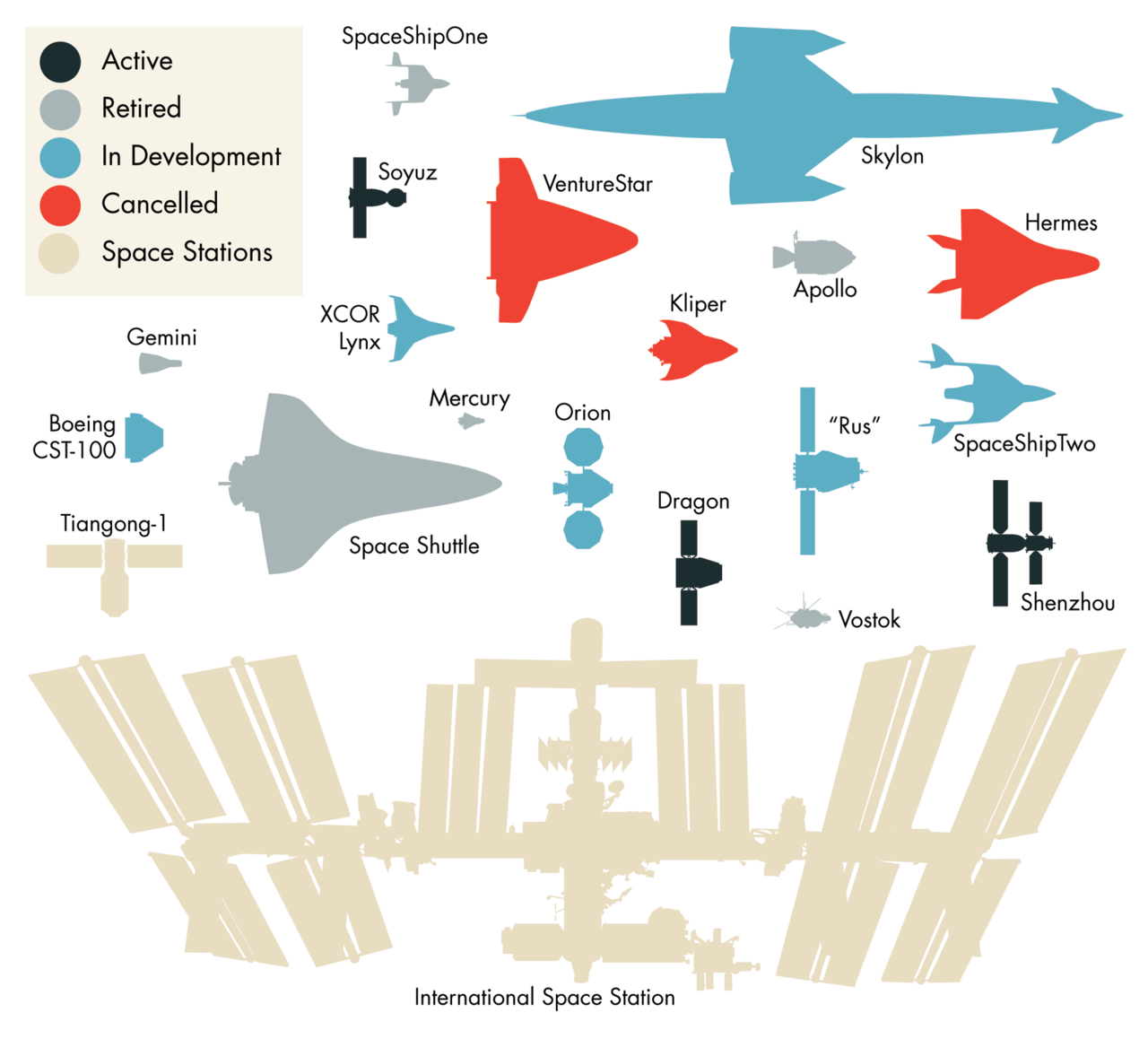
Space_ships_map

Invader Xan drew them:

This, my friends, is an image showing several of the most notable spacecraft we plucky human beings have created (and are busily creating) to date. The past, the present, and the ones that never quite made it. All spacecraft shown are to scale (assuming my sources were accurate).

A late addition to the fleet here.

(Hat tip: Flowing Data)

“The World’s Largest Muslim-Majority Country”

Elizabeth Pisani ponders Indonesia's future – and its past:

Indonesia is essentially a make-believe nation. It was brought into notional existence in 1945 with a declaration of independence of unsurpassed vagueness. It reads, in its totality:

"We the people of Indonesia hereby declare the independence of Indonesia. Matters which concern the transfer of power etc will be executed carefully and in the shortest possible time."

There’s a lot wrapped up in that "etc"—not least some consensus about what constitutes "Indonesia." Sukarno, the visionary demagogue who blurted out the declaration of independence after the defeat of Japan in the second world war and became the new country’s first president, took it to mean the remains of the former Dutch colony, the Dutch East Indies. But that colony itself was a shape-shifting beast without cultural, linguistic, religious or even geographical coherence, its only raison d’être the fattening of purses in Amsterdam and Rotterdam.

Cop Killing

Balko determines that 2012 "is on pace to be the safest ever for America's police officers":

According to the FBI's Uniform Crime Reports, the homicide rate for police officers in 2010 (the last year for which data is available) was about 7.9 per 100,000 officers. That's about 60 percent higher than the overall homicide rate in America, which is 4.8. But it's lower than the homicide rates in many large cities, including Atlanta (17.3), Boston (11.3), Dallas (11.3), Kansas City (21.1), Nashville (8.9), Pittsburgh (17.3), St. Louis (40.5), or Tulsa (13.7).

In fact, of the 74 U.S. cities with populations of 250,000 or more, 36 have murder rates higher than that of police in America. It's more likely to be murdered just by living in these cities than the average police officer is to be murdered on the job.

The job of police officer also isn't anywhere near the most dangerous job in America. If we include traffic fatalities, the job of police officer will in some years rank among the 10 most dangerous in America (PDF). But take away car accidents, and it doesn't come close.


Ad War Update

The Obama campaign counters the "doing fine" deluge: 

Sam Stein has more:

In the background is a graphic showing the president at the podium for that press conference where he spoke the phrase, with the words "doing fine" below. The ad is a response spot to the attacks the president has come under for uttering that remark. The campaign did not blast it out to the national press, though a campaign official did confirm on background that it was airing in the following states: Colorado, Nevada, North Carolina, Ohio, Iowa, Virginia, New Hampshire, Pennsylvania and Florida.

And the campaign continues the line of attack on Bain/outsourcing: 

Stephanie Cutter's explanation here. Meanwhile, as SCOTUS anxiety builds, Crossroads "Generation" takes on some of Obamacare's most popular components among young people: 

Previous Ad War Updates: June 22June 21June 20June 19June 18June 15June 14June 13June 12June 11June 8June 6June 5June 4June 1May 31May 30May 29May 24May 23May 22May 21May 18May 17May 16May 15May 14May 10May 9May 8,  May 7May 3May 2May 1Apr 30Apr 27Apr 26Apr 25Apr 24Apr 23Apr 18Apr 17Apr 16Apr 13Apr 11Apr 10Apr 9Apr 5Apr 4Apr 3Apr 2Mar 30Mar 27Mar 26Mar 23Mar 22Mar 21Mar 20Mar 19Mar 16Mar 15Mar 14Mar 13Mar 12Mar 9Mar 8Mar 7Mar 6Mar 5Mar 2Mar 1Feb 29Feb 28Feb 27Feb 23Feb 22Feb 21, Feb 17, Feb 16, Feb 15, Feb 14, Feb 13, Feb 9, Feb 8, Feb 7, Feb 6, Feb 3, Feb 2, Feb 1, Jan 30, Jan 29, Jan 27, Jan 26, Jan 25, Jan 24, Jan 22, Jan 20, Jan 19, Jan 18, Jan 17, Jan 16 and Jan 12.