The Failures Of Food Aid

A new Harvard study shines a spotlight:

For every 10 percent increase in the amount of food aid delivered, they discovered, the likelihood of violent civil conflict rises by 1.14 percentage points. The results confirm anecdotal reports that food aid during conflicts is often stolen by armed groups, essentially making international donors part of the rebel logistics effort. According to some estimates, as much as 80 percent of the food aid shipments to Somalia in the early 1990s was looted or stolen.

More recently, in Afghanistan, "up to one-third of the aid to Uruzgan province has reportedly fallen into Taliban hands."

The Daily Wrap

Egyptpresident
Today on the Dish, Andrew addressed Romney's casual and repeated lies as the core reality of the campaign and considered the revealing case of Monsignor Lynn. Romney's numbers are solid even as he struggles to level the "ethnic playing field," but he should probably think outside the economy. The food stamp program expanded below the poverty line, the Cheneys shied from the cause of marriage equality, David Blankenhorn came around, and gay adoption grew pools of committed parents. 

We checked in on political developments in Egypt, questioned the US foreign policy consensus, and traced Soviet meddling in the Middle East. Postwar Berlin is still cheap, Greece and Germany blew off steam, and civilians became the primary targets of war. 

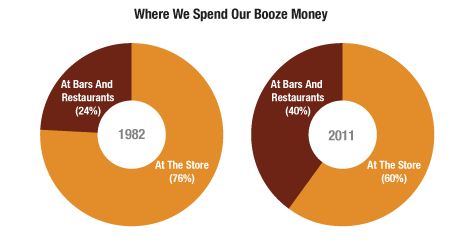
We studied slinkies, looked at HIV transmission laws, anticipated the end of checks, and reimagined jury duty. We wondered about eye contact, remembered closet monsters, and re-read "A Good Man is Hard to Find." We fetishized small businesses for the wrong reasons, made the case for leisure,  broached disease and guilt, were leery of teenage anti-depressants and bullish on animal biology, and examined causes of death over time. Happy marriages take different shapes, laughing happens deep in our brains, and bars are increasingly pricey. Tattoos were once for aristocrats, there is nothing on Earth "untouched by man," autonomy is  a victim of anorexia, and according to Michael Chabon, you should keep your dreams to yourself. We parsed Abraham Lincoln: Vampire Hunter, geared up for the big decision on Thursday, and Romney inevitably obfuscated

Moore award nominee here, quote for the day here, ask Scott Horton anything here, URL of the day here, MHB here, FOTD here, and  VFYW here. Ad war update here

M.A. 

(Photo of Tahrir Square by Khaled Desouki /AFP/Getty Images.) 

The Age Of Man

Surface-Damage

It's reaching everything:

We move more earth and stone than all the world's rivers. We are changing the chemistry of the atmosphere all life breathes. We are on pace to eat to death half of the other life currently sharing the planet with us. There is nothing on Earth untouched by man — whether it be the soot from fossil fuels darkening polar snows or the very molecules incorporated into a tree trunk. Humanity has become a global force whose exploits will be written in rock for millennia. 

(Image: "Surface Damage" by Threadless user meatpaste via LikeCool)

“The Next Middle-Class Entitlement”?

Jordan Weissman studies the growth of the food stamp program in the face of GOP resistance: 

Enrollment in the federal Supplemental Nutrition Assistance Program (SNAP), as its officially called, increased 70 percent between 2007 and 2011. Annual spending more than doubled to an all-time-high of $78 billion. It's now the second largest welfare program behind Medicaid, which cost the federal government about $275 billion last year. But here are a few facts to keep in mind.

According to the non-partisan Congressional Budget Office, the food stamp program's growth "has been driven primarily by the weak economy." About 65 percent of the increased spending was the result of people simply getting poorer. Another 20 percent was due to the stimulus act, which boosted the maximum benefit at a time when the recession was absolutely grinding up vulnerable families.

As the CBO notes, there have been no — I repeat no — significant legislative changes to who is eligible since Obama took office.  Meanwhile, the average household receiving food stamps had an average income of $731 dollars, including other welfare payments. Around 85 percent of recipients were below the poverty line, which amounts to a measly $18,500 a year for a family of three. The vast majority are elderly, disabled, or have children. Among single, young, and healthy recipients, the average income is $268 a month. 

The Power Of Eye Contact

Sam Harris examines it:

One behavior that you can readily notice in many gurus, as well as in their students, is an unusual commitment to maintaining eye contact. In the best case, this behavior emerges from a genuine comfort in the presence of other people and deep interest in their well-being. Given this frame of mind, there may not be a reason to look elsewhere. But maintaining eye contact can also become a way of "acting spiritual"—and an intrusive affectation. Needless to say, there are people who maintain rigid eye lock, not from an attitude of openness and interest—or from a desire to appear open and interested—but as an aggressive and narcissistic show of dominance. (Psychopaths tend to make exceptionally good eye contact.) Whatever the motive behind it, there can be tremendous power in an unwavering gaze.

Faces Of The Day

GT_BOYS-PROTEST_120625

Ultra-Orthodox Jewish men and boys (some of them dressed in sacks as a sign of mourning) protest against Tal Law replacement on June 25, 2012 in Jerusalem, Israel. The Tal Law, which exempts ultra-Orthodox yeshiva students from mandatory military service, was declared unconstitutional by the High Court in February and is due to expire in August. By Lior Mizrahi/Getty Images.

Will The Check Ever Die?

Felix Salmon hopes so:

In America, the question remains: What financial technology will replace the check? Don’t look to the banks for innovation—they have little incentive to replace the credit and debit cards that use their check-clearing infrastructure and generate billions of dollars in interchange fees. Services do exist that work around the banks, but they generally require both the payer and the payee to set up an account with them first, and most normal people have no desire to do that.

Later he adds:

All in all, I’m quite sure that over the 15 years I’ve been in the States, I’ve somehow failed to deposit at least a few checks along the way, and that most of the time it’s been entirely my own fault. It’s an incredibly anachronistic system, though, and I don’t really see why there’s such an onus on me to open my mail and recognize the check and successfully deposit the check. All of those things are easy enough that we get them right 99% of the time, but even at 99% accuracy we’re still talking about 3% of checks going undeposited. And no one would dream, today, of regularly using a payments system with a 3% failure rate.

Was Abraham Lincoln Really A Vampire Hunter?

No, but it's a useful metaphor:

Slaves in the colonial era created a complex folklore about the southern master class, worrying that slave traders were cannibals. My research uncovered at least one case in Louisiana which newly imported slaves became convinced that the masters were witches and vampires (after watching them drink red wine). These tales of terror illuminate rather than obscure important truths. Slavery did represent a kind of dark magic in which legal fictions transmogrified the bodies of human beings into property. The institution of slavery did become a kind of cannibalism, swallowing millions from the African continent, digesting them in the rice and cotton fields in the relentless pursuit of wealth that characterized the alleged southern "aristocrats." America needed a vampire hunter in 1860.

Jesse Walker adds:

When a piece of conspiracy folklore is this popular, it says something true about the anxieties and experiences of the people who believe and repeat the tale, even if it says nothing true about the objects of the theory itself. The slave traders really were conspiring against their prisoners; it was just the nature of the conspiracy that was misunderstood. The captives were to be consumed by the white economy, not by white mouths.

Sadly, the movie itself sounds terrible.

America’s Foreign Policy Consenus

Aaron David Miller recently suggested that "if you can get past the campaign rhetoric, there's not much difference between the candidates" on foreign policy. Michael Cohen thinks this is a problem:

Wouldn't America have been better off with a more robust public debate about the decision to invade Iraq? The answer today seems tragically self-evident. But because there was so much unanimity about the war, those who were opposed were seen as outliers, radicals, or extremists. It's a perfect example of the dangers and even folly of fetishizing bipartisan consensus.

Larison explains the differences between Romney and Obama, even though they're both inside the consensus Cohen worries about:

If Miller wants to make the case that leading members of both parties share many of the same assumptions about the U.S. role in the world, its overseas military presence, the importance of U.S. "leadership," and the nature of foreign threats to the U.S. and its allies, he will get no argument from me. That bipartisan foreign policy consensus exists and it unfortunately remains as strong as ever. That isn’t what Miller is arguing. He is claiming that there is now more bipartisan consensus on foreign policy now than at any time in the last 25 years, which is not true, and he is insisting that there are no real differences between the major party candidates on foreign policy, which is demonstrably false.