The Causes Of Death

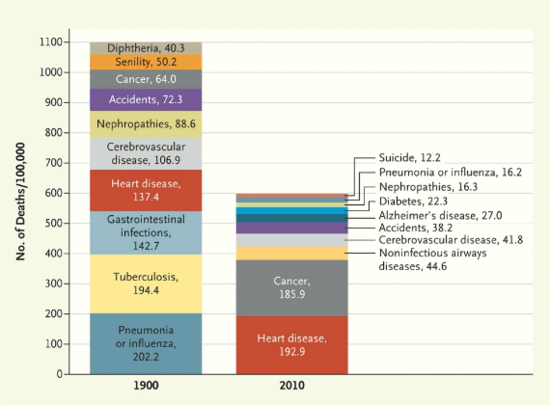
How they changed over a 110-year period:

Death_Causes

Mataconis captions:

[L]ooking at the chart for 2010 we see that the top two causes of death, accounting for 757.6 per 100,000 deaths, are diseases that are related either to behavior or old age. Indeed, one would expect that in the future the number of deaths attributed to things like Alzheimer’s Disease are likely to increase. These are among the hardest causes of death to eradicate because, in the end, our bodies will break down.

Is Romney Too Fixated On The Economy?

Mike Crowley counters the conventional wisdom: 

The 1980 and 1992 elections suggest that beating an incumbent in times of economic distress might require campaign themes that go beyond the economy. Reagan pounded Carter over foreign policy and the size of government. Clinton was brimming with policy ideas, including a major health care plan. And, crucially, in both cases the challengers were more likeable–or at least seemed so on television. … It’s obviously ominous for Obama that both those incumbents lost. But it’s possible that that Romney is doing him a favor with his light touch on issues other than the economy.

Forcefeeding Anorexics

A UK court recently ruled that the state has the power to hook up an anorexic women to a feeding tube if she is in danger of starving to death. Charles Foster figures they made the right call:

Autonomy is a victim of anorexia. It is so badly paralysed that it can’t do all the work…. The presumption in favour of the maintenance of life is essential. It’s an appropriate tie-breaker in cases like this. It’s an appropriate way of entrenching intuitions and keeping patients safe.

Jacob Williamson squirms at the logic:

[I]t’s really not clear what it means to say an agent lacks autonomy in such situations. She feels unbearable pain and does not wish to be held down against her will. She has convictions on this question as strong as our own. But someone else decides that they count for nothing, and so she is to be treated like a child. I think force-feeding her is, ultimately, wrong.

Every Child Deserves A Family

GT_GAYFOSTERPARENT_120618

After reviewing research on gay and lesbian adoption, Adam Pertman voices his support:

The bottom line is simple: no state can effectively prevent lesbians or gay men from becoming mothers or fathers, because they can do so in other ways–such as surrogacy and insemination–or by moving somewhere that permits them to foster or adopt children. So all a state can accomplish if it imposes restrictions, as Arkansas tried to do and as Utah and Mississippi still do, is to shrink the pool of prospective parents and, as a result, decrease the odds that children in its custody will ever receive the benefits of living in permanent, successful families.

The American Academy of Pediatrics, the American Association of Family Physicians, the National Association of Social Workers, and the Child Welfare League of America all agree.

(Photo: Frank Martin Gill sits with his six-year-old foster son, known as N.R.G., after the Third District Court of Appeal in Miami ruled that Florida's ban on gays adopting is unconstitutional on September 22, 2010 in Miami, Florida. By Joe Raedle/Getty Images.)

Of Mice And Men

Animal biology is helping to cure many more human ailments than we ever thought possible:

[Zoobiquity author Barbara Natterson-Horowitz] points out that the risk of cancer should increase as animals get bigger. The more cells an animal has, the more tickets it has in the oncological lottery. But whales defy this expectation. The biggest whales often live more than 100 years, despite the fact that they should be dead from cancer long before then. Some scientists have speculated that whales have evolved some powerful anti-cancer weapons. No one knows what those weapons actually are, but we’d do well to find out.

Previous discussion of Natterson-Horowitz's book here

A Good Man Is Hard To Find

Flannery

In a rare audio recording, Flannery O'Connor reads her brilliant short story, "A Good Man is Hard to Find." Mike Spring at Open Culture provides background:

In April of 1959–five years before her death at the age of 39 from lupus–O’Connor ventured away from her secluded family farm in Milledgeville, Georgia, to give a reading at Vanderbilt University. She read one of her most famous and unsettling stories, “A Good Man is Hard to Find.” The audio, accessible above, is one of two known recordings of the author reading that story. (The other, from a 1957 appearance at Notre Dame University, can be heard here.) In her distinctive Georgian drawl, O’Connor tells the story of a fateful family trip…

I remember when I first read that story. It took me a couple of hours to recover.

(Hat tip: The Paris Review. Image: "Self-Portrait" by Flannery O'Connor, via Melville House)

Did The Soviets – And Not The Brits – Screw Up The Middle East?

Claire Berlinski reviews a new book based on stolen, classified Russian documents:

The documents clearly suggest that many contemporary conflicts in the Middle East were fomented by the Soviet empire, particularly in the final years before its break-up. And the events he describes have had a significant impact upon the current state of the region—from the conflict in Iraq to the Israeli-Palestinian peace process, to the development of a de facto alliance between the European Union and the Arab states. Perhaps most significantly, there is much here to suggest that it is past time to reexamine Gorbachev’s reputation as a reformer and liberalizer.

Diseases We Deserve?

A reader quotes me:

"I'm so sorry I let you down [by contracting HIV]." No one would say that with a diagnosis of, say, diabetes…

I must disagree with you. Diabetes II has been tied almost inextricably with obesity and "bad" behaviors in our media culture, even though the American Diabetes Association firmly states on their website that most obese people will never get diabetes II and that there is a strong genetic link to developing the disease.

I don't know if you are aware of the vilification that Paula Deen endured when she announced her diagnosis. Being fat and known for cooking fried Southern foods made people very much blame her for this disease. I have a mother who was diagnosed with diabetes II, and the shame, humiliation and embarrassment for not being "good" enough is huge for her – she feels entirely at fault for getting this disease.

Update from a reader:

Contrary to your reader's comment, Paula Deen, aka "The Butter Queen", was not vilified for contracting Diabetes. She was vilified for keeping her condition a secret for years and continuing to encourage people to eat the unhealthy foods she cooked on her show. And discovering she was shilling for a diabetes drug (or profiting from a disease that she has helped exacerbate with her recipes) was also was not taken in the best light, either. Basically, people hate hypocrites.