The Many Ways To A Happy Marriage

The Stranger is featuring a series of happy couples' various takes on "traditional marriage". Dan Savage investigates the Femdom:

"At first I was like, 'Okay, I will be dominant in the bedroom if you will be submissive in other areas of our lives,'" says Elizabeth. "What I really wanted was a submissive to do the fucking laundry," she says. "I wanted him to do the dishes." Both agree that, at least at first, their exploration of erotic dominance and submission—Elizabeth's dominance, Robert's submission—was about Robert's desire to submit. But assuming the dominant role inside and outside the bedroom awakened something in Elizabeth. Today, she wouldn't contemplate returning to the way things were. Now Robert is submissive to Elizabeth at all times…

A larger lesson: 

"The thing that [anti-gay social conservatives] think they're defending—the idea that there's only one way to be married—is already dead," says Robert. "And the one thing that would truly undermine our marriage would be to tell us that we're doing it wrong. We might not be married now if we had kept doing marriage the traditional way."

“Uncivil Wars”

Susie Linfield reflects on how wars have changed:

Marxist historian Eric Hobsbawm … has estimated that in World War I, soldiers constituted 95 percent of casualties; in contemporary conflicts, most of which are intra-national, unarmed civilians account for 80 to 90 percent of casualties.

In many of today’s wars, civilians are the deliberate—indeed, the primary—targets: think, for instance, of the Lord’s Resistance Army, the Ugandan group that enslaves children; of the militias in the Democratic Republic of Congo, who are systemic practitioners of mass rape and vaginal mutilation; of the Taliban’s bombings of schools and marketplaces; of Al Qaeda’s attacks on Iraqi mosques; of Al Shabaab’s assaults on medical students, teachers, and soccer fans; of the recent wars in Darfur, Colombia, Chechnya, Liberia, and Sierra Leone. Political theorist John Keane has dubbed these conflicts “uncivil wars” whose perpetrators practice “violence according to no rules except those of destructiveness itself …"

Capitalism Has No Endpoint, Ctd

Robert Skidelsky and Edward Skidelsky push for leisure in place of the endless chase for economic gain: 

The image of man as a congenital idler, stirred to action only by the prospect of gain, is unique to the modern age. Economists, in particular, see human beings as beasts of burden who need the stimulus of a carrot or stick to do anything at all. "To satisfy our wants to the utmost with the least effort" is how William Stanley Jevons, a pioneer of modern economic theory, defined the human problem. That was not the ancient view of things. Athens and Rome had citizens who, though economically unproductive, were active to the highest degree—in politics, war, philosophy, and literature. Why not take them, and not the donkey, as our guide?

Along similar lines, Sophie Elmhirst reminds us that our brains need to rest:

Quiet: from the Latin, quies, meaning "rest, quiet" and linked to the Old English hwil, meaning "space of time". That’s about right: quiet isn’t only about sound but about pace, gentleness, slowness – spaces and places where things come to rest. Some people never seem to sit down; they’re constantly doing and talking, as if to stop is to fail. Noise, meanwhile, is from the Old French, noise, meaning "uproar, brawl", apparently derived from the Latin, nausea, meaning "disgust, annoyance, discomfort" or, literally, seasickness. Which is pretty much how it feels when you’re in a room of people yapping frantically at each other about all the things they’re doing with their lives.

Nicholas Carr chimes in:

I've long suspected, based on observations of myself as well as observations of society, that, beyond the psychological and cognitive strains produced by what we call information overload, there is a point in intellectual inquiry when adding more information decreases understanding rather than increasing it. … Because we humans seem to be natural-born signal hunters, we're terrible at regulating our intake of information. We'll consume a ton of noise if we sense we may discover an added ounce of signal. So our instinct is at war with our capacity for making sense. 

Egypt Gets A President

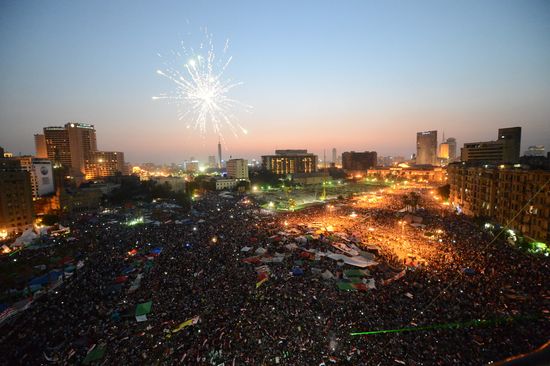
Tahrir_Square

Wendell Steavenson analyzes the situation:

Morsi has been given a mandate, but it is far from overwhelming. He will attain a Presidency without a constitution or a parliament, and his administration will begin in the midst of an ongoing power struggle with the military. It is not at all clear, either, how long he will serve—certain generals have already said that there will need to be a new Presidential election in light of a new constitution. But in the middle of all the ongoing uncertainty, today was a moment to reflect that, despite everything, a free and fair election was conducted and that Egypt, for the first time in its seven-thousand-year history, as one protester in Tahrir Square put it to me, had chosen its own leader.

Issandr El Amrani considers America's interests:

The US' real favored outcome has been clear for a while: a strong, rooted civilian party restoring stability (and decent economic governance) in the Brothers and clear red lines on issues such as foreign policy (especially towards Israel) and unfettered bilateral military-to-military relations (overflight rights, fast-track Suez Canal access, etc.). In other words, some sort of understanding between the Brothers and the generals. In a sense, Egypt could use a breather away from the revolutionary fervor and responsible people getting the house in order. But alongside with this comes worrying possibilities: an uneasy military-Islamist alliance, perpetually unstable, with the generals undermining the civilians and the Islamists resorting to populist antics in their impotence. It's a different time and a different set of circumstances, but late 1980s Sudan is not exactly an inspiring example of Islamist-military coexistence.

Brian Ulrich hopes for the best:

What I would definitely like to see is the appointment of a national unity government that includes a non-Islamist prime minister and representatives of all the major revolutionary trends or factions. Hopefully the MB will have learned from the fracas over the constitutional committee that Egyptians elected them to supervise a transition, not begin remaking the country in their own image.

(Photo: Egyptians set off fireworks in Cairo’s Tahrir Square as they celebrate the victory of the Muslim Brotherhood's candidate, Mohamed Morsi, in Egypt's presidential elections on June 24, 2012. Tens of thousands packed into Tahrir Square in the largest celebration the protest hub has witnessed since Hosni Mubarak's ouster. By Khaled Desouki /AFP/Getty Images)
The Core Reality Of This Campaign

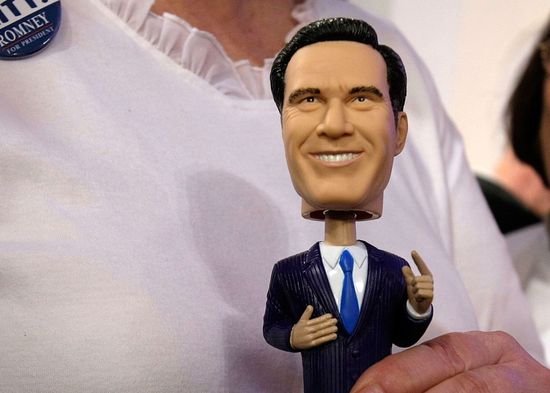
BOBBLEMITTAlexWong:Getty

In a nutshell:

The United States has never been witness to a presidential candidate, in modern American history, who lies as frequently, as flagrantly and as brazenly as Mitt Romney.

The Dish has covered most of the individual incidents, but Michael Cohen does a great job compiling them – and noting that Romney is perfectly happy to repeat lies that have already been debunked, and to deny having told the lies whenever challenged. Prometheus's robot David has a more ethical backbone than Romney's post-truth will-to-power:

First, there is Romney's claim that the 2009 stimulus passed by Congress and signed by President Obama "didn't work". According to Romney, "that stimulus didn't put more private-sector people to work." While one can quibble over whether the stimulus went far enough, the idea that it didn't create private-sector jobs has no relationship to reality. According to the Congressional Budget Office, the stimulus bill created more than 3m jobs – a view shared by 80% of economists polled by the Chicago Booth School of Business (only 4% disagree).

Romney also likes to argue that the stimulus didn't help private-sector job growth, but rather helped preserve government jobs. In fact, the Obama years have been witness to massive cuts in government employment. While the private sector is not necessarily "doing fine", as Obama said in a recent White House press conference, it's doing a heck of a lot better than the public sector.

And the list goes on. Romney has accused Obama of raising taxes – in reality, they've gone down under his presidency, and largely because of that stimulus bill that Romney loves to criticize. He's accused the president of doubling the deficit. In fact, it's actually gone down on Obama's watch.

(Photo: Alex Wong/Getty.)

Moore Award Nominee

"Okay, we all know that there are major problems with some of their op ed columnists. First off, there’s David Brooks, that shallow, insufferably smug propagandist for the 1 percenters whose only interesting moments occur when he drops the genial nice-guy pose and shows us his snarling, viciously punitive, anti-working people side. Then there’s Maureen Dowd who, half the time, reads like she has the emotional maturity of Paris Hilton (though I will say that Modo’s recent columns about Jerry Sandusky and the Catholic Church have been spot-on). Finally, there’s Ross Douthat, a know-nothing hack with serial killer eyes whose creepy, misogynist sexual politics are positively medieval, and whose column has become one of my favorite hate-reads ever," – Kathleen Geier, Washington Monthly.

Whatever happened to the art of insult?

This Just In

"CNN National Political Correspondent Jim Acosta reports that Mitt Romney's campaign is not saying anything and is being cautious," – CNN'S SCOTUS live-blog.

Others are also beginning to notice that Mitt Romney has no actual, you-know, specific policies to engage with. His strategy seems to be to say nothing about what he'd do and lie pathologically about everything Obama has done.

When Mary Married Heather

… they had to go to DC, because their home state of Virginia is run by the most neanderthal group of Republican reactionaries in the country. Whom Mary's father, Dick Cheney, strongly supports.

The amazing thing about Dick Cheney is that he is actually given credit at this point for defending his own daughter's right to marry. But neither he nor Mary has lifted a finger to help advance the cause or make the case, when either one could have transformed the debate. The family is parasitic on the courage of others – and utterly without principle in their enmeshment with power.