This Is Your DEA On Drugs

Well, it seems like she's on drugs, because she cannot answer a simple question and refuses to acknowledge the absurdity of classifying marijuana as equivalent to heroin in its risks. But hats off to Jared Polis for doing what we rarely see at hearings – grilling a public official until she becomes a strange echo of Mr Mackey:

Drugs are bad, m-kay?

Can Modern Women “Have It All?”

Anne-Marie Slaughter believes that they can, but "not today, not with the way America’s economy and society are currently structured":

[T]he minute I found myself in a job that is typical for the vast majority of working women (and men), working long hours on someone else’s schedule, I could no longer be both the parent and the professional I wanted to be—at least not with a child experiencing a rocky adolescence. I realized what should have perhaps been obvious: having it all, at least for me, depended almost entirely on what type of job I had. The flip side is the harder truth: having it all was not possible in many types of jobs, including high government office—at least not for very long.

Dreher argues that no one, male or female, can have it all:

"Quality time" is a lie. If we are going to put service to our careers over service to our families, then we should at least not lie to ourselves and others about what we are doing. It is unlikely that you, me, or anybody, can be a first-rank CEO, or top politician, or at the top of our profession, and a first-rank father, mother, son, or daughter. At some point, something’s got to give.

Rising Political Stars

Molly Ball claims that the GOP has more of them. Larison counters:

Republicans only seem to have a much deeper "bench" among elected officials because they currently don’t control the White House and because they have a tendency to over-promote new and under-qualified politicians for higher office. Whenever a party controls the executive branch, a lot of its promising and capable members are appointed to administration positions. Depending on the appointment and the administration’s overall record, that can be a political death sentence. 

Citizens United Is Working

John Roberts' bid to open election campaigns to any billionaire who wants to pay for ads is paying off. It is beginning to look as if Obama will be outspent by 3 – 1, when everything is taken into account. The sheer money behind Romney is staggering. Money quote:

"There’s no way they’ll be able to keep up. Our SuperPACs are our Star Wars, if you will," said a Republican operative close to the Romney campaign.

One Party Is Unhinged

Or, rather, it is living in an alternative reality. 63 percent of Republicans in a new poll believe that Saddam Hussein had WMDs when we invaded in 2003, despite even George W. Bush's acknowledgment that he didn't. 64 percent also believe that Barack Obama was born in a foreign country, even though we have the long-form birth certificate from Hawaii. This alternate reality is sustained by a 24 hour propaganda network, and hermetically sealed off from any external intervention.

We are reaching a democratic crisis of some sorts. One major political party refuses to accept empirical truths. It has become a hall of ideological mirrors.

The Horse In The Horserace, Ctd

A reader writes:

So, just when I thought the MSM coverage of dressage could sink no lower than Amy Davidson's in the New Yorker, I found this post offered by Vanity Fair. Yes, Colbert did nail the awkwardness, and we know dressage looks silly to the outside world. Personally, I think figure skating looks ridiculous. But I don't doubt for a moment that the people who compete in figure skating bring determination, dedication, and discipline to their sport. Dressage is no different. In fact, one of the many things I love about dressage is just how extremely difficult it is to master. A racehorse can be trained to peak performance within months. A dressage horse requires no less than six years, and usually closer to ten, of daily effort and long hours of training.

Here's the other thing I love about dressage: Literally any horse and rider can do it.

Although I cringe at the "horse dancing" label, it is appropriate for one reason – just as anybody can dance, anybody can do dressage. Moreover, dressage instills correct basics, teaching beginning riders a humane way to work in conjunction with their horse. Although there are controversial riders and techniques, dressage, more than any other horse sport, rewards harmony between horse and rider. This is something to applaud.

For myself, I grew up poor and worked at dressage barns in exchange for lessons. With horses that cost less than $1,000, I took on the fancy warmbloods and did well, sometimes even winning against the "big" horses at a fairly high level of competition (not international, mind you, but also nothing to be ashamed of). Yes, there are rich owners in the sport. But the vast majority of the people who are in the business – the grooms, the owners, the trainers, the breeders – are what we call "horse poor." Their available income goes into their horses and nothing else.

And I tell you what – it is a grind. It is a hard life. It is 5:30am feedings and stall cleaning and tractor work and it's all day, every day, 365 days a year. I'll never forget my friends saying, "You have to work on Christmas?" every single freaking year. I quit the life at 33, mostly because my body was just so worn out and the continuous poverty was exhausting.

Ultimately, you need to get lucky and find the right horse – that one out of a million – with the ability, the physical and mental fortitude, and the desire "to do sport," as Mittens would say. From my perspective, when someone finds their horse of a lifetime it's something to be celebrated. It is a rare and beautiful thing, and it is not something money can buy. For example, just take a look at the Germans who bought arguably the greatest dressage horse ever, Moorlands Totalis, from the Netherlands. It turns out, Totalis is not at all stoked on the Germans, and no longer wants to be "in sport." You cannot force harmony between horse and rider. It is a magic that is either there or it isn't.

Anyway, I know this is probably your 500th email about dressage. This thing probably went unread, but it's just so frustrating to read these slapdash assessments of a sport that I love, a sport that is admittedly inaccessible to the casual viewer. I want those of you at the Dish to know what dressage is, and what it isn't. Thanks for listening…

Our reader follows up:

You asked: "Why do I hear so many stories of horrible abuse of horses?"

I'd say: In dressage? Two reasons. Firstly, you will always have a certain number of aberrant individuals. Secondly, because of a practice called rollkur. Rollkur came into vogue in the '90s and was popularized by the success of a woman named Anky Van Grunsven. Rollkur is the hyperextension of the horse's neck. This is what it looks like:

Image003 (1)

The idea is that forcing the horse to flex at the poll (the joint right behind the ears) creates suppleness. IMHO, that's just patently untrue. My own take is this: Anky found success with superior horses who succeeded despite her tough tactics. Jealous competitors decided they must be winning because of them and they aped her techniques.

Now, before Anky came along and popularized this hard-handed riding style, exercises somewhat similar to rollkur were well utilized. The abusive use of rollkur became conflated with useful stretching exercises, and it seems some lack the ability to distinguish between the two. Rollkur is marked by the use of force to bring the nose into the chest and then keep it there. The horse almost always expresses some level of distress. In the above photo, you can see the whites of the horse's eyes. Often, a horse will wring its tail, pin its ears, or act out.

Unfortunately, rollkur remains controversial, with some still arguing for its usefulness. More unfortunately still, a lot of those arguing for it are Olympic riders. Interestingly, rollkur is extraordinarily unpopular with the rank and file of the dressage world. You say "rollkur" at a dressage show and you'll get a dozen tirades about the cruelty of the practice.

Bottom line, for me: Out of all the horse sports I'm familiar with – and I'm familiar with a lot of them – dressage has the highest percentage of trainers, owners, breeders and riders practicing ethical horsemanship. It's not perfect, and Olympic level dressage today is nowhere near as ethically pure as it was in the '60s, '70s, '80s, back when superlative horsemen like Reiner Klimke reigned supreme. (We are rather in a sort of Dark Ages when it comes to our Olympic level dressage these days.)

Here is footage of Klimke with his horse of a lifetime, Ahlerich. This is their victory lap at the 1984 games. The horse is happy – so, so happy – he is relaxed, and doing some profoundly difficult dressage for fun while Klimke holds the reins with one hand. This is what a well-trained horse looks like.

[At the top of this post] is footage of Anky schooling her horse. This is not a happy horse. This is a horse in distress. (Please note the YouTube comments by the rank and file)

So, long story short, you hear stories of horrible abuses because such stories are there for the telling. But that doesn't mean there aren't countless tales to be told of Average Joe dressage riders who do right by their horse. It just means those stories aren't nearly as interesting.

Dish readers can be indispensable when niche stories like this pop up. Earlier reporting from readers in the dressage world here and here.

How To Survive A Plague, Ctd

A reader writes:

Whenever I see images of the Quilt, I always look for my friend Fernando Delgado, who was one of the first of my friends to die of AIDS, in 1986 or ’87.  Your post had an image of eight quilt panels – and one was Fernando’s!  This is not the first time I’ve seen his panel in a news story.  But it’s never really surprising when I do, since the man had at least four different panels!  Fernando was larger than life, a beautiful San Francisco man who was still running around Castro Street and having fun long after his OIs would have forced a more timid soul (like me) to become housebound.  The man was so loved, and so heroic, people couldn’t stop making him panels.  We’ve all known so many heroes.  Thanks for reminding me.

The quilt is coming again to Washington next month for the first International AIDS Conference in the US in decades. Why America now? Because we repealed the HIV travel ban (thanks to Bush and Obama), and the specter of Jesse Helms’ hatred was finally wiped from the law. I knew I wrote a little essay on the AIDS quilt for The New Republic. Zack Beauchamp dug it up and transcribed it. It was written in 1992. It’s not available online, so I thought I’d add it to this thread at the risk of self-plagiarism, because it reveals what in retrospect was a tipping point – for heterosexual involvement in gay rights and equality. Because in family there is no gay or straight; there is simply family. Herewith a blast from the past:

I first saw the AIDS quilt three years ago, on its last trip to Washington, when it was only a few thousand panels in size and fit comfortably in the Ellipse in front of the White House. Last weekend, at 26,000 panels (one-sixth of the number of deaths in the United States so far), it filled most of the vast space between the Washington Monument and the Reflecting Pool. Neither experience was forgettable; and neither Aidsquilt1still even faintly morbid. Like the Vietnam Memorial, a few minutes’ walk away, the quilt has to be entered in order to be understood; a piece of interactive architecture of both public and private space.
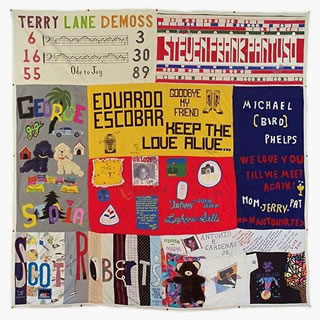
But unlike the Vietnam Memorial, the quilt is a buoyantly colorful, even witty, monument. It doesn’t immortalize its commemorated in regimented calligraphy, its geography is not the remarkable, black snowdrift of casualties, but a kind of chaotic living room, in which the unkempt detritus of human beings—their jeans, photographs, glasses, sneakers, letters—are strewn on the ground, as if expecting the people to whom they belonged to return. People walk over this cluttered landscape, looking like tourists, caught between grief and curiosity, saying little, peering intently down at the ground. As you approach the quilt from the rest of the Mall, toward a place where tens of thousands of people are congregated, noise actually subsides.

The panels themselves are tacky and vital, and therefore more chilling: you are invited to grieve over faded Streisand albums, college pennants, grubby bathrobes, cheesy Hallmark verses, and an endless battery of silk-screen ‘70s kitsch. Unlike the formulas of official memorials, each panel manages to speak its own language in its own idiom; you have to stop at each one and rethink.

Camus suggested in La Peste that the most effective way to conceive of large numbers of deaths was to think in terms of movie theaters, but the quilt dispenses with such mind games by simply reproducing shards of the lives of the fallen, like overheard, private conversations.

Some panels are made by lovers, others by parents, friends, even children of the dead; and some are made by those whose names appear on them and speak with uncanny candor. “Life’s A Bitch And Then You Die,” quips one. Even the names themselves rebel against any attempt to regiment them. In the program, some people are identified with full names, others with first names, others with nicknames. There are sixteen Keiths; and one Uncle Keith; twenty-eight Eds; one Ed & Robert; eighty-two Davids; one David Who Loved The Minnesota Prairie; one mysterious David—Library of Congress; and one David—Happy Birthday. Some go only by two initials—T.J.; others spell it out in full—Dr. Robert P. Smith, Arthur James Stark Jr., HM1 James T. Carter, USN; others are reduced to symbols—five stars (unnamed) “commemorating five theater people who have died”; still others are summoned up by nothing but a baseball cap and an epitaph. Celebrities, of course, creep in—I counted four Sylvesters and twenty-nine Ryan Whites—but they are scattered randomly among their peers. The most piercing: Roy Cohn’s. A simple inscription: “Bully. Coward. Victim.”

The democracy of the plague is enhanced by the unending recital of names over the loudspeaker, as friends and relatives and strangers read out the death roll. The names resonate with metronomic specificity, adding an aural dimension to the visual litany. “Patrick J. Grace, Dan Hartland, Ron Lopez, Edwina Murphy, Mark Jon Starr, Billy, Kim John Orofino, Frank, Bob Flowers, Sergeant Rick Fenstermaker, U.S. Marine Corps …” Many of the two-minute recitations end in “and my brother and best friend” or “my sweet little sister” or some such personal touch. From time to time, a mother’s voice cracks over “my precious son and best friend,” and the visitors to the quilt visibly stiffen at once, their throats caught in another, numb moment of unexpected empathy. I bumped into an acquaintance. “What’s going on?” I asked, lamely. “Oh, just looking for friends.”

Just when you’re ready to sink into moroseness, however, the panels turn on you. Since this act of remembrance is one our public authorities have not sanctioned (neither President Reagan nor Bush walked the couple of hundred yards to visit the quilt), it is mercifully free of decorum. Drag-queen creations—taffeta, pumps, and pearls embroidered across silk—jostle next to the overalls of manual workers and the teddy bears of show-tune queens. There’s plenty of bawdiness, even eroticism, and a particularly humanizing touch you don’t find in cemeteries: a lot of the spelling is wrong. Many of the epitaphs have a lightly ironic edge to them, coming close to a kind of death camp: “The Fabulous Scott Tobin”; “Dennis. We Didn’t Get To Know Each Other Very Well, And Now We Never Will.” My favorite panel ornament was a Lemon Pledge scent furniture polish can.

Others simply shock you into reality: “Hopefully the family now understands” inscribed beneath a pair of someone’s jeans; “For the friend who still cannot be named—and for all of us who live in a world where secrets must be kept.” And another: “You still owe me two years, but I forgive you and will always love you. I never located your parents. Maybe someone will see this and tell them.”

The point of it all, of course, is not merely to release grief, but to affirm the dignity of those who have died so young and in the face of unique public disdain. For many of the families who came to D.C. last week-end, the event was the end of an extraordinary journey to grapple not simply with their loved ones’ deaths, but with their lives. A few short years ago virtually everyone I saw at the quilt was gay. This time the presence of families—predominantly heterosexual—was overwhelming. These were ordinary people who through their loved ones’ deaths were asserting, beyond their own sorrow, the overcoming of their own shame. Being there was a catharsis not simply of the horrors of the disease, but of the bigotry that stalked so many of those on the ground and, by association, those who reared them.

This is one way in which AIDS has surely changed America. With the collapse of the closet, a collapse accelerated by HIV, attacks on gay people are now attacks on our families and friends as well. They will no longer go unanswered. “I have done nothing wrong. I am not worthless. I do mean something,” as one panel put it. “This is my beloved son,” echoed another, “in whom I am well pleased.”

Capitalism Has No Endpoint

Robert and Edward Skidelsky's new book, How Much Is Enough?, explores the diminishing returns on greater and greater wealth. Robert Skidelsky examines capitalism's limits:

Intelligent defenders of capitalism always recognize that it's a system with moral flaws, but they have regarded such flaws as the price of progress. Keynes was typical in this respect. In that essay, "Economic Possibilities for our Grandchildren," he writes: "For at least another hundred years we must pretend to ourselves and to everyone else that fair is foul and foul is fair"—he knew his Shakespeare—"for foul is useful and fair is not. Avarice and usury and precaution must be our gods for a little longer, for only they can lead us out of the tunnel of economic necessity into the sunlight." How innocent those words sound today.

Capitalism, it is now clear, has no tendency to evolve into something else. I'm not saying something higher, but just to evolve into some other system, a system fit for abundance. It has no tendency to do that. Left to itself, the machinery of one generation will carry on churning endlessly and pointlessly, pointlessly because it never asks the question, "What is this for, what's it all about?" To bring it to a standstill requires an act of collective imagination and will.

And this is in part what Christianity is for, the religion of unachievement, the West's check on the necessary amoralism of the market. And yet it is now reduced to Paul Ryan's love of Ayn Rand or the "Prosperity Gospel" and Christianism has all but internalized capitalism as the end rather than the means of human flourishing. Meanwhile, we are destroying the planet in search for "more" and "more". Are we happier now? Will we ever be if this materialism is our primary source of values?

End Of Gay Culture Watch

A word from the Green Card holder. This is why I love America: a dance style pioneered in the underground drag "Houses" of African-American gay men in the 1980s (almost all of whom died of AIDS) is expropriated by an Italian-American woman, filmed by Hollywood genius, David Fincher, and then repurposed for an elementary school. Yes, this is an irresistible country: