Will The Roberts Ruling Change Public Opinion?

Noam Scheiber sees real room for movement: 

Had Anthony Kennedy been the deciding vote, the conventional wisdom would have been that this was a partisan decision with an unreliable and unpredictable swing-voter more or less arbitrarily siding with the liberals. But with the Court’s conservative chief justice providing the fifth vote, the decision has real heft. Not only is this likely to grab the attention of voters who had no opinion beforehand (though opinion-formation is simply beyond the capacity of some of them), it’s likely to get the attention of the fraction of health care opponents who told pollsters they wouldn’t necessarily be upset if the court affirmed the decision. And that could be a very big deal for the political legitimacy of the health care law going forward.    

Tom Jacobs cites recent research on Roe v. Wade

Analyzing public opinion data from the era, [John] Hanley and his colleagues report that “among those who had heard of the decision, we see that support for abortion increased in nearly every one of the demographic groups studied” between 1972 and 1973. They add that “for all groups considered except infrequent church attenders” (who presumably were more pro-choice to begin with), “the effect of the decision appears to have been higher levels of permissiveness toward abortion.” The researchers add that “Whether this short-run effect can be maintained is another question altogether,” noting that the Roe v. Wade decision “did catalyze an organized response among activists that produced sharp conflict over abortion rights in the late 1970s, and up to the present day.”So the health-care decision won’t end the debate. But it may boost support for the plan over the coming months, which gives the Obama re-election campaign another reason to feel good about the result.
The Genius Of Louis C.K.

27_louisck_940

Season 3 of the transcendently funny comedian's show premiered last night. While reviewing the pilot, Nathan Rabin summarizes C.K.'s appeal:

Over the course of the past year or so, Louis C.K. has made a remarkable evolution from being merely one of our most beloved and respected artists—a man his colleagues and peers talk about with hushed awe and total reverence—to being something of a contemporary folk hero—a balding, ginger, slightly overweight stand-up-comedy Robin Hood speaking truth to power and reclaiming the means of distribution from the nefarious likes of Ticketmaster…[the new episode's opening bit] corresponds to the show’s enduring fascination with masturbation, aging, physical decay, and sexual humiliation

In a recent chat with Jay Leno, Louis wished he was gay:

Alyssa comments

[W]hat the riff is really about is what heterosexual men lose and lose out on in the process of vigorously reinforcing their heterosexuality for the general public: the chance to be enthusiastic, to be affectionate, to wear what you want. It’s a critically important conversation, and I’d love to see more men in positions of power in media engage in it, or even who seemed comfortable enough to stop reinforcing their masculinity for a minute.

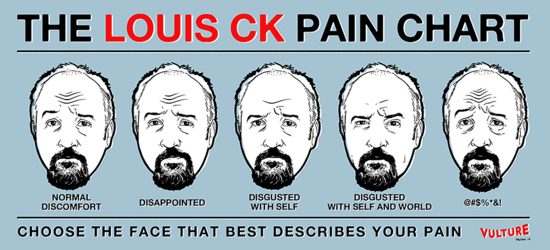
Above chart by Kyle Hilton, who captions:

Louis CK's facial expressions on Louie are a tutorial on how to wordlessly convey discomfort and emotional dyspepsia; in each episode, he covers all possible combinations of furrowed brows, wincing squints, and exhausted exhalations. Last night's season-three premiere provided a real showcase when he could not bring himself to break up with his girlfriend and instead just twisted his face into an endless series of grimaces of repressed unhappiness.

Defense Corporations Didn’t Kill Bin Laden

Loren Thompson, a cheerleader for the defense industry, wants "some sort of official acknowledgement of the role that private enterprise played in the Bin Laden raid." Ackerman unloads

Louisville Slugger did not win last year’s World Series. Mario Manningham’s cleats did not keep him in bounds for one of the greatest receptions in Super Bowl history. Even the haters must recognize that LeBron James’ NBA Finals performance is not attributable to Nike or Gatorade. In truth, defense corporations receive a different form of acknowledgement for their services: giant Defense Department contracts. Unlike SEALs, the defense industry’s reward isn’t always based on performance.

Poseur Alert

"The destabilizing nature of Foucauldian genealogies, while potentially frightening, is ultimately beneficial if it allows for military planning and thinking to predict with greater accuracy the potential conflicts and situations that modern militaries might find themselves in. The genealogical focus on discontinuities and breaks with accepted narratives provides an outlet for creativity and innovation that the structured current thinking in military history and strategy does not provide. Rather then emphasizing study and inquiry that upholds accepted norms and standards, Foucauldian genealogies provide a greater scope of inquiry that encourages the study of deviations and discontinuities within these accepted narratives. Given the clear failings of the accepted narratives in the recent conflicts in Afghanistan and Iraq, where intricate insurgencies appeared to surprise the military establishment and proved difficult to suppress, a new approach appears worthy of investigation. That is not to say that a Foucauldian ideology or outlook could have prevented the costly counterinsurgency campaigns that the U.S. has waged in Afghanistan and Iraq," – Alex Verschoor-Kirss, Small Wars Journal.

When Politics Is Lost In Translation

The Chinese are puzzled by American healthcare politics:

Chinese readers strain to understand the political incentives for arguing against providing care. A piece about how the Supreme Court’s decision will affect the campaign, broadcast on China National Radio today, struggled to explain how rational voters could find common cause with a party that seeks to prevent them from gaining access to care. “More and more poor people in America will realize that the Obama Administration is truly on their side.” There was something quaint in its conclusion: “This whole debate over health-care reform is a good thing for the Obama Administration. For the Republicans, it’s a miscalculation.”

America’s Somali Black Hole

Eli Lake reports on it:

Overcrowded, underfunded, and reeking of urine, the Bosaso Central Prison could make even the most dedicated insurgent regret ever getting into the terrorism business. Many inmates don’t have shoes, and instead of uniforms, they wear filthy T-shirts and ankle-length garments wrapped around their waists that resemble sarongs (called ma-awis in Somali). When I visited earlier this year, the warden, Shura Sayeed Mohammed, told me he had 393 prisoners in a place designed to hold no more than 300. He said that since 2009, he had received 16 inmates captured by Americans. … Obama’s plan to get America out of the international jailer business means that developing-world prisons have picked up the slack.

Will The States Take The Medicaid Money?

Josh Barro believes so:

Even the most conservative states participate in the original Medicaid program, which is also optional. The last state to implement Medicaid was Arizona, in 1982, seventeen years after the federal program was created. And they joined because not being in Medicaid was unpopular: lawmakers acquiesced and enacted a program under the threat that voters would otherwise pass one by ballot initiative.

It took 17 years to get every state on board for Medicaid with the federal government paying 57 percent of the tab. With the feds paying 90 percent of the bill for the expansion, I expect universal adoption to come much faster.

Which Party Has A Better Record On The Economy?

In a new book, Richard J. Carroll lays out an analysis of presidential economic performance since Truman. The results are unambiguous: 

Five out of six Democrats reduced the national debt as a percentage of GDP, while four out of six Republicans raised it. The story is similar on budget deficits, with five of the top six performances recorded by Democrats and four of the bottom five recorded by Republicans. With respect to GDP growth, three of the top four performers were Democrats and four of the bottom five were Republicans. In reducing the poverty rate, the top three were Democrats and two of the bottom three were Republicans. The Democrats also had a better record on employment. Republicans had better records on reducing inflation, achieving four of the top five performances, while Democrats had four of the bottom five showings. Republicans also did well in lowering tax revenue as a percentage of GDP, claiming the top five spots.

How does Obama fare?

When all of the indicators are combined, [Obama] ranks ninth out of 12, one position below Reagan but above Bush 41, Carter and Bush 43. 

Ask Klaidman Anything

Ask Klaidman Anything

In his new book, Kill or Capture: The War on Terror and the Soul of the Obama Presidency, Newsweek and Daily Beast reporter Daniel Klaidman draws on extensive research, including interviews with more than 200 sources, including current and former officials in the Obama administration, to work his way into the president’s mind as Obama learned what it meant to fight a shadowy enemy in the 21st century.

Highlights from the book here. To submit a question for Daniel, simply enter it into the field at the top of the Urtak poll (ignore the "YES or NO question" aspect and simply enter any open-ended question). We primed the poll with questions you can vote on right away – click "Yes" if you are interested in seeing him answer the question or "No" if you don't particularly care. We will air his responses soon. Thanks for participating in the poll, it really helps.