When people are prohibited from practicing their religion – for example, by laws that bar worshiping in certain ways – there can be no doubt that their freedom of religion has been violated. Religious persecution was common in previous centuries, and still occurs in some countries today. But prohibiting the ritual slaughter of animals does not stop Jews or Muslims from practicing their religion … Neither Islam nor Judaism upholds a requirement to eat meat.
What if your government banned the singing of Christmas carols tomorrow (I owe this example to Graham Oppy, I think)? I doubt that any form of Christianity requires the singing of Christmas carols. So does that mean that Christians (or at least those for whom singing Christmas carols is a valued practice) have not had their freedom of religion impinged on? Surely it doesn’t mean that. We’d still worry that this law was motivated by some sort of animus against religion – specifically against Christianity – and we’d still want to know why the state has any role in enacting laws on that sort of ground.
Hollie Nyseth Brehm recently examined why many people don't respond to tornado warnings:
[M]any people get into the mindset that the warning is "just another warning." … According to the National Weather Service, three out of four tornado warnings are false alarms. Social scientists believe that just explaining that these were false alarms (for example, that a tornado formed but didn’t touch down) would help; otherwise, people often think they are just mistakes.
Jenny Diski reviews a wave of new apps that force you into productivity. Write or Die, set to "kamikaze mode", starts deleting words you have written if you don't type for more than 45 seconds:
If you think you’ve got writers’ block after 45 seconds of not writing, you don’t need an app, you need someone gently to tell you that you should consider the possibility that writing is not just about writing, it’s also (and maybe mainly) about the space in between the writing, when nothing seems to be happening, or random stuff is having an incoherent party inside your head. … So is there a geek out there to make a new app for very slow people like me that actually prevents you from writing (forcing on you kittens, Twitter, solitaire, online shopping, hypnotic daydream brain-altering beats, lunch, sex, the Mail online) until you absolutely have to?
A commenter answers:
Fortunately, enterprising geeks have devised such a tool, preventing very slow people myself and yourself from actually writing, forcing on you kittens, Twitter, solitaire, online shopping, hypnotic daydream brain-altering beats, lunch, sex, and the Mail online, until you absolutely have to write. It’s called the Internet.
The group released a new web video on Tuesday highlighting private equity firm Bain Capital's involvement with Stage Stores, a department store that filed for bankruptcy in 2000, shortly after Romney left his position at the firm's helm. According to the video, about 6,000 workers lost their jobs when stores were shut down in Michigan, Ohio, Pennsylvania, Iowa, and Wisconsin — all stops on Romney's "Every Town Counts" bus tour.
Romney's Super PAC dwells on Obama's "doing fine" gaffe (part of a $6 million buy):
President Barack Obama’s re-election campaign filed a complaint the Federal Election Commission Tuesday demanding that Crossroads GPS, the well-funded Republican advocacy organization, disclose its donors.
Jay Ulfelder notices that, despite their relative accuracy, statistical models are very rarely used by policymakers to anticipate future crises:
The finding that models outperform subjective judgments at forecasting has been confirmed repeatedly by other researchers, including one prominent 2004 study which showed that a simple statistical model could predict the outcomes of U.S. Supreme Court cases much more accurately than a large assemblage of legal experts. Because statistical forecasts are potentially so useful, you would think that policy makers and the analysts who inform them would routinely use them. That, however, would be a bad bet. I spoke with several former U.S. policy and intelligence officials, and all of them agreed that policymakers make little use of these tools and the “watch lists” they are often used to produce.
One potential explanation:
Ken Knight, now Analytic Director at Centra Technology, spent the better part of a 30-year career in government working on risk assessment, including several years in the 2000s as National Intelligence Officer for Warning. According to Knight, “Part of it is the analytic community that I grew up in. There was very little in the way of quantitative analytic techniques that was taught to me as an analyst in the courses I took. There is this bias that says this stuff is too complex to model…People are just really skeptical that this is going to tell them something they don’t already know.” This organizational bias may simply reflect some deep grooves in human cognition.
Ulfelder describes his own model for predicting coups here.
I’ve seen and read and written a lot about the AIDS plague in America, fifteen years of mass sickness and death that killed five times as many young Americans as the Vietnam War in roughly the same period of time. I was a volunteer “buddy” to a man dying from AIDS before I tested HIV-positive myself. I lost my dearest friend, who found out he had AIDS at the very moment I found out I was HIV-positive, and countless others as well. I was scared shitless for years. I remember one night talking on the phone to an old boyfriend who was in the same mess as I was: “One thing we need to remember, if we survive this,” I said. “We must never forget how fucking terrified we are.”
I channeled that fear into my books, Virtually Normal and Love Undetectable. I wrote the first because I didn’t expect to live to write the second. The date on the preface is the day I was diagnosed. I wrote the bleakest essay of my life in 1990 for TNR: “Gay Life, Gay Death.” I went to ACT-UP meetings in New York City to absorb the scene and to Harlem’s projects to see a dying gay man whose main worry was that a white guy like me on his doorstep would out him in front of his entire community. I watched young, vibrant men in their twenties turn into skeletons in a matter of weeks. I wandered through the great horizontal cathedral of the AIDS quilt on Washington’s Mall, and saw a wave of grief that reduced the entire scene to an eerie silence.
People forget that HIV decimated the immune system – but people actually died from the opportunistic infections. These “OI”s were something out of Dante’s Hell. So many drowned to death from pneumocystis. Or they would develop hideous KS lesions, or extremely painful neuropathy (my “buddy” screamed once when I brushed a bedsheet against the tip of his toes), or CMV where a friend of mine had to inject himself in the eyeball to prevent going blind, or toxoplasmosis, a brain degenerative disease where people wake up one day to find they can’t tie their shoe-laces, and their memories are falling apart. Within the gay community, 300,000 deaths amounted to a plague of medieval dimensions. Once you knew your T-cells were below a certain level, it was like being in a dark forest where, at any moment, some hideous viral or bacterial creature could emerge and kill you. And for fifteen years there was nothing to take that worked, just the agonizing helplessness of waiting to die, and watching others get assaulted by one terrifying disease after another.
In this immense catastrophe, you had an almost epic tale: no sooner had a critical mass of gay men actually come out, established themselves in urban ghettoes, and finally celebrated their humanity and sexuality than they were struck down in droves. But the next part of the story is the most amazing. We could so easily have given up in shame or self-hatred or exhaustion. But somehow, we found the internal resources to fight back. We knew that the federal government would refuse to react as they would have had this disease occurred anywhere but among homosexuals. And so we were almost a model of self-help, activism and empowerment. We had nothing to lose any more – and that unleashed a kind of gay power that is the most powerful reason, in my view, for why we have made so much progress so quickly since.
ACT-UP had its problems. It would alienate people unnecessarily; it would polarize; it would disrupt religious services; it could be a parody of p.c. claptrap (some meetings were interminable victim-fests), and tiresomely accuse almost anyone not in ACT-UP of being a murderer (yes, I was busted more than once). And yet all of this was a function of rage and will that was and is inextricable from defeating the plague.
“How To Survive A Plague” is the first documentary that I have seen that does justice to this story of a civil rights movement rising from the ashes of our dead.
It gets the chronology just right – with the false hopes and then the real progress and then the crushing news of bad drug trials. The worst years were 1992 – 1995. That was when the deaths were always at your door, when our local gay paper, the Washington Blade, had up to a dozen pages a week just for obituaries, and when I lost my friends who just missed the miracle of cocktail therapy. 1996 was a real nail-biter. Everything was a race against time; some won that race; some fell before the finish. “I just got out from under the barbed wire,” said one friend who lived just long enough to get the treatment. But he left many behind who had been hanging from the same length of string.
ACT-UP begat the research citadel went on to help guide and revolutionize it. The whole concept of being a patient was turned from being a passive recipient of authoritative men in white coats to being an aggressive interrogator with any medical doctor who didn’t know his shit. Almost all of us were certain we’d die of it. And almost all of us mastered the science because we didn’t trust anyone else to help us.
The film gets this; it shows us what today’s generation never saw: the extreme suffering of agonizing and terrifying deaths, compounded at times by ostracism, shame and family betrayal . It shows the women who helped lead the movement – Ann Northrop and Garance Franke-Ruta (now an Atlantic blogger) among many others; and it beautifully captures the manic passion of Mark Harrington and the sharpened lead at the end of the activist pencil, my old friend Peter Staley. There’s one moment in it when you forget and forgive all of Larry Kramer’s occasional excesses because of the look in his eyes. The look was determination to live. And he lived.
If you want to understand the gay civil rights movement in the last twenty years, you need to see this film. None of it would have happened as it did, if we had not been radicalized by mass death, stripped of fear by imminent death, and determined to bring meaning to the corpses of our loved ones by fighting for the basic rights every heterosexual has taken for granted since birth. No spouse was ever going to be turned away from his husband’s deathbed again, as far as I was concerned. Never. Again. For me, marriage equality is not an abstract concept. It has always been my attempt to make my friends’ deaths mean something more than tragedy. And it is non-negotiable.
I was there in Ptown at the film festival with some of my generation of survivors – Peter Staley, Kevin Jennings, David France, Tim McCarthy, whose videos of throwing the ashes of loved ones over the White House gate cannot leave my mind. We hugged afterward, my face blurred red with sobbing. It felt a little like a veterans’ get-together, we older men remembering our salad days of terror and combat. We are not free of health issues as older HIV-positive men. But they are nothing compared with the past. In that sense, we are all children of the plague, forged by it, tempered by it, and, in the words of Mark Helprin, I doubt we will ever be anything else …
… for soldiers who have been blooded are soldiers forever… That they cannot forget, that they do not forget, that they will never allow themselves to heal completely, is their way of expressing their love for friends who have perished. And they will not change because they have become what they have become to keep the fallen alive.
Today on the Dish, Andrew recounted the horrifying reality of the AIDS plague and its role in galvanizing a powerful movement for equality, celebrated Chris Geidner's new high profile job covering gay stories, and documented yet another instance of Romney refusing to let facts get in the way of a good campaign. We warned you to ignore fake scandals, pinpointed the unemployment rates that mattered in November, debated the importance of Latino voters in November, reconceptualized Obama's immigration move as a turnout booster, tracked Obama's slide in the young whites demographic, assessed how open Obama has been with the press, placed bipartisanship on its death bed, isolated the "core conservatism" of the left, and defended more open borders.
Andrew also parried Greenwald on drones, questioned the Administration's various tallies of civilians killed by the programs, lauded Max Boot's reasonableness about Egypt, figured China should pitch in more in Syria, gave a list of rules demarcating cults from religions, chuckled at Anderson Cooper's response to Twitter trolls, and asked you to Ask Veronique de Rugy Anything. We speculated that Merkel may have blinked and aired another broad view on Obama's foreign policy. Sorkin helmed a lemon, Abed represented the autistic, words shortened over time, Microsoft challenged Apple for tablet supremacy, band profits plummeted, and newspapers relied on monopolies. We knew little of the brain, mind limited exercise more than matter, closure seemed more like an ongoing challenge, and a man made a mockery of kindness. Variable pricing helped all, meters may (or may not) have been better ran by private companies, shipping expanded, and loans remained after death. Ask Sister Gramick Anything here, Quotes for the Day here and here, Hathos here, VFYW Contest Winner here, VFYW here, MHB here, and FOTD here.
Jody Lynee Madeira unravels it in Killing McVeigh, a new book about the execution of Oklahoma City bomber Timothy McVeigh and the aftermath:
First, closure is most affirmatively not what contemporary culture says it is — absolute finality, in the sense of such colloquial phrases as "over and done with," "dealt with," "put behind one's self," "let bygones be bygones," "forgive and forget." Closure is not a state of being, a quality, or even a realization. If closure exists at all, it must be as a process, a recursive series of adjustments that a self makes in response to external, often institutional developments. … At some point in our constant procession through response and readjustment, we come to a state of awareness that can conclude an event in our lives. This point marks are awareness of an ongoing stasis and is an ending of sorts, even if it is not a "happy" one, even if sorrow, anger, trauma persist. From this perspective, one's ability to state that there is no closure is itself a closure.
What the economic collapse has wrought on a father whose son passed away but whose student loans did not:
Now, [Francisco Reynoso]'s suffering a Kafkaesque ordeal in which he’s hounded to repay loans that funded an education his son will never get to use — loans that he has little hope of ever paying off. … And the loans are maddeningly opaque. Despite the help of a lawyer, Reynoso has not been able to determine exactly how much he owes, or even what company holds his loans. Just as happened with home mortgages in the boom years before the 2008 financial crash, his son’s student loans have been sold and resold, and at least one was likely bundled into a complex Wall Street security. But the trail of those transactions ends at a wall of corporate silence from companies that include two household names: banking giant UBS and Xerox, which owns the loan servicer handling the bulk of his loans. Left without answers is a bereaved father.
It’s important to know … that the loans Reynoso took out and is struggling to repay are private loans, which, as of 2005, are offered the same protections as taxes, child support, and criminal fines. This means that these loans are non-dischargeable, even if the loan holder files for bankruptcy. And even as the rules for paying back have become more strict, the private student loans themselves have become more popular.
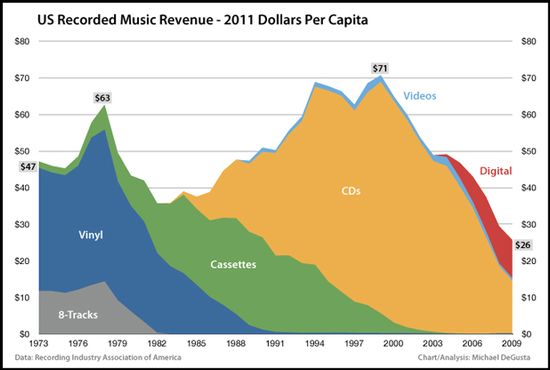
Emily White admits that she didn't purchase the vast majority of the 11,000 songs in her iTunes library. David Lowery, who teaches "the economics of the music business at the University of Georgia," responds by explaining misconceptions of the music industry. Among them is the idea that "artists can make money on the road":
The average income of a musician that files taxes is something like 35k a year w/o benefits. The vast majority of artists do not make significant money on the road. Until recently, most touring activity was a money losing operation. The idea was the artists would make up the loss through recorded music sales. This has been reversed by the financial logic of file-sharing and streaming. You now tour to support making albums if you are very, very lucky. Otherwise, you pay for making albums out of your own pocket. Only the very top tier of musicians make ANY money on the road. And only the 1% of the 1% makes significant money on the road. (For now.)


 The Dish