Which Unemployment Rates Matter For November?

Unemployment rates in key swing states are much lower than the national average (with the exception of Florida, Nevada, and North Carolina). Tom Holbrook makes the case that "presidential elections are national elections and it is national conditions–not state-level variation around those conditions–that drive them": 

[I]t may seem natural to expect that voters living in states with more rapidly improving economies would be more likely than voters who live in states with weaker economies to support incumbent party candidates. It also makes sense that so much attention has been paid to  the unemployment rates in the states, given the overall high levels of unemployment. However, I did some work on this a long time ago (dissertation, actually) and found that what appeared to be state-level economic effects in a pooled vote model vanished in the presence of controls for the state of the national economy. And even though others (see Campbell and Klarner) have found significant state-level economic effects in more recent pooled models that used broad indicators such as change in income and change in economic output, I'm still skeptical that state-to-state variations in economic conditions–especially those based on unemployment–have much to do with presidential election outcomes.

Our Ignorance Of The Brain

Neuroscientist Bradley Voytek wants more skepticism of brain research:

When you ask something like "where is creativity in the brain" you assume that researchers can somehow isolate creativity from other emotions and behaviors in a lab and dissect it apart. This is very, very difficult, if not impossible.  … Imagine asking "where is video located in my computer?" That doesn't make any sense. Your monitor is required to see the video. Your graphics card is required to render the video. The software is required to generate the code for the video. But the "video" isn't located anywhere in the computer.

Alex Knapp summarizes Voytek's argument:

In brief, he says, the primary problem are neuroscientists themselves. Or at least, some of the assumptions that neuroscientists make. The problem, he notes, is a problem that long term readers here are familiar with – the confusion of cause and effect, as well as an over-reductionist view of the brain. Namely, that imaging studies showing a portion of the brain "lighting up" when something happens means that that area of the brain is directly involved in the activity. Something that he analogizes to "like how when your arms swing faster when you run that means that your arms are ‘where running happens’."

Is Political Compromise Dead?

Ezra Klein uses the Republican flip on healthcare mandates to argue that if it isn't dead, it's surely pining for the fjords:

"The basic way you wanted to put together a big deal five years ago is that the thoughtful minds in one party would basically go off and write a bill that had seventy per cent of their orthodoxy and thirty per cent of the other side’s orthodoxy and try to use that to peel off five or six senators from the other side," [Jason Grumet, the president of the Bipartisan Policy Center] says. "That process just doesn’t work anymore." The remarkable and confusing trajectory of the individual-mandate debate, in other words, could simply be the new norm.

Microsoft Joins The Tablet Wars

Farhad Manjoo cheers for "Surface":

Many of its traditional PC partners—Samsung, Asus, Dell, and HP—have already tried to take on Apple with rushed, ill-considered, cheaply made tablets. Microsoft would have been foolish to rely on that gang of losers to create tablets that were worthy of the new Windows. With the Surface, the company is taking its future into its own hands.

Kevin Drum homes in on the product's key feature:

[T]he most important aspect of the Surface tablet — by a mile — isn't that Microsoft is paying a bit more attention to hardware. It's the fact that the Pro version is both a tablet and a real computer. This is huge, and it's huge whether you're an Apple fan or a Windows fan.

Jesus Diaz is excited

If it fulfills its promise, if Microsoft Surface Pro is $800 or $900 and can pull six or seven hours of battery life, then things will change. It's going to be hard, since they don't have the app ecosystem yet, but that will come eventually. Microsoft has the user base, the developer base, and the deep pockets to make sure of that.

Matt Novak less so:

The response time when touching the Surface screen feels just a millisecond longer — and comparatively, the flip from vertical to horizontal feels like an eternity. The user interface is, again, perfectly acceptable in the limited amount of time I got to play with one. But it felt 10 percentage points from wonderful. I suppose these are the minor details you notice when you’ve been using Apple products pretty much exclusively, but that's precisely why they matter — most people have only used one other tablet in their lives, and that tablet is an iPad.

Measuring America’s Kindness

The hitchhiker shot while writing a book about kindness in America? He shot himself. Dan Brooks zooms out:

Here is the real Kindness of America: the inspirational belief that kindness is what other people do for you, and that what you do—make up a person who shot you, for example, and then stay silent for a while even after a real person has been arrested for your made-up backstory—is pretty much irrelevant. … That’s the irony of America, too. In the world’s oldest democracy, whose guiding concern has been to maximize individual liberty, we measure our kindness by what everyone else is doing. The best way to show Americans how kind Americans can be is to write a book about it—not, say, to devote our lives to actually doing kindness on others. 

Will Latinos Really Determine The Election?

Sean Trende is skeptical:

While the Latino vote is frequently portrayed as a critical voting bloc, in truth it is concentrated in only a few swing states with just a handful of electoral votes. The only states where Latinos make up more than 10 percent of the electorate are: Arizona (16 percent of the electorate in 2008), California (18 percent), Colorado (13 percent), Florida (14 percent), Nevada (15 percent), New Mexico (41 percent), and Texas (20 percent).

Of these, only Colorado, Florida, and Nevada are swing states; New Mexico and Arizona are at best borderline swing states. In Florida, the Latino vote largely (though decreasingly) comprises voters of Cuban descent and is therefore atypical of other Latino electorates. So in the end, we’re talking about Colorado and Nevada as the states where this is likely to produce dividends of any size, for a total of 15 electoral votes.

Ed Kilgore pushes back.

Where Obama Has Lost Support

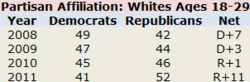
Young white voters:

In a close national election, movement among any group could potentially prove decisive. Young whites constituted just 11 percent of the electorate in 2008, but that's more than the entire Latino vote and nearly as much as African Americans. The GOP primary and Young_Whites
Obama’s decision to endorse gay marriage does not appear to have rejuvenated enthusiasm or support for Obama among a socially moderate cohort, and it is unclear what tools Democrats possess to rebuild their support. Given Obama's effort to build enthusiasm among Latino voters by halting deportations and and granting work authorization to young undocumented workers, perhaps we can expect the Obama campaign to announce a bold initiative on student loans over the next few months. Of course, even if Obama can regain the loyalty of young whites, it will still be a challenge to persuade them to vote at 2008 levels.