The View From Your Window Contest: Winner #107

Vfyw_6-16

A reader writes:

Are you freakin’ kidding us?  Since there isn't a single distinctive feature in this View, my only guess is St. Somewhere.

Another writes:

I'd recognize this view anywhere.  Based on the concrete gutter, the style of the railing, and the chamfered corners on the column I would say we are looking at the Atlantic Ocean.  But technically speaking we're not looking through a window; we seem to be on a balcony.  Therefore, I think we need a do over.

Nice try. Another:

This could be any tropical place with white sand, a quonset hut and a left-hand break. So I'm just going to randomly say New Zealand.

Another:

Tropical, coastal plain quickly giving way to elevated terrain, and dirt roads in an area that obviously has some money. Could be any number of places, but I'm going to go with Bain Boeuf, Mauritius.  (It sounds somewhat connected to the presidential election, at the very least.)

Another:

Given this week's news about the unrest in Myanmar and Daw Aung San Suu Kyi's European travels, Myanmar seems to be a likely candidate for a VFYW. It's been many years since I've been there, but this looks somewhat like Ngapali, Thandwe in Rakkhine State on the west coast of Myanmar on the Andaman Sea.

Another:

Coming up with a reason for this one (beyond intuition) is hard.

It feels like a temperate climate looking due south with vegetation and buildings that seem South African. Cape Town itself is a bit built up and a bit to the west. Knysna looks south toward the ocean and has a some hillsides that could pose this view.

Another gets on the right track:

The color of the sea, the vegetation, and vacation villas set among more modest red-roofed homes all suggest the Caribbean.  But I'm not seeing any features distinctive enough to narrow this down!  I'll take a wild guess that it's on the island of St. Martin, and leave this one to someone who spent their honeymoon in that exact spot!

Another:

Plymouth, Montserrat? Inside the exclusion zone looking toward the pier. Here's a similar one from the abandoned Air Studios:

Plymouth

Another:

Looks to me like Guanabo, or maybe Tarará, neighboring districts on the eastern outskirts of Havana, about 15 miles east of the city center. Am I close?

Yep. Another:

Not much to go on here. The vegetation and soil look Carribbean. The colored rooftops suggest recent construction and tourism – and it looks like a fair-sized town. The elevated vantage point facing the sea suggests hilly terrain. So my wild guess is somewhere on the eastern outskirts of Montego Bay, Jamaica.

Correct!  But another reader gets more specific:

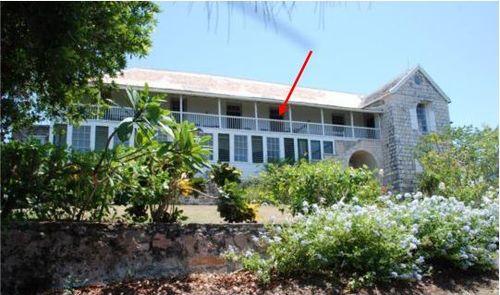
I happened to have been there in March, so I was lucky and "Montego Bay" came to mind quickly. The photo was taken from this porch, looking north. I would guess that it's the 2nd or 3rd bay of the porch. The house, as you can see, was owned by the Barretts, one of whom, Edward, was father to Elizabeth Barrett Browning. Here is some of her verse (the first sonnet of Sonnets from the Portuguese) that you might appreciate:

I thought once how Theocritus had sung
Of the sweet years, the dear and wished-for years,
Who each one in a gracious hand appears
To bear a gift for mortals, old or young:
And, as I mused it in his antique tongue,
I saw, in gradual vision through my tears,
The sweet, sad years, the melancholy years,
Those of my own life, who by turns had flung
A shadow across me.  Straightway I was ’ware,
So weeping, how a mystic Shape did move
Behind me, and drew me backward by the hair;
And a voice said in mastery, while I strove,—
“Guess now who holds thee!”—“Death,” I said, But, there,
The silver answer rang, “Not Death, but Love.”

We'll get a VFYW book to you shortly. From the submitter:

Aerial

While on our vacation last week to Montego Bay, Jamaica, we toured the Greenwood Great House near Falmouth. The estate was built in 1800 by the Barrett family (family of Elizabeth Barrett Browning), who owned a vast 15-square-mile sugar plantation extending from Falmouth to Montego Bay. The photo is taken from the upper veranda on the north side of the house looking to the north. The attached aerial photo shows the location of Greenwood Great House between Falmouth and Montego Bay, Jamaica. The other attached photo shows the exact location of the view:

Location

(Archive)

Yglesias Award Nominee

"The U.S. will share that popular opprobrium if it appears to connive in this military coup. Obama would be better advised to tell the generals, in no uncertain terms, that they need to take a step back from the political arena. The military should still have a role to play but only as a guarantor of the election process. As long as a Brotherhood government must face voters in the future, popular sentiment will act as a check on its illiberal tendencies. The days of military rule have long passed in Egypt. The military just doesn’t know it yet," – Max Boot.

Boot gets extra points for the following sentence:

I do not envy President Obama having to figure out how to respond.

Isn't it refreshing that a Republican, instead of constantly pouncing, actually accepts that these foreign policy decisions are often very very hard compromises between competing goals. But I agree with Max more generaly. Sure, the dangers of the Muslim Brotherhood forming Egypt's government are real. But I see far more danger in the US backing the generals and aligning against the Arab Spring's indispensable country.

How To Survive A Plague, Ctd

A reader writes:

I tested positive for HIV a month ago. I suspected I had it, since I’ve had several inexplicable illnesses the last six months including ear infections, tonsillitis, random fevers, anal redness and most recently shingles – which finally got me to the clinic. I’m 37 and knew that I wouldn’t have shingles at this age unless my immune system was compromised by HIV. When I received the initial news, “your test came up reactive”, my head began swelling and felt like it would pop. The volunteer who tested me was so sweet, couldn’t have been nicer. He pummeled me with info and resources and really I just wanted to get out of there and breathe, but I appreciated it and accepted everything very matter of fact.

I’m cute. I live in West Hollywood and have been quite active sexually (though dismally unfortunate romantically). I’ve a few ideas how I might have gotten infected, but I’ve never consciously had unprotected sex, and always thought I was safe. Must have been a drunk one, I guess.

I just read your post on the documentary How to Survive a Plague. I’m old enough to remember the plague years quite well. I’ve known people who have died. I’m writing to you because I feel like apologizing. Getting infected now feels disrespectful to everyone that has worked so hard to fight this. I had all the information, I know the history, but I was reckless.

It’s been two weeks that I’ve been on Complera. One pill. Every morning. Forever. And I’ll be fine. I already feel better. A lot better. My issues are whom to tell, will I be rejected by other men, making sure I never lose insurance, getting the refills in time. You’ve experienced things I will never know, and thanks to you and all the soldiers of the plague years my HIV status is reduced a pill a day and a stigma, maybe.

I’m not ready to watch that documentary. Everything is a bit too fresh and I’m not so solid emotionally. I didn’t mean to do this to myself and never thought it was ok to be unsafe. I have always tried to be careful. Maybe an apology is appropriate, maybe not. It happened and I can’t change it now. I’m going to live. And I’m going to be fine. So I guess more importantly, I want to say thank you.

Ask Sister Gramick Anything: Should Gays Be Allowed To Marry?

TNR recently profiled Sister Gramick and we’re honored to have her voice on the Dish. A reader responds to yesterday’s video:

Sister Gramick is not the first to use Galatians as she does, of course. I find Galatians especially problematic for the Roman Catholic Church in its opposition to marriage quality because it gets to the heart of the matter: the genderlessness of the soul and the will.

As I realized as a mere youth, the sacramental theology of marriage and Canon Law makes it clear that the only essential element of marriage is consent of the parties to be married. Canon 1057 §1 says, “The consent of the parties, legitimately manifested between persons qualified by law, makes marriage; no human power is able to supply this consent. Canon 1057 §2 does indeed mention “man” and “woman”, “Matrimonial consent is an act of the will by which a man and a woman mutually give and accept each other through an irrevocable covenant in order to establish marriage,” and “man” and “woman” are mentioned elsewhere in the canons, but if the essential element of marriage, what makes the marriage, is the “consent of the parties, legitimately manifested between persons qualified by law” and if the law (and here I do mean civil law, which the Canon give explicit priority) makes no distinction of gender, it is impossible to imagine that the gender of the parties makes any difference at all.

Indeed, Canon 1058 says, “All persons who are not prohibited by law can contract marriage.” And, when one thinks even a bit more deeply about it, this makes perfect sense, as there is really no gender to the soul of the baptized nor, therefore, to consent, as in Galatians 3:27-28, “For as many of you as have been baptized into Christ have put on Christ. There is neither Jew nor Greek, there is neither bond nor free, there is neither male nor female: for ye are all one in Christ Jesus.” The gender references in Canon Law, therefore, must be considered accidents and not essentials.

“Ask Anything” archive here

The Private Equity-Public Sector Union Alliance

Suzy Khimm notes an important irony: 

Despite their attacks on Romney’s firm for “putting profits above workers,” unions have ramped up their pension fund investments in private equity to record levels.

The largest public-employee pensions had 11 percent of their holdings in private-equity investments, totaling $220 billion. As it turns out, however, private equity is even more dependent on union investments than the other way around. Since 2006, “U.S. private equity firms have received approximately 26% of all fund commitments from U.S. public pension systems,” Fortune’s Dan Primack points out. That could accordingly make private-equity managers on Wall Street a bit squeamish of the Republican attacks on public-sector unions–i.e., their customers. Romney, for one, has backpedaled on any remarks suggesting that he wants to cut public-sector jobs for teachers and firefighters.

Silly Season Is Upon Us

Beware of the fake scandals:

It’s no surprise that mid-summer, when lots of newsmakers are on vacation (and when little is happening even in the sports world), is when stories such as the "ground zero mosque" or Shirley Sherrod’s supposed racism took off. Not just those; any kind of meaningless hype, whether it’s a supposed gaffe or some meaningless polling random variation, is going to get far more attention than it deserves.

My take on the WaWa non-story here.

Will The Mini-Dream Act Win Obama Votes?

Harry Enten doubts it. He says Latinos don't vote based on immigration policy:

The fact is that even if immigration were the big issue, there probably isn't room for Obama to improve his standing against Romney among registered Latinos. According to the Pew poll, 20% of Latinos identify with or lean toward the Republican party; 67% identify with or lean to the Democratic party. That's why it's not surprising that Obama led Romney 68% to 23%. For Obama to pick up any measurable support from the Latino community, he would need to win pretty much every independent voter, or start flipping Republicans. That seems unlikely, given the relative unimportance of immigration to Latino voters.

Nate Silver sees the policy as an attempt to boost turnout rather than win new Latino voters:

Mr. Obama’s decision could motivate some additional turnout among these voters. If, for instance, Hispanic turnout increases by 5 percent, and 5 percent of Hispanics who might otherwise have voted for Mr. Romney now vote for Mr. Obama instead, it would swing a net of about 1 percentage point in support to Mr. Obama. That is hardly a game-changer, but it could matter in an election that could be very close.

Earlier discussion of the new immigration policy here and here.

Representing The Spectrum

Julia Bascom, who is autistic herself, reflects on why seeing a character like Community's Abed was so important to her:

There’s a difference between TV Autistics and autistic characters on television. TV Autistics—Bones, House, Sheldon, Sherlock—are caricatures, and, not coincidentally, all fan-diagnosed. They are socially awkward/anti-social/socially maladapted, eccentric geniuses free of any serious adaptive functioning limitations, motor issues, sensory sensitivities, or language differences, able to manage independently in all major areas of daily living, with a bonus side of savant skills and the empathic range of a rock. They’re awesome, but they’re a stock character, and they manage to simultaneously hint at the autistic experience without actually meaning it.

Abed Nadir walked around like a bird or a giraffe, and he couldn’t do thumbs-up and he talked too fast and knew too many things and he was sharp and suspicious and easy and trusting. He did things that were simultaneously uncanny/creepy and sweet/thoughtful, and he couldn’t do bills or read clocks but he could tell psychiatrists to fuck off and he could fight with his best friend when his best friend tried to take charge, and he was jealous and sharp with his crushes. He had friends and private worlds, and all the scars that come from growing up a mistake, and things were imperfect and messy and painful and visceral but he always emerged okay. Abed Nadir said “please don’t do a special episode about me” and Jeff Winger promised he “wouldn’t dream of it.”

(Hat tip: Jesse David Fox)