Ask Sister Gramick Anything: What In The Bible Backs Gay Rights?

TNR recently profiled Sister Gramick. A glimpse at the nun’s fascinating bio:

Sister Jeannine Gramick is a Roman Catholic religious sister and a co-founder of the activist organization New Ways Ministry, a Catholic social justice center working for justice and reconciliation of lesbian and gay people with the institutional Catholic Church. After a review of her public activities on behalf of the Church that concluded in a finding of grave doctrinal error, the Vatican’s Congregation for the Doctrine of the Faith (CDF) declared in 1999 that she should no longer be engaged in pastoral work with lesbian and gay persons. In 2000, her congregation, in an attempt to thwart further conflict with the Vatican, commanded her not to speak publicly about homosexuality. She responded by saying, “I choose not to collaborate in my own oppression by restricting a basic human right [to speak]. To me this is a matter of conscience.”

We are so honored to have her voice on the Dish.

GOP: No Gays Allowed, Ctd

Kirsten Powers reports on the latest Christianist sideshow:

A few weeks ago, at their annual Watchman on the Wall conference, which included a video message from Republican superstar Sen. Marco Rubio, the FRC gave a Baptist pastor named Ron Baity their highest "pro-family" award of the year. Yep, this is the person who gave a sermon to his church that compared being gay with being a murderer. He also said, "I can’t believe the perverseness of two men or two women wanting to slobber over each other … that’s worse than sick. I don’t even think maggots would do that."

Even Christian organizations think the award went too far. As Alan Chambers, the head of Exodus, told Powers:

They should take back the award. I reached out to Tony Perkins and I have heard nothing back. It’s time for the Christian community and leaders to realize we have got to do a better job.

There is room for biblically held beliefs with regard to sexuality, but we need to change how we talk about them. Homosexuality is not bigger than other issues, but the church has made it the biggest issue.

Jim Burroway senses a possible sea change:

To be sure, Exodus is not becoming a pro-gay or gay-affirming organizaiton. But I think today’s statement condeming the FRC’s honoree does break new ground, if for no other reason than for the fact that Exodus International has strongly criticized a very powerful and influential anti-gay organization. I’m not willing to read anything more into this statement than that. But I’m also not willing to read anything less.

Previous coverage of pastors preaching hate here and here.

Creepy Ad Watch

Blogs-hebrew-061412

Josh Nathan-Kazis provides translation and context:

"Dear Jew: You are entering a dangerous place. Shield your eyes." That’s the Hebrew-language text on a huge billboard that an Orthodox group has paid to post alongside a Brooklyn highway. The "dangerous place" is Manhattan. The danger isn’t specified, but it’s clear they’re not talking about muggings.

Presumably directed at ultra-Orthodox Jews traveling to Manhattan for work, the billboard puts a stark spin on the new study out yesterday from the UJA-Federation of New York, which raised the possibility of an impending Orthodox majority among New York Jews. New York’s Orthodox Jews and non-Orthodox Jews exist in separate, parallel worlds. In the broadest terms, each group has its own borough. Brooklyn Jews are poor, young, and religious. Manhattan Jews are rich, old, and more secular. While Brooklyn’s Jewish community is exploding, Manhattan’s is shrinking. And judging in part by the highway billboard, the ascendant Brooklynites have little regard for the declining Manhattanites.

It's a culture war within a minority.

The Daily Heckler, Ctd

A reader writes:

The video of the Daily Caller reporter interrupting and arguing with Obama in the middle of his prepared Rose Garden remarks was a sad spectacle.  It also highlighted a core, positive attribute of Obama: his calm, adult and restrained responses to a number of indignities ranging from Joe Wilson yelling "You lie!" during his State of the Union speech, to Boehner's unprecedented rejection of a requested date to address a joint session, to the continuing demand that he "show his papers" and prove he is a citizen.

But, on a different tack, this episode reminds me of one of the biggest surprises and disappointments of the Obama presidency: how is it that Obama did not revive the JFK-style practice of frequent (and engaging) press conferences?  

Whether you agree with Obama's policies, it would be hard to think that this young, stylish, and intelligent guy would not be able to similarly thrive with repeated televised jousting with the press. It's so obvious that the failure to do so is bizarre, and (even weirder) Obama has been even less accessible to press conferences than recent presidents. To me, this has been one of the major mistakes of his presidency.  

I realize that there are major risks to unfiltered questioning by the press, but this should be an area of unique strength for Obama, like it was for JFK.  And it is free!  You don't need to raise millions in donor contributions for this platform.   You also don't need to complain that the media is not accurately covering your accomplishments – you can shape the news coverage yourself.  More importantly, failing to do these press events only, and wrongly, cements the notion of the "imperial Presidency."  So, a disastrous move politically and an equally bad move substantively.

Some facts that support our reader:

Obama has held slightly more news conferences than Bush did in his first three years (17 to 11). But for a president widely regarded as more fluent and comfortable with impromptu speaking than Bush was, the achievement seems unimpressive. [Study author Martha Kumar of Towson University] notes that Bill Clinton and George H.W. Bush had faced the White House press corps far more times than Obama has by the time they reached their third year in office. Obama has also held fewer off-the-cuff Q&A's at photo calls and appearances (94) than either George W. Bush (307) or Clinton (493) — something that has chafed White House reporters.  

It's a worrying part of a pattern in which candidates for office avoid the kind of grilling that, say British prime ministers get at Question Time. Palin was the worst – never giving a single open press conference when running as an unknown for vice-president. When the press allowed her to get away with it, they were changing the rules of the game – to our collective detriment.

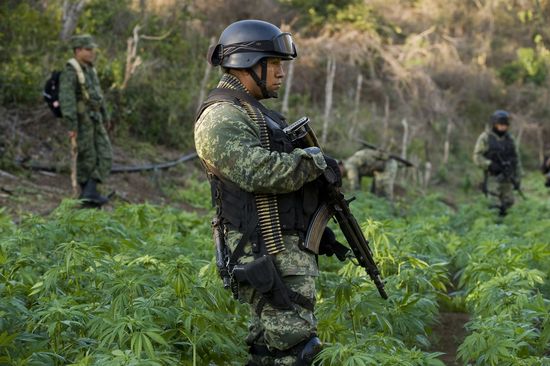
The Cartels’ Cash Crop

137986825

Not coca:

Moving cocaine is a capital-intensive business, but the cartel subsidizes these investments with a ready source of easy income: marijuana. Cannabis is often described as the "cash crop" of Mexican cartels because it grows abundantly in the Sierras and requires no processing. But it’s bulkier than cocaine, and smellier, which makes it difficult to conceal. So marijuana tends to cross the border far from official ports of entry.

The cartel makes sandbag bridges to ford the Colorado River and sends buggies loaded with weed bouncing over the Imperial Sand Dunes into California. Michael Braun, the former chief of operations for the D.E.A., told me a story about the construction of a high-tech fence along a stretch of border in Arizona. "They erect this fence," he said, "only to go out there a few days later and discover that these guys have a catapult, and they’re flinging hundred-pound bales of marijuana over to the other side." He paused and looked at me for a second. "A catapult," he repeated. "We’ve got the best fence money can buy, and they counter us with a 2,500-year-old technology."

An overview of the cover-story on the reigning Sinaloa cartel, as well as recent reporting on the sadistic Zetas, here.

(Photo: A Mexican soldier stands guard at a marijuana field, in Los Algodones community, Culiacan, Sinaloa State, Mexico on January 30, 2012. Mexican soldiers found a marijuana field and incinerated the drug as part of the Culiacan-Navolato operation. More than 40,000 people have been killed in rising drug-related violence in Mexico since December 2006, when President Felipe Calderon deployed soldiers and federal police to take on organized crime. By Alfredo Estrella/AFP/Getty Images)

Greece Avoids Disaster, For Now

Krugman is his usual cheery self:

[E]stablishment types should actually be dismayed by this outcome: if current policies fail completely, which seems almost a given, and Greece exits the euro anyway, which seems highly likely, the entire Greek center will end up discredited; better, in a way, to be able to blame the radicals.

In a later post, he sighs that "the worst thing about the Greek election is the possibility that it will encourage the Germans and the ECB to persist a bit longer with their fantasies about how things might work." Zachary Karabell wonders whether the Eurozone can survive:

Greece was not the final straw, or at least not today. All may go to hell quite soon, but given that the amen chorus is singing notes of doom, a contrarian would be advised to consider the risks that everything doesn’t fall apart, that world leaders continue to show a remarkable ability to muddle through at the last moment, and that while the tail risks are shudderingly fearsome, the stability of the system as a whole is far greater than most imagine. Now, markets will turn to Spain, Italy, debt—who knows—and affix the same anxieties that have been so indelibly attached to Greece.

Brad Plumer fears that Greece's economy won't recover:

It remains to be seen whether Europe will offer Greece a deal that allows the country to shore up its economy and get back on the path to recovery. Famed gloomy economist Nouriel Roubini is skeptical this will ever happen, predicting that “in 6-12 months [the New Democracy-led government] will fall as economy will fall into a depression. Then new elections will lead Syriza to win [and] a Grexit will occur.”

Yglesias notes that the markets are down:

One reason the markets aren't reassured is that there's nothing reassuring about an ideologically divided and inherently unstable coalition presiding over deeply unpopular austerity measures. Another reason markets aren't reassured is that to the extent the "deeper issue" in Greece is endemic corruption and malgovernance driven by decades of New Democracy and Pasok running the state as a patronage mill for party supporters, forming a New Democracy / Pasok grand coalition is not a promising foundation for change. The insiders are circling the wagons and saying nice things to German officials in the hopes of keeping some money flowing in, but there's absolutely no real solution here.

Ezra Klein looks ahead:

In the coming days, euro zone leaders are set to release a number of plans to deal with some of the more systemic elements of the crisis. There's going to be a proposal for the European Central Bank to regulate and insure financial institutions across the euro zone. The French are pushing for a (much-too-small) stimulus. The Greek elections have bought them the time to release these proposals. But it's the proposals themselves, and not the elections in Greece, that will decide whether the euro zone is sustainable going forward.