Obama’s Best Buds: The Bushes

145494341

Here's Jeb Bush:

"Ronald Reagan would have, based on his record of finding accommodation, finding some degree of common ground, as would my dad — they would have a hard time if you define the Republican party — and I don’t — as having an orthodoxy that doesn’t allow for disagreement, doesn’t allow for finding some common ground. Back to my dad’s time and Ronald Reagan’s time – they got a lot of stuff done with a lot of bipartisan support."

Here's Obama yesterday:

Neither Romney nor the Republicans in Congress will endorse any policy that asks the wealthiest Americans to pay even a nickel more in taxes. It’s the reason why we haven’t reached a grand bargain to bring down our deficit; not with my plan, not with the Bowles-Simpson plan, not with the so-called Gang of Six plan. Despite the fact that taxes are lower than they’ve been in decades, they won’t work with us on any plan that would increase taxes on our wealthiest Americans.

Now Bush is not endorsing Obama's priorities or policies, but he is complaining about total GOP obstructionism and purism. And he has offered a diagnosis of why the GOP is so rigid:

I don’t have to play the game of being 100,000 percent against President Obama.

Jeb Bush is calling his own party game-players and obstructionists rather than responsible politicians in a time of national crisis. And the polls show Americans agree that Obama is more willing to compromise than the GOP. At the same time, you have George H W Bush bragging for the first time about his decision to raise taxes. And you have Obama's echo in Cleveland of George W. Bush's position that he would't balance the budget "on the backs of the poor."

The only thing missing was the Bush family's conviction that the Latino vote is central to the political future. And guess what? Today Obama trumped Romney on that as well. He has hit the Bush trifecta.

But he's still a radical Muslim socialist atheist, of course.

(Photo: Bush and Obama at the White House unveiling of the Bush presidential portrait. By Brendan Smialowski/Getty.)

“Mr. Romney”

Dan Amira notices that Obama has started to refer to his opponent as “Mr. Romney.” Amira notes that “Mr.” is the “more appropriate honorific,” according to protocol experts. Mark Steyn, for one, is pleased

The primary debates were all “Governor”, “Senator” and “Mr. Speaker”, even though there wasn’t a single governor, senator, or speaker on the stage. What’s the point of a republic if a guy can serve one term in the House of Representatives in the early Seventies and be addressed as “Congressman” until he keels over half-a-century later? Turning offices into titles of nobility is, to my mind, even more unrepublican than having a bunch of marquesses and viscounts queening it up because “Senator”, “Governor” et al. are titles that by definition are in the gift of the people and, when the people are no longer willing to bestow said title or the office-holder declines to submit himself to their adjudication, the use thereof should cease.

Why Doesn’t Gayness Die Out?

A common hypothesis, which the Dish has covered before, is that "a gene predisposing a man to be gay might make a woman even more attracted to men than she otherwise would be, so that she would engage in more heterosexual sex and thus become pregnant more often."  New research adds a wrinkle to the theory:

Rather than making women more attracted to men, the "gay man gene" appears to make these women more attractive to men. … Turns out, the moms and aunts of gay men have an advantage over the moms and aunts of straight men for several reasons: They are more fertile, displaying fewer gynecological disorders or complications during pregnancy; they are more extroverted, as well as funnier, happier and more relaxed; and they have fewer family problems and social anxieties.

Where Will Egypt Go Next?

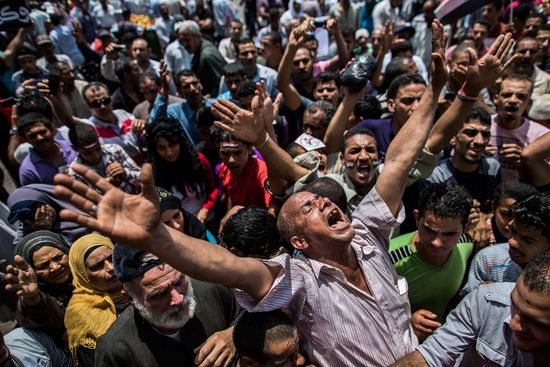
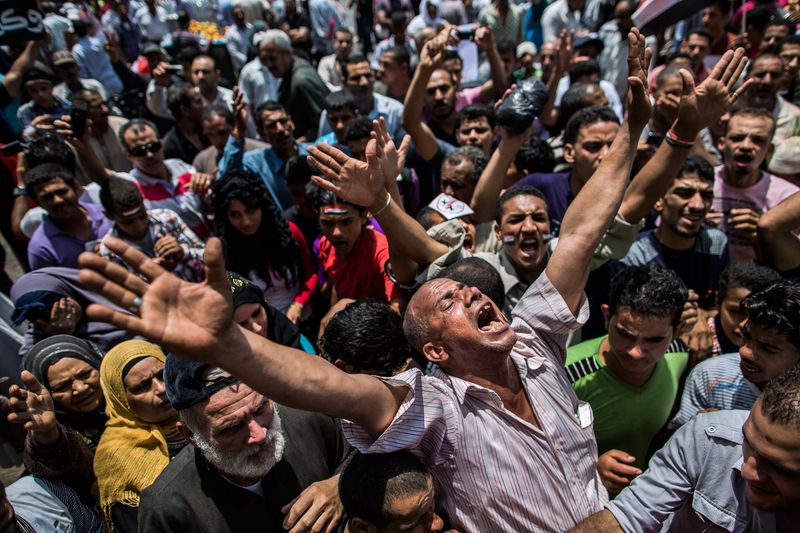
GT_EGYPT_120615

Paul Pillar lays down some scenarios for a post-Parliament world:

The next near-term chapter of this story will hinge on the outcome of the second round of the presidential election. A victory by Shafik has the greatest potential to trigger an upsurge of unrest and violence, if many Egyptians come to see it as affirmation that a hoped-for revolution has been effectively reversed. There is some talk of Morsi perhaps being made prime minister under a Shafik presidency, although that would depend on understandings yet to be reached between the Brotherhood and the Supreme Council of the Armed Forces. Possibly a Shafik win would be a first step toward a power structure similar to that in Algeria, in which the president is an important player but has only partial autonomy from the military-dominated pouvoir, which more or less corresponds to what in Egypt is more often called the deep state. There would be less likelihood of violence and severe instability with a Morsi win, but that would be only the first stage in a long process of bargaining and maneuvering between the Brotherhood and the military.

Lauren Bohn profiles those Egyptians who support Shafiq and other members of the old regime:

With many Egyptians worried by a gaping security and leadership vacuum since last year's uprising, Shafiq attracts voters who’ve become tired, if not angered, by Egypt’s revolutionaries. They see the military as the only institution that can prevent complete turmoil. In the villages that surround Shafiq’s Nile Delta offices, residents curse Tahrir Square, the epicenter of last year’s pro-democracy uprising. In a small village of Minia El Kamh, Heba Ahmed, says she’s nostalgic for the days before the revolution when “everything wasn’t so uncertain.” Shafiq has drawn support from people like Ahmed, state employees, and security forces and their families, as well as influential businessmen and members of the former ruling NDP party. Some Coptic Christians, who make up around 10 percent of Egyptian society, also voted for him as a bulwark against the rising power of Islamists.

Juan Cole thinks the Brotherhood has squandered whatever good will it had:

There is certainly a case to be made that the Muslim Brotherhood behaved badly. Its leaders knew what they were doing when they ran candidates as “independents.” Once it got a working majority in parliament, the Brotherhood gave every evidence of seeking to make itself the one party in a new one-party state. It tried to stack the Constituent Assembly charged with writing a new constitution with its members. And, after promising not to run a presidential candidate (so as to reassure the electorate that it wasn’t trying to dominate both the executive and the legislature), its leaders abruptly changed their minds and put up a presidential candidate. Moreover, the man they put forward, Khairat al-Shater, is an allegedly corrupt businessman whose corruption cases caused him to be ruled ineligible. The Brotherhood was charged with using its dominance of parliament to dole out patronage to relatives of its MPs and officials.

Daniel Serwer counters:

It is hard for me to picture a new parliamentary election that doesn’t produce a strong Muslim Brotherhood showing.  It may not be as strong as their 48% of the seats won by the MB’s Freedom and Justice party in the last polls, but it is still likely to be the plurality. Will the military permit it to happen?  I have no idea, but their performance to date suggests a determination to hold on to power that is profoundly anti-democratic.

Joseph Farag throws up his hands:

Just days before Egyptians head to the polls for the second round of presidential voting, the ramifications of the call to dissolve parliament are unknown.  The dissolution of parliament, the prospect of a Shafiq presidential win, and the recent announcement that the military police will have the right to arrest civilians has resulted in a chorus cry about a military coup in disguise.  Given all that has transpired to date, any attempt to predict what will happen next is sheer folly.

Recent Dish on Egypt's parliament dissolution here and here.

(Photo: Egyptians gather to protest in Tahrir Square on June 15, 2012 in Cairo, Egypt. Egypt's Supreme Constitutional Court ruled that the Islamist-led Parliament must be immediately dissolved, and also allowed the right of Hosni Mubarak's last prime minister, Ahmed Shafiq, to run for president. Egyptian candidates Mohamed Morsi and Ahmed Shafiq are pegged against each other in the second round of voting for the country's president to be held on the 16th and 17th of June. By Daniel Berehulak/Getty Images.)

Yglesias Award Nominee

"Much of Mr. Adelson’s casino profits that go to him come from his casino in Macau, which says that obviously, maybe in a roundabout way foreign money is coming into an American political campaign… That is a great deal of money, and we need a level playing field and we need to go back to the realization… that we have to have a limit on the flow of money and corporations are not people," – John McCain.

The Mormon Marriage Model, Ctd

In pointing out that Mormon marriages are eternal once sealed in a Temple, I implied this made divorce "really not that much of an option". The truth is: the eternal celestial marriages do make divorce far more stigmatized among Mormons and doubtless contribute to their relatively low divorce rate. But Mormons can be unsealed in the Temple just as they are sealed. This LDS site explains:

Although being sealed in the temple means being together for time and all eternity we live in a day and age when divorce is prevalent. People marry, divorce, and remarry. In doing so many people who divorce no longer desire to be with their ex spouse for all eternity. Most who remarry desire to be with their new spouse in the next life instead of their previous spouse, to whom they are still sealed.

Imagine living with an embittered ex-spouse for eternity! But the Mormons, like Romney, are nothing if not flexible. Notice the "we live in a day and age when divorce is prevalent" excuse: you won't get that kind of concession to the times from, say, the Pope. But this is more complicated than it might sound:

For a woman (called a sister) to receive a temple divorce she must be ready to be sealed to another man and the two of them must both be temple worthy and hold a current temple recommend.

Because a man can be sealed to more than one woman he does not need to have his temple sealing canceled to be able to be sealed to another woman, and a request to do so would most likely be refused unless his previous wife is ready to be sealed to another man and requests to have her temple sealing canceled. What a man does need, though, is permission to be sealed to another woman. This process is done through the bishop and must also be approved by the First Presidency.

My italics. Notice the patriarchal dynamic here. Women are to be kept married as far as is possible. Men not so much. And notice too that a husband, if his wife died, could re-marry in a Temple, and have two eternal wives in the afterlife. Which should make the afterlife lively – and perhaps a little awkward at times.

Obama’s Immigration “Game-Changer”

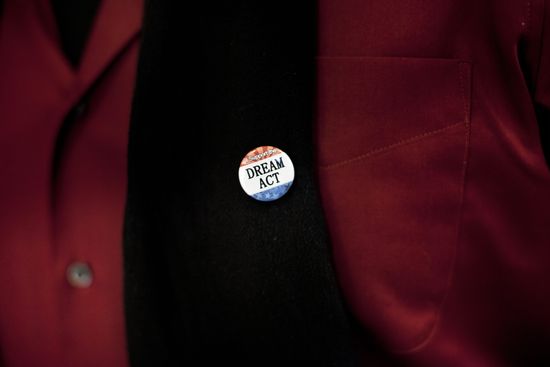
Dream_Act

The president basically just implemented a watered-down version of the DREAM Act through an executive order. Garance Franke-Ruta provides details:

The executive order taking advantage of prosecutorial discretion in deportation cases will cover individuals brought to the United States through no fault of their own before the age of 16 who have lived in the U.S. at least five years and have no criminal record. They must also have earned a high school degree or served in the military, and still be under 30. Those who meet the criteria can get deportation proceedings (or the threat of same) deferred for two years and seek work permits.

Drum cheers:

Sure, this is election-year positioning, but sometimes good policy is good politics. And not only will this be good for Obama's electoral chances directly, but it presents Republicans with an excruciating dilemma: either lay low and piss off their base or else follow their usual anti-Obama playbook and unleash a blizzard of criticism that will torpedo their efforts to attract Latino voters for years to come. 

Greg Weeks thinks it's not enough:

I don't see this as enough to boost Latino political participation in the November election on its own. However, if Mitt Romney and other Republican leaders make a point of railing against it, it could well help Obama at the margins. The problem for Obama is that he's made so many promises on immigration and immigrants that have not panned out.

Adam Serwer calls it a "game-changer":

Republicans will call this "amnesty." Yet this move doesn't grant citizenship or legal status. It's essentially a promise not to deport and permission to work—unless the order is reversed. This is a temporary solution to a policy problem that Congress has consistently lacked the courage to resolve: the presence of undocumented immigrants who are here through no fault of their own and who have never known another home. And the devil is in the implementation. Previous promises to excercize discretion by the administration haven't panned out as advertised. 

Erica Johnson wonders if this is a "calculated move to steal some of Sen. Marco Rubio’s alternative-DREAM-Act thunder":

It’s widely known that Sen. Rubio has been crafting legislation that would give visas to undocumented immigrants who were brought here as children if they attend college or join the military, though it would not provide legal permanent residency — and President Obama’s plan sounds pretty darn similar. Plenty of Republicans aren’t exactly thanking Rubio for his upcoming proposal, but as a tea-party rockstar with Hispanic roots, Rubio is a major threat to Democrats’ claim that they’re the best political party for Latinos’ interests. Team Obama definitely needed to get out in front on this one.

Greg Sargent thinks along the same lines:

The question now is whether Republicans will be able to support the new initiative at all, now that Obama has put his name on it. Republicans will likely try to take credit for it by arguing that Rubio’s work on the DREAM alternative made this happen. But it was already unclear whether Republicans — Romney included — would have the room to back such an alternative, given the GOP base’s passions on the issue. So what many Republicans will likely do now is object to the new initiative on the basis of process, arguing that Obama’s end run around Congress represents tyranny and the like.

James Joyner, who supports the DREAM Act, wishes Obama left immigration policy to Congress: 

[T]he key issue here is one of the Constitutional balance of power. Presidents, of course, push the envelope all the time. Typically, though, it’s done in the arena of national security policy, where the Constitution creates “an invitation to struggle” and where the stakes of dawdling can be quite high. In the matter of border policy, however, there’s simply no question where the power lies and no exigent circumstances to justify flouting the law.

(Photo: A supporter of the DREAM Act waits to greet senators as they head to vote on Capitol Hill December 18, 2010 in Washington, DC. By Brendan Smialowski/Getty Images)