So Was I Wrong About Yesterday?

The chattering class has poured cold water all over Obama’s speech yesterday: nothing new, too long, we’re bored. Dana Milbank has the most stirring and cogent objection:

The falsehood is that he has been serious about cutting government spending. The fallacy is that this election will be some sort of referendum that will break the logjam in Washington.

I agree with Dana that Obama made a huge error in not immediately grasping the Bowles-Simpson commission as his own. I 146344791decision is that private negotiation was better than taking a public stance that would immediately make compromise impossible. If Obama had endorsed Simpson-Bowles, the GOP would have denounced it. But that would simply have given Obama a clear and brutal chance to call the GOP out on their phony fiscal policy. And when push really came to shove, he put politics above “Yes We Can”. Sure, he had partisan base pressure: Bowles-Simpson would slash Medicare more potently than the Democratic party would like, especially in an election year. But what he needs and needed is simplicity and clarity. In that case, his caution was foolish. He’s been living with the consequences ever since. But it remains true that discretionary spending has been modest in this presidency – far more modest than the last one. And Dana is unfair in not pointing out the serious pilot schemes in the ACA to curtail out-of-control healthcare spending. These try to tackle the problem from the source. They cannot replace higher premiums, or means-testing, or Paul Ryan’s more aggressive attempt to restrict what seniors can buy by limiting their vouchers’ value over time. But they are an integral part of the long-term solution, if there is one. Again, the tragedy of our current situation is that both sides have decent ideas to tackle this debt, but polarization has turned the best of both parties’ ideas into the worst of all worlds. As for Dana’s second point, does he not see he is blaming the victim? He does, actually, and rightly places the blame on the GOP:
Obama alleged, correctly, that Republicans’ refusal to countenance tax increases scuttled the Bowles-Simpson plan and the Senate’s Gang of Six plan. He argued, also correctly, that Republicans’ refusal to budge on taxes is “the biggest source of gridlock in Washington today.” He’s on solid ground, too, in saying Republicans would end Medicare as we know it. But none of that is going to help Obama, because he hasn’t come up with a viable alternative.

But his alternative is pretty clear: more investment and stimulus in the short-term and a Grand Bargain with the GOP in the next Congress. He’s betting that his re-election would allow for a better chance at a real deal with Boehner. I have no doubt Obama would love to cut a huge, legacy-making budget deal that would restore long-term confidence, even if it were to alienate part of his base. And his unspoken message is that in a second term, he could make exactly those kinds of deals – because he has just earned a vote of confidence from the people, because he will not be running again, and because the fiscal crisis is now. Taxmageddon will see to that. Dana is wrong to see the logjam as eternal. It simply cannot be without real pain to both parties, or a real fiscal crisis, which was how Obama set up the final negotiation in the last debt ceiling deal.

So in a sense, Obama’s message is what it can only be: we all want to tackle the debt seriously. Within the next six months, let alone four years, we will have to make key decisions or lose control of our fiscal destiny. The question is how will we do it? Would you rather thave those decisions with me at the bargaining table – or leave it entirely to the current Republican party?

When framed like that, I remain convinced that this is a cogent case. And he put it well. He can hone it some more – and should. But the actual choice we now face is either a draconian exercize in budget cutting entirely on the backs of the middle class and poor, exempting the wealthy, or a deal with Obama for a more balanced, less ideological and more inclusive collective sacrifice. Maybe this choice argument will be swamped by pure GOP hazing, mockery and taunting in a terrible economy that could suddenly get worse. But the choice argument is all Obama has. He should not be berated for making it.

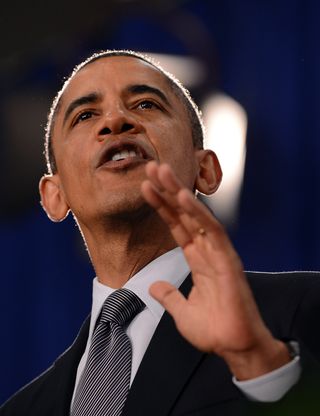
(Photo: the president yesterday in Cleveland, Ohio. By Jewel Samad/Getty.)

How Romney Talks

John McWhorter ponders the Mormon's use of gee, golly and gosh:

Romney’s God-fearing, impersonal G-words … reveal him as linguistically a person of another time, in which the public mood was cooler than today’s. That can be a good thing. Even Father Coughlin would not have called an earnest young woman, or anyone else, a slut on the radio. Yet the fact remains that there are few better ways to connote the air of a mannequin in 2012 than by saying gosh with a straight face.

The Mormon Marriage Model

Douthat praises Mormon families:

The state of Utah has one of the lowest abortion rates in the country and one of the lowest rates of out-of-wedlock births. It has a high marriage rate, a relatively low divorce rate, and the highest birth rate (despite a low teen pregnancy rate) of any state. An America that looked more like Utah would have more intact families, less child poverty, fewer abortions — and, for that matter, a better fiscal outlook as the Baby Boomers retire.

He doesn't mention the unique nature of Mormon marriages: they are the only ones that are without the "till death do us part" constriction. Mormon marriages are eternal. If you believe that, divorce really isn't much of an option. But Ross also fears that social acceptance of marriage equality will lead to stigmatization of these types of marriages:

If the conservative case for gay marriage is correct — a view held by manywritersI esteem — then such a view can and should coexist with a deep appreciation for the things that Mormon marital culture does well. (Indeed, some of these writers would argue that redefining marriage to include gay unions is a prerequisite for making more traditional understandings of heterosexual wedlock credible to the younger generation.) Obviously I hope they’re right about that potential coexistence. I also think there’s not-implausible alternative, though, which is that a society that has universalized same-sex marriage will have more difficulty than ever acknowledging, in anything but the most backhanded and grudging fashion, that more traditional and religiously-oriented marital cultures do anything well at all.

I have no idea why. There is enormous diversity among heterosexual marriages right now – from yuppie childless bicoastal couples to ultra-orthodox families in Brooklyn to Brady Bunch arrangements to archaic forms of marital servitude among some new immigrants. Same-sex marriages and Mormon marriages all fall easily within this vast American spectrum.

One New Priest Ordained In New York This Year, Ctd

Matthew Schmitz says I erred in my interpretation of this year's low number:

Sullivan mistakes for weakness what is the effect of increased vigor. As Christopher White noted on this blog last month, the New York archdiocese is having a dry year because of beefed-up curricular requirements that have added an extra year to the studies of one class. From his post:

Fr. Luke Sweeney, explained the low number for this year noting that "the seminary formerly had a five-year program: one year of philosophy and four of theology. In 2006 the U.S. bishops asked for two years of philosophy; inserting the extra year caused a "gap year" in which there were no candidates."

While dissidents within the Church may try to use this year’s low numbers in New York to bolster their calls for women’s ordination and a removal of the celibacy requirement for priests, the latest data from the Center for Applied Research in the Apostolate (CARA) reveals that ordination rates to the priesthood are at a 20 year high.

“Virtual Paralysis Induced By Fear of Political Blowback”

The neocons – aided by lies and scare tactics – are winning the fight for war against Iran. Bob Wright analyzes how the Obama administration, in an election year, remains frozen and afraid of AIPAC:

A deal on 20-percent uranium would markedly increase the distance between Iran and a nuclear weapon–yet in Baghdad, P5+1 refused to offer Iran relief from even one of the many, many banking and oil sanctions already in place. It even refused to offer to delay–by even a few months!–the implementation of new European Community oil sanctions scheduled to kick in next month …

I'm all for getting Obama re-elected. But I don't share the now-reflexive assumption that the Israel lobby is an awesome force that renders resistance futile. (Only last week the vaunted AIPAC machine faltered, as a congressional candidate strongly opposed by AIPAC defeated the AIPAC-approved candidate.) And I refuse to believe that progressives can't find a way to reconcile real, tangible progress on the peace and security front with electoral success. In any event, what we're seeing now–a grim, uncreative, and slightly pathetic submission to the winds of war–is not what I expected from the man who got people chanting, "Yes, we can."

Will The Mormon Church Ever Accept Gays?

Max Perry Mueller sees Josh Weed's story as a certain sort of progress. How the Mormon Church may eventually see gays and lesbians:

Last year, Taylor Petrey, a straight Mormon and Harvard-trained theologian, published an essay in the Mormon journal Dialogue entitled “Toward a Post-Heterosexual Mormon Theology.” Without advocating for a change in official church doctrine, Petrey argued that Mormons should “think less about the types of sex that people are having, and more about the types of relationships that people are building.” That shift in focus would allow the LDS Church to understand consensual, homosexual sex taking place in monogamous relationships the same way it understands the sex being had by straight married couples. According to Petrey, such a reorientation would allow church leaders “to adopt the same standard that they hold for heterosexual couples, that the relationship as a whole is the primary point of religious attention, not the details of sexual practices performed in such a relationship.”

Neither Petrey nor [Ken] Wilcox [a gay Mormon working on a documentary about LGBT Mormons] expects such a change in thinking to happen anytime soon. Unlike the 1978 revelation that allowed black Latter-day Saints full participation in the Mormon Church, the kinds of reforms required to make gay Mormons full and equal members of the Latter-day Saint community radically change the way Mormons think of their (explicitly male, implicitly heterosexual) “Heavenly Father.”

Neil Young ponders outreach efforts by gay-friendly Mormons: 

[T]he Salt Lake City gay pride parade the first weekend of June included a surprise: some 300 heterosexual members of the Church of Jesus Christ of Latter-day Saints. Calling themselves "Mormons Building Bridges," the group explained on its Facebook page that marching in the parade would be its first effort in a larger project to reach out to gay Mormons with "understanding and respect after many years of strife and heartbreak."

I have some personal experience with this. An old boyfriend of mine was basically traumatized by his own church because of his sexual orientation. He told me church officials followed him around to gay bars, confronted him and his family, and forced him to flee everything he knew growing up. He was a force of nature who lived with AIDS far longer than he should have. And at his funeral, much of his family was absent. Mormonism is so all-encompassing a culture, so tight a network of families, that ostracism is particularly hard on those who cannot get an eternal spouse as ordained by the LDS church. It is such a heterosexual religion – based on eternal family couplings – that the plight of the gay Mormon is an acutely painful one for many.

But I have to say that in my visits to Salt Lake City to talk to huge PFLAG groups, I saw an emerging generation of parents and siblings of gay Mormons who are insistent that Mormon family values extend to gay family members as well. I'm hopeful – probably more hopeful for gay Mormons than I am for gay Catholics, in so far as changing doctrine is concerned. Throughout history, Mormonism has adjusted – sometimes radically, as with race – to meet the temper of the times. They aim to please – and to grow.

(Video of a young Mormon who marched in the Salt Lake City gay pride parade from the earlier this month.)

The Center Of The Drone War

Noah Shachtman and Spencer Ackerman identify it:

For all the handwringing about the undeclared, drone-led war in Pakistan, it’s quietly been eclipsed. Yemen is the real center of the America’s shadow wars in 2012. After the US killed al-Qaida second in command Abu Yahya al-Libi earlier this month, Pakistan is actually running out of significant terrorists to strike. Yemen, by contrast, is a target-rich environment — and that’s why the drones are busier there these days.