How Women Power The Internet

Genevieve Bell explains:

It turns out women are our new lead adopters. When you look at internet usage, it turns out women in Western countries use the internet 17 percent more every month than their male counterparts. Women are more likely to be using the mobile phones they own, they spend more time talking on them, they spend more time using location-based services. But they also spend more time sending text messages. Women are the fastest growing and largest users on Skype, and that's mostly younger women. Women are the fastest category and biggest users on every social networking site with the exception of LinkedIn. Women are the vast majority owners of all internet enabled devices–readers, healthcare devices, GPS–that whole bundle of technology is mostly owned by women.

Alexis Madrigal's takeway:

All this to say: there are clear business reasons for technology companies to focus their efforts on women. But few do. In fact, I'd contend that women are using these technologies despite the advertising and ethos of many tech and Internet companies.

Along the same lines, Alyssa Rosenberg argues that several tech companies are suffering because of sexism.
Are Trailers Bad For Film?

Noel Murray wonders:

[T]he glut of coverage of trailers, casting notices, and the like has helped foster a sense that the movies don’t matter as much as the idea of the movies. Entertainment-media coverage runs the risk of becoming like sports reporting (where "What’s going to happen in tonight’s game?" is starting to outpace highlights and analysis) and political reporting (where "What do the pundits think about the candidate’s speech?" gets more attention than whether the claims in that speech are true). Already, some movie-lovers regularly lash out against bad reviews—and sometimes even good reviews—of movies they haven’t yet seen. They make up their minds when they see the posters and the commercials. Everything else is mere formality.

Curtailing Soda Won’t Make Us Skinny

In response to Bloomberg's soda ban, Aaron Carroll calls for "a holistic approach to obesity." He argues that even less draconian policies, such as soda taxes, won't work:

We’d need a pretty high tax [on soda] to make a difference. A recent study showed that it would take a tax on soda of more than 16% to reduce the caloric intake from them by 100 calories per day. But that same study found that almost all of the calories saved from reduced soda intake would likely be replaced by increased calories from other foods and drinks. That’s borne out in research. Partial fixes don’t work. If you ban sugar-sweetened beverages in school, kids will just drink more when they’re not in school.

Can Mobile Be Monetized?

Time_Ad_Money

Alexis Madrigal has doubts:

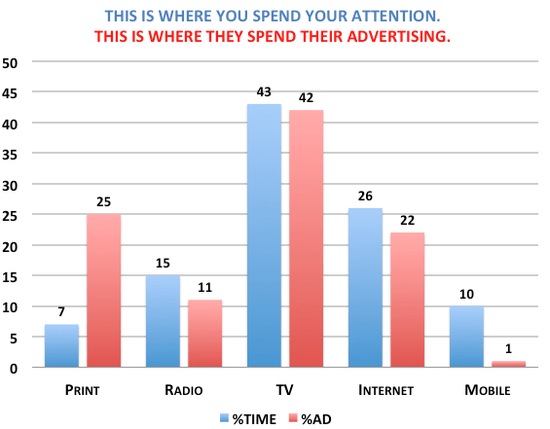
By the iron laws of the universe, where the people spend time, advertising dollars will follow. But there is another possibility, of course. It could be that advertising is simply inimical to the smartphone experience. In a great post at Monday Note, investor Jean-Louis Gassée explores this hypothetical and comes away convinced. The screens are too small and people are too distracted to pay any attention to the ads on their phones. And the seeming virtues of location-based ads don't seem that way to the people who'd be receiving them. 

(Chart by Derek Thompson)

Obamacare’s Economic Impact

Jonathan Cohn counters repeated claims that the Affordable Care Act is a recession-prolonger and "job-killer": 

[T]he best study I’ve seen on this subject is a new report from the Urban Institute and Robert Wood Johnson Foundation, examining the impact of Massachusetts health reform on that state’s job market. Yes, that’s the same law Romney signed as governor. Yes, that’s also the same law whose coverage scheme was a template for Obama’s. The report’s conclusion is unambiguous: "The evidence from Massachusetts would suggest that national health reform does not imply job loss and stymied economic growth."

The study is impressively thorough, too. It breaks down employment numbers by education, income, and part-time versus full-time status. No matter how they analyzed the data, they came up with no evidence that health reform had hurt the job market. "All" the reforms did was get insurance to many more people, providing them with better access to care and more financial security. This is consistent with predictions from the Congressional Budget Office, which determined reform’s only significant employment impact was a reduction in the labor force, primarily because people holding onto jobs just to keep insurance could finally retire. 

The Cleveland Speech, Ctd

Sargent's post is well worth a read:

Obama framed that choice as one between GOP adherence to free market and anti-tax fundamentalism on one side, and concerted government action to rebuild the middle class on the other. Crucially, he said the main obstacle to progress on the deficit and on jobs legislation is GOP opposition to raising taxes on the wealthy. "It’s the biggest source of gridlock in Washington today — and the only thing that can break the stalemate is you."

Yes, it was framing debt reduction and stimulus as equally blocked by a GOP stuck in old ideas that makes this argument more geared toward independents. And more powerful for an incumbent in tough times. It's based on this basic polling truth:

While the Republican base is calling on its leaders to stand firm, key swing voters send a very different message — with 66 percent of independents saying they want GOP leaders in the House and Senate to compromise.

Earlier coverage of the speech here and here.

Face Of The Day

GT_POLICE-MASK_120614

National Police agents look for members of the gang Mara 18 in a south area of Tegucigalpa on June 14, 2012. Tegucigalpa and Honduran northern city of San Pedro Sula are among the most dangerous cities in the world, with at least 119 homicides every 100 thousand inhabitants, according to civil organizations. By Orlando Sierra/AFP/Getty Images)

The Rise Of Child Allergies, Ctd

A reader writes:

I'm a microbiology and immunology graduate student at Johns Hopkins, and I thought I'd add a bit to this post. The hygiene hypothesis has been developed quite a bit, and its characterization in the post is overly simplistic. Rather than focusing on exposure to "dirt", the key really seems to be the lack of intestinal helminth (worm) infections in the developed world. I don't want to get overly technical, but these organisms chronically infect people. In fact, in the developing world almost everyone is infected by one or more species of helminth at all times. These infections induce an immune response that suppresses the type of immune response that is responsible for allergy, which is due to Type 1 Hypersensitivity Reactions.

Another expert weighs in:

First, a one line CV: I'm a biologist at the University of Chicago (my focus is neurobiology but I have a strong general background). I think the hygiene hypothesis is correct but does not tell the whole story. In addition to food allergies, allergies in general are going up at an alarming rate. While the lack of exposure to environmental bacteria and the like certainly plays a role, let's not forget what kids in the city are exposed to. Cities are chock full of toxic agents; the very air we breath is dirty and bad for us, especially for the young.

Here in Chicago, century-old coal plants are just now being shutdown (a fight I am proud to say I played a part in as a local activist). Still, the contamination of the water, land, and air is long-lasting and has hugely important impacts on child allergies. In Pilsen, a neighborhood one of those plants is located in, if you left a window open, particulate matter would settle on your apartment floor. Truly horrible and more impactful on children's health than Purell, which isn't really that effective anyway.

The hygiene hypothesis is probably true but let's keep our eyes on the prize here: we city dwellers are constantly being poisoned.

No One Told Me The Apocalypse Would Include Math

Spanish_bonds

Brad Plumer tries to drum up interest in Spain's extremely important and extremely boring bond yields, which hit 7 percent today. Why the bond numbers matter:

The fact that it has to pay so much to borrow money means its debts will keep getting bigger and bigger and bigger. Which means it might not matter if Spain’s borrowing costs are at 7 percent or 77 percent. All of those levels appear to be “unsustainable.” At a certain point, no one’s going to want to lend Spain any more money. The government will then either need a direct bailout from the rest of Europe — that’s what happened to Greece, Portugal, and Ireland when their borrowing costs soared too high — or else it will have to leave the euro altogether. The latter might mean global economic calamity.

Drum is waiting to see whether all hell will break lose:

Europe's come-to-Jesus moment is now looking terrifyingly imminent. Hopefully, Angela Merkel's tough talk is aimed mainly at the Greeks, who hold another round of elections this weekend, and will soften up next week. If not, who knows? The clock is very definitely ticking away.